Mexico's Tactical Dominance in 2-0 Win Over South Africa
Mexico’s 2-0 win over South Africa at Estadio Azteca was a clinic in territorial control and structural dominance, shaped as much by Mexico’s 4-1-4-1 as by South Africa’s ill-fated 5-3-2 and subsequent disciplinary collapse. Across 90 minutes, Mexico’s superior passing rhythm and positional play steadily squeezed the visitors, turning a modest xG edge (1.41 to 0.07) into a comfortable, if not ruthless, opening World Cup group-stage victory.
Mexico’s base shape was a classic 4-1-4-1 under Javier Aguirre, with Erik Lira anchoring in front of the back four and allowing the advanced midfield line of Roberto Alvarado, Brian Gutiérrez, Álvaro Fidalgo and Julián Quiñones to push high between South Africa’s wing-backs and outside centre-backs. The structure translated directly into territorial control: 61% possession, 520 passes to 335, and an excellent 90% pass completion (467 accurate) gave Mexico a stable platform to recycle attacks and sustain pressure.
The early breakthrough at 9 minutes encapsulated the plan. Lira, operating as the single pivot, not only screened transitions but also acted as the first playmaker line. His assist for Quiñones’ opener came from stepping into the half-space and finding the advanced midfielder between South Africa’s lines. Quiñones’ movement from the left interior channel into the box punished the gaps inherent in a 5-3-2 that was pinned deep and unable to compress vertically. With Mexico taking a 1-0 lead and going into half-time ahead by that margin, they could lean even more into controlled possession rather than forcing the game.
Defensively, Mexico’s back four of Israel Reyes, César Montes, Johan Vásquez and Jesús Gallardo were rarely stretched. South Africa managed only 3 total shots, with just 1 inside the box and 2 on target, reflecting how effectively Mexico’s rest defence locked down transitions. Lira’s positioning in front of the centre-backs limited direct service into Lyle Foster and Iqraam Rayners, while the full-backs could step out to wing-backs Khuliso Mudau and Aubrey Modiba knowing they had cover behind.
With the ball, the 4-1-4-1 often resembled a 2-3-5 in settled possession: Lira dropped to form a three with the centre-backs in build-up, the full-backs pushed high, and both interior midfielders occupied the half-spaces. This structure underpinned Mexico’s shot volume: 16 total attempts, 9 from inside the box, and 5 blocked shots, indicating consistent presence in and around South Africa’s penalty area. The finishing could have been more clinical given the shot count, but the underlying chance creation was steady rather than spectacular, in line with the 1.41 xG.
Second Half
The second half’s tactical picture was transformed by discipline. South Africa’s first red card at 49 minutes, when Siphephelo Sithole was dismissed for “Professional foul last man”, forced Hugo Broos’ 5-3-2 into an emergency low block. Down to ten men, South Africa’s midfield lost its ability to step out, and the front two were increasingly isolated. Broos responded with a double substitution: at 56 minutes Thalente Mbatha (IN) came on for Lyle Foster (OUT), and at 61 minutes Themba Zwane (IN) came on for Jayden Adams (OUT), aiming to add fresh legs and some ball security in midfield.
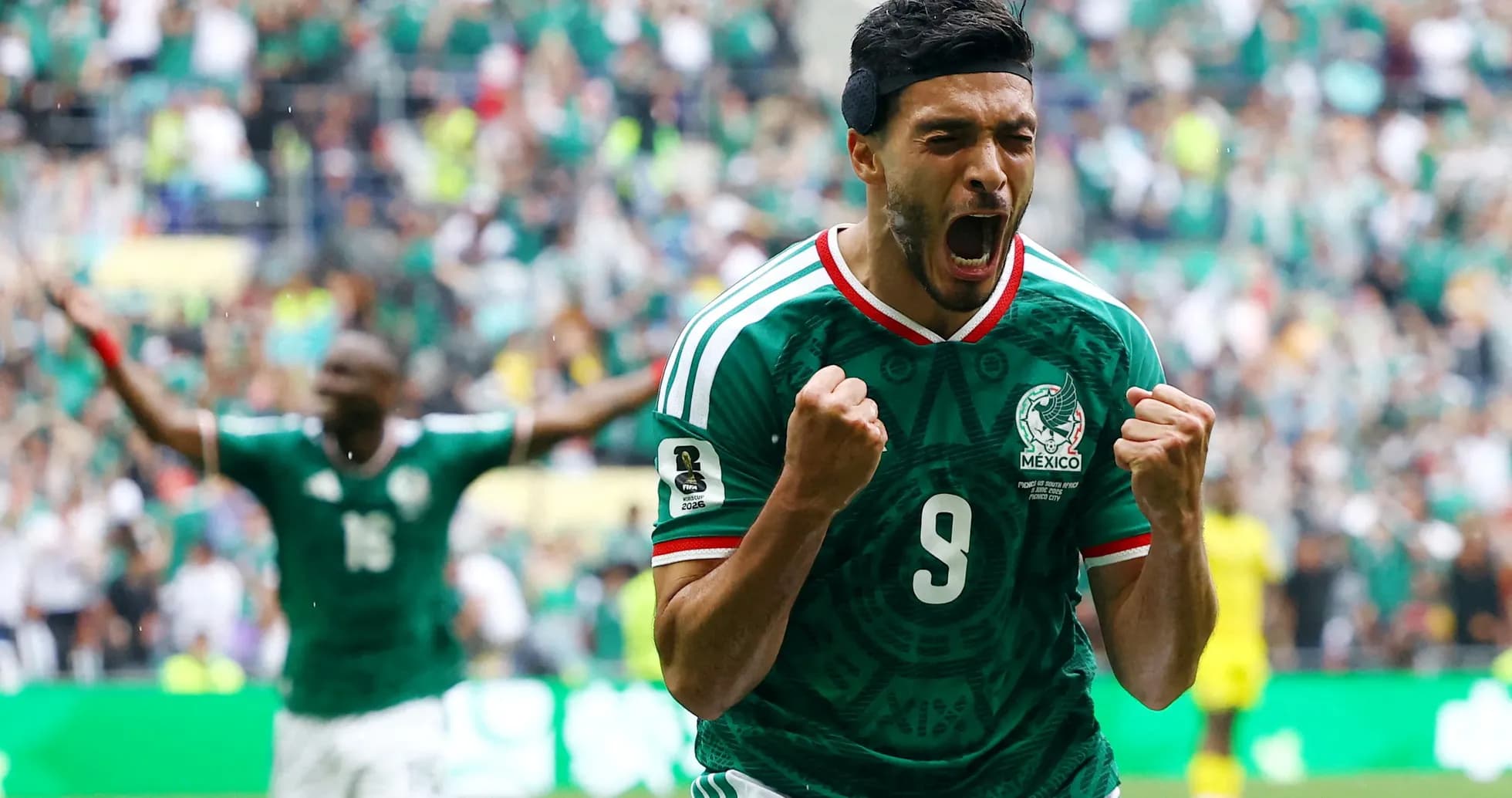
Aguirre’s in-game management was equally decisive. At 66 minutes, he injected Gilberto Mora (IN) for Álvaro Fidalgo (OUT) and Luis Chávez (IN) for Brian Gutiérrez (OUT), refreshing the central lanes and maintaining the intensity of the press and possession game. The immediate payoff arrived at 67 minutes when Raúl Jiménez doubled the lead, assisted by Roberto Alvarado. The goal reflected Mexico’s superior occupation of the final third: Alvarado found space to deliver after sustained pressure, and Jiménez’s presence as the lone striker was rewarded.
From there, Mexico controlled tempo and risk. Jiménez (OUT) made way for Armando González (IN) at 76 minutes, and Edson Álvarez (IN) replaced Lira (OUT) at the same moment, ensuring the single-pivot role remained secure. Alexis Vega (IN) for Julián Quiñones (OUT) at 79 minutes maintained vertical threat on the flank while protecting key starters’ workloads in a group-stage context.
South Africa’s late collapse in discipline further entrenched Mexico’s dominance. Nkosinathi Sibisi’s yellow card for “Foul” at 74 minutes highlighted the strain in their back line. A VAR “Card upgrade” review on Themba Zwane at 82 minutes was followed at 84 minutes by a straight red for “Violent conduct”, leaving South Africa with nine men and effectively ending any tactical contest. Mexico’s own red card, when César Montes was sent off at 90+2 minutes for “Professional foul last man”, came too late to alter the balance but underlined that Mexico’s aggressive defensive line can flirt with risk when protecting space behind.
In goal, Raúl Rangel (Mexico) was largely a spectator but still required focus, making 2 saves in line with South Africa’s limited 2 shots on target. His opposite number Ronwen Williams (South Africa) also recorded 2 saves, a reflection less of Mexican wastefulness than of how many of Mexico’s 16 shots were either blocked by the packed back line or missed the target. Both keepers’ raw numbers sit comfortably within the context of the respective xG figures: Mexico’s 1.41 xG produced two goals, while South Africa’s negligible 0.07 xG shows Rangel (Mexico) was rarely exposed to high-quality chances.
Statistically, the match confirmed the tactical story. Mexico’s 61% possession and 520 passes, with 467 accurate (90%), reveal a side comfortable circulating the ball, using width and half-spaces to move a deep block. South Africa’s 39% possession and 335 passes, 272 accurate (81%), show a team forced into reactive, low-risk circulation without vertical penetration. Mexico’s 3 corners to South Africa’s 1 further illustrate territorial advantage.
Discipline became the decisive secondary theme: Mexico finished with 1 yellow and 1 red, South Africa with 2 yellows (one later superseded by VAR-led “Violent conduct”) and 2 reds. Those dismissals turned an already uphill tactical battle for South Africa into a survival exercise. Ultimately, Mexico’s structured 4-1-4-1, anchored by a controlling pivot and supported by intelligent rotations in the advanced line, translated clear statistical superiority into a controlled, professional 2-0 win that sets a strong tactical benchmark for the rest of their group campaign.