Spain's Tactical Mastery Secures 1-0 Victory Over Argentina
Spain’s 1-0 extra-time win over Argentina in the World Cup Final at MetLife Stadium was a tactical strangulation decided by structure and control more than chaos. Across 120 minutes, Spain imposed a positional masterpiece: 65% possession, 20 total shots and 12 on goal, against an Argentina side held to just 2 shots in the entire match and none on target. The contrast in approaches was stark—Luis de la Fuente’s 4-2-3-1 used the ball as a defensive tool, while Lionel Scaloni’s 4-4-2 tried to compress space and survive transitions. In the end, the weight of Spain’s territorial dominance and their superior organisation broke Argentina’s resistance in extra time.
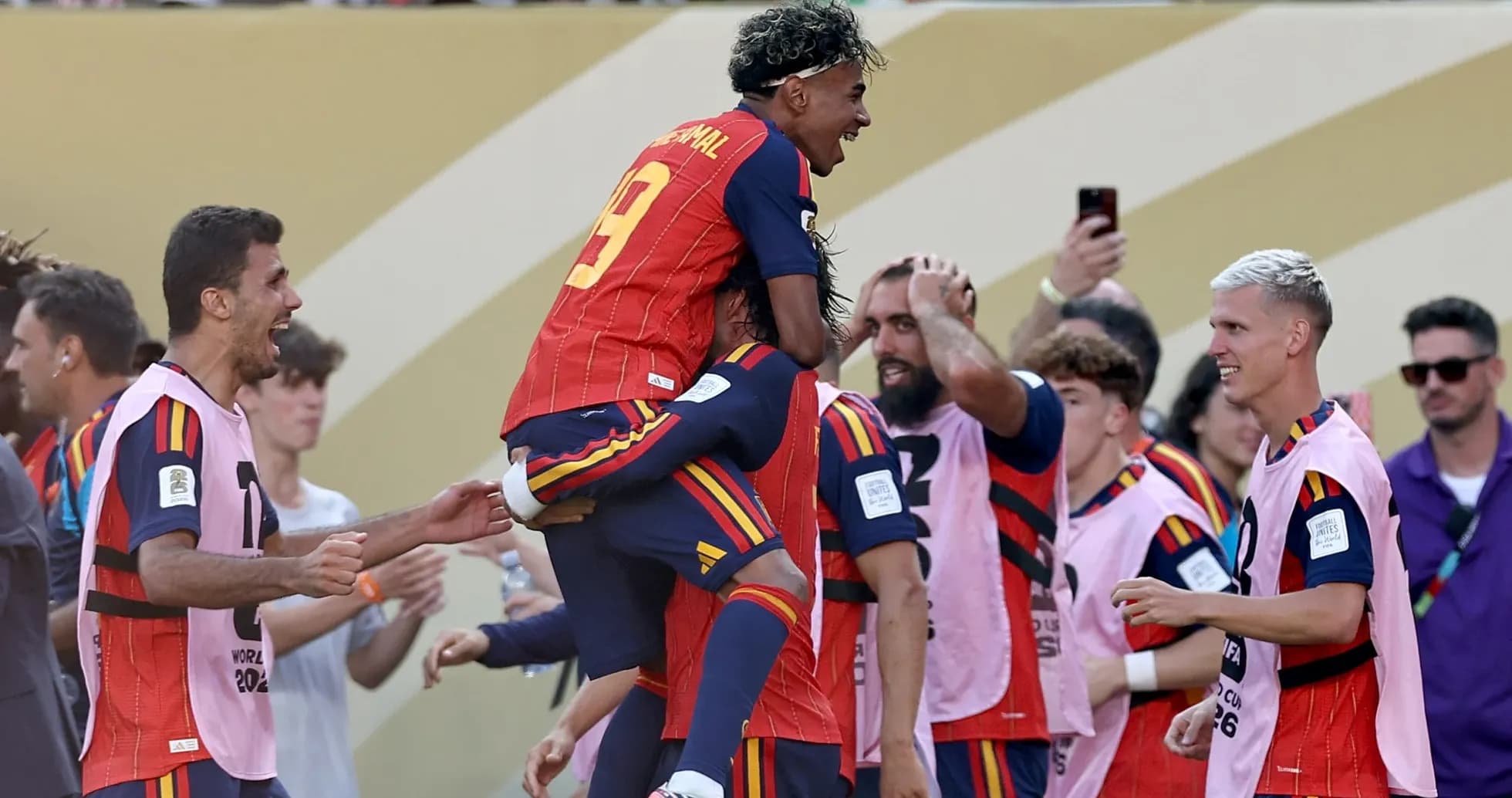
Ferran Torres’ extra-time strike, assisted by Nico Williams at 106', was the logical culmination of Spain’s sustained pressure and intelligent use of width and half-spaces. Argentina, reduced to ten men after Enzo Fernández’s dismissal at 90+3', were forced into an even deeper block that eventually cracked under the volume and quality of Spanish attacks.
I. Tactical structures and game script
Spain’s 4-2-3-1 was built on a secure base. Unai Simón (Spain) had virtually nothing to do in terms of shot-stopping, underlined by Spain’s “Goalkeeper Saves” figure of 0 and Argentina’s total of 0 shots on goal. The centre-back pairing of Pau Cubarsí and Aymeric Laporte, flanked by Pedro Porro and Marc Cucurella, operated extremely high, compressing the pitch and enabling Spain to lock Argentina in their own half for long stretches.
Rodri and Fabián Ruiz formed a double pivot that controlled rhythm and rest defence. Their role was twofold: circulate possession with minimal risk and immediately counter-press any loss, preventing Argentina’s forwards from ever facing goal in transition. Spain’s passing numbers—852 total passes, 762 accurate at 89%—reflect a team not just keeping the ball, but using it to suffocate counter-attacks.
Ahead of them, Lamine Yamal, Dani Olmo, Alex Baena and Mikel Oyarzabal initially provided a fluid attacking line, constantly rotating between inside pockets and wide zones. However, the key tactical acceleration came with the introduction of Pedri and Ferran Torres at 62' and Nico Williams at 75'. These changes injected verticality and direct dribbling into a structure that had already worn Argentina down positionally.
Argentina’s 4-4-2, with Lionel Messi and Julián Alvarez up front, was forced into a reactive posture from early on. The back four of Gonzalo Montiel, Cristian Romero, Lisandro Martínez and Nicolás Tagliafico sat deep, with the midfield line of Rodrigo De Paul, Enzo Fernández, Alexis Mac Allister and Nicolás González trying to stay compact between the lines. Yet Spain’s 9 shots inside the box and 9 corners to Argentina’s 4 showed that this block was repeatedly pushed back towards its own penalty area.
II. Spain’s attacking mechanisms and the decisive goal
Spain’s dominance in shots (20–2) and shots on goal (12–0) was not simply volume; it was the product of clear attacking patterns. With such high possession, Spain often created a 2-3-5 shape in settled attack: the full-backs advanced, one pivot (often Rodri) anchored behind the ball, and the attacking midfielders plus the striker occupied the final line.
Lamine Yamal and, later, Nico Williams were crucial in stretching Argentina horizontally. By pinning full-backs wide, they opened interior lanes for Pedri and Mikel Merino (on for Dani Olmo) to receive between the lines. Ferran Torres, operating as a central reference, alternated between running in behind and dropping to combine, forcing Argentina’s centre-backs to make uncomfortable decisions.
The winning goal at 106' encapsulated this evolution. After 90 minutes of being dragged side to side, Argentina’s ten-man block had less capacity to close spaces and track runners. Nico Williams, on from 75', provided the assist for Ferran Torres, whose finish capped a move that came from Spain’s ability to sustain pressure in the final third. By extra time, Spain’s positional play had turned Argentina’s defending from organised to desperate.
III. Argentina’s defensive approach and breakdown
Statistically, Argentina’s plan was clear: accept long phases without the ball and try to survive in a low-to-mid block. Their 35% possession and 463 total passes (357 accurate, 77%) show a side rarely able to string together sustained attacks. Instead, they leaned heavily on defensive work, committing 25 fouls and accumulating 6 yellow cards plus 1 red.
The early yellow for Lisandro Martínez at 41' and repeated cautions for Leandro Paredes, Enzo Fernández and Alexis Mac Allister signalled how often Argentina were arriving late into duels against Spain’s quicker circulation. The dismissal of Enzo Fernández at 90+3'—two yellows (Argument at 83', Foul at 90+3') followed by a red—was the tactical tipping point. Reduced to ten men just as the match entered its decisive phase, Argentina lost one of their key central midfielders, further weakening their ability to contest second balls and protect the half-spaces.
Despite this, Emiliano Martínez (Argentina) produced a remarkable performance, reflected in Argentina’s 11 goalkeeper saves and 1.81 goals prevented. While Spain’s xG of 1.94 suggests they should have scored earlier and perhaps more, Martínez’s shot-stopping kept Argentina alive deep into extra time. His interventions were the main reason the score remained 0-0 after 90 minutes despite the shot disparity.
IV. Control, risk management, and the statistical verdict
From a macro view, this Final was decided by control versus resistance. Spain’s xG of 1.94 against Argentina’s 0.22 confirms the eye test: one team consistently created, the other barely threatened. Spain’s 9 corner kicks to Argentina’s 4 and their 4 offsides to Argentina’s 1 underline how often Spain were probing the last line compared to Argentina’s infrequent forays forward.
Crucially, Spain’s defensive structure ensured that their territorial dominance did not expose them to counter-attacking risk. Holding Argentina to 2 total shots and 0 on target in 120 minutes against a front line including Lionel Messi and Julián Alvarez is as much a tactical achievement as their attacking output. With Unai Simón (Spain) untested in terms of saves, Spain effectively turned their possession into a shield.
Argentina’s disciplinary load—6 yellow cards and 1 red, all on their side—was both a symptom and a cause of their problems. Chasing without the ball, they were forced into repeated “Foul”, “Argument” and “Unsporting behaviour” incidents that broke rhythm but also eroded their structure and numbers.
In the end, the numbers and the narrative align: Spain’s high-possession, high-precision positional play, supported by a stable 4-2-3-1 and impactful substitutions, systematically overwhelmed Argentina’s 4-4-2 block. The 1-0 scoreline after extra time feels narrow compared to the underlying metrics, but tactically, it was a comprehensive Spanish performance befitting a World Cup Final.