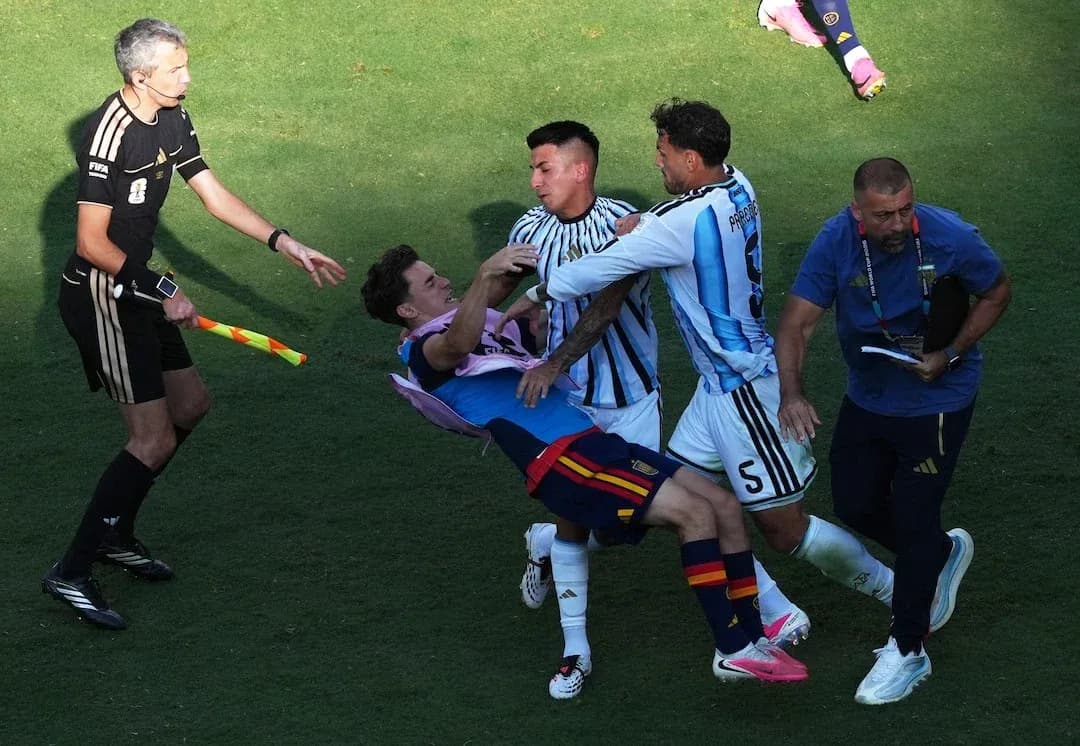
Spain Crowned World Champions After Narrow Victory Over Argentina
Spain 1-0 Argentina (after extra time) at MetLife Stadium crowns Spain as world champions, decided by Ferrán Torres’s extra-time strike. Spain, who came into the World Cup knockout phase as Group H winners, convert their territorial and technical dominance into the biggest prize, while Argentina’s perfect group campaign as Group J winners ends in heartbreak after 120 minutes of largely reactive football.
Match Report
The final unfolded as a territorial siege from Spain against a deep, combative Argentina. The first flashpoint arrived on 41', when Lisandro Martínez (Argentina) — yellow card (Foul) — was booked after stepping out of the defensive line to halt a Spanish attack, underlining Argentina’s reliance on last-ditch interventions.
On 44', Nicolás Otamendi replaced Lisandro Martínez (Argentina), an early defensive reshuffle that suggested concern either over Martínez’s booking or his physical condition. That was followed on 45', when Leandro Paredes replaced Nicolás Iván González (Argentina), adding an extra midfield controller and further signalling Argentina’s intent to congest central spaces rather than press high.
Early in the second half, Argentina’s discipline frayed again. On 52', Leandro Paredes (Argentina) — yellow card (Argument) — went into the book after protesting a decision, symptomatic of mounting pressure as Spain continued to monopolise the ball.
On 58', Nahuel Molina replaced Gonzalo Montiel (Argentina), a like-for-like change at right-back aimed at refreshing the flank that was being repeatedly targeted by Spain’s wide combinations.
Spain’s first attacking changes came on 62'. Ferrán Torres replaced Mikel Oyarzabal (Spain), adding more direct running in behind to stretch Argentina’s compact block. In the same minute, Pedri replaced Fabián Ruiz (Spain), injecting additional creativity and tempo control between the lines.
Argentina responded with a double substitution on 70'. Facundo Medina replaced Cristian Romero (Argentina), altering the profile of the left-sided centre-back, while Giuliano Simeone Baldini replaced Rodrigo De Paul (Argentina), pushing fresh legs into the forward line to chase counters and long clearances.
Spain continued to rotate their attacking midfield unit on 75'. Nico Williams replaced Alejandro Baena Rodríguez (Spain), bringing raw pace and 1v1 threat on the flank, and Mikel Merino replaced Daniel Olmo Carvajal (Spain), adding vertical runs from midfield and extra aerial presence for Spain’s sustained pressure.
Argentina’s frustrations remained visible. On 82', Enzo Fernández (Argentina) — yellow card (Dissent) — was cautioned after protesting, and on 90+2', Cristian Romero (Argentina) — yellow card (Dissent) — was booked from the bench area, further evidence of a side increasingly surviving rather than competing for control.
As the match moved into extra time, Spain refreshed their spine. On 99', Martín Zubimendi replaced Rodrigo Hernandez Cascante (Spain), maintaining defensive balance and counter-pressing intensity in midfield, while Eric García replaced Aymeric Laporte (Spain), keeping the back line physically fresh for potential Argentine counters.
Argentina made another conservative, structurally minded change on 102', when Marcos Senesi replaced Julián Álvarez (Argentina), effectively sacrificing a striker to add another defender and commit even more firmly to a low block and aerial resistance.
The tension on the Argentine bench boiled over on 104', when Lionel Sebastián Scaloni (Argentina) — yellow card (Dissent) — was booked, the head coach’s caution reflecting the emotional strain of defending for such long periods.
The decisive moment arrived on 106' Spain goal — Ferrán Torres (assisted by Nico Williams). Williams, who had been a constant outlet since his introduction, isolated his full-back on the flank, drove to the byline and delivered a low cut-back. Ferrán Torres timed his movement perfectly between centre-backs to sweep a first-time finish beyond Emiliano Martínez, finally breaking a resistance that had held for over 100 minutes. The goal gave Spain a 1-0 lead in extra time and fundamentally changed the game state, forcing Argentina to chase a match they had largely tried to contain.
Argentina’s response remained more combative than creative. On 111', Alexis Mac Allister (Argentina) — yellow card (Foul) — was booked for a late challenge as Spain managed the tempo and protected their slender advantage through controlled possession and tactical fouling when required. With Argentina unable to generate shots on target, Spain saw out the remaining minutes to secure the title.
Fixture Statistics & Tactical Audit
- xG: — not provided for either side
- Possession: Spain 65% vs 35% Argentina
- Shots on Target: Spain 12 vs 0 Argentina
- Goalkeeper Saves: Spain 0 vs 11 Argentina
- Blocked Shots: Spain 3 vs 1 Argentina
The numbers underline how one-sided the contest was in terms of territory and chance creation. Spain were dominant (65% possession) and relentlessly proactive in the final third, registering 20 total shots with 12 on target, repeatedly working the ball into the box (9 shots inside) and forcing Emiliano Martínez into 11 saves. Argentina, by contrast, were almost entirely passive in attack, producing just 2 shots in 120 minutes and none on target. Their compact 4-4-2 block, later morphing into a back five after Senesi’s introduction, was designed to absorb pressure, and for over 100 minutes it succeeded, aided by blocks, last-ditch duels and Martínez’s shot-stopping. However, the absence of any meaningful attacking output meant their margin for error was minimal; once Ferrán Torres scored, there was no established attacking structure or rhythm to mount a sustained response. From a tactical lens, the 1-0 scoreline arguably flatters Argentina given the shot and on-target disparity, and more accurately reflects Spain’s control than the narrow margin suggests.
Standings Update & Seasonal Impact
Spain, who advanced from Group H with 7 points, add three more for this win to finish their World Cup campaign on 10 points in the overall record, with their goals for rising from 5 to 6 and goals against from 0 to 0, maintaining a perfect defensive record and improving their goal difference from +5 to +6. That defensive platform, extended through the final, underpins their status as world champions.
Argentina, flawless in Group J with 9 points, remain on that total after this defeat. Their goals for stay at 8 while goals against increase from 1 to 2, trimming their goal difference from +7 to +6. Having arrived in the knockout phase as one of the tournament’s form teams, they leave the final having failed to register a shot on target, a stark attacking drop-off at the decisive hurdle despite their strong overall World Cup numbers.
Lineups & Personnel
Spain Starting XI
- GK: Unai Simón
- DF: Pedro Porro, Pau Cubarsí Paredes, Aymeric Laporte, Marc Cucurella
- MF: Rodri, Dani Olmo, Fabián Ruiz, Álex Baena
- FW: Lamine Yamal, Mikel Oyarzabal
Argentina Starting XI
- GK: E. Martínez
- DF: G. Montiel, C. Romero, Lisandro Martínez, N. Tagliafico
- MF: R. De Paul, E. Fernández, A. Mac Allister
- FW: N. González, L. Messi, J. Álvarez
Post-Match Verdict
Spain delivered a clinical performance (12 shots on target from 20 attempts) rooted in territorial dominance (65% possession) and positional structure. Their 4-1-2-3 allowed Rodri to anchor transitions, while interiors and wingers rotated intelligently to create overloads, particularly once Pedri and Nico Williams entered. The bench was used proactively to maintain tempo and attacking threat deep into extra time, and the eventual winner was the product of that sustained wide pressure and fresh legs.
Argentina, by contrast, produced a vulnerable attacking display (0 shots on target, 2 total shots) despite a resilient defensive effort (11 saves by Emiliano Martínez and multiple blocks). Scaloni’s adjustments increasingly prioritised defensive solidity — swapping centre-backs, refreshing full-backs and eventually adding Senesi for Álvarez — which compressed space but left Messi and the forwards isolated. The accumulation of yellow cards (five bookings plus the coach) reflected the strain of constant defending. In the end, Spain’s insistence on probing and their superior shot volume made the breakthrough feel inevitable, and once it arrived, Argentina’s lack of offensive structure meant the world title slipped away without a genuine late siege.