USA Defeats Bosnia & Herzegovina 2-0 in Tactical Showcase
USA’s 2-0 win over Bosnia & Herzegovina at Levi's Stadium in this World Cup Round of 32 tie was defined by structural clarity and superior box play rather than territorial dominance. With Bosnia & Herzegovina edging possession 52% to 48%, the match was less about ball retention and more about how each side translated their touches into threat. USA’s 4-3-3 under Mauricio Pochettino proved far more efficient in attacking zones, generating 0.92 xG and converting twice, while Sergej Barbarez’s 5-3-2 struggled to turn control into chances, finishing with just 0.25 xG despite a marginally higher share of the ball.
I. Executive Summary
USA built their game around a compact 4-3-3 structure, using the front three and high full-backs to stress Bosnia & Herzegovina’s back five. The key tactical hinge was vertical access into Folarin Balogun and Christian Pulišić between the lines, supported by Malik Tillman’s late surges from midfield. Bosnia & Herzegovina, in contrast, relied on a conservative 5-3-2, aiming to progress through Edin Džeko and Ermedin Demirović as reference points, but their possession remained largely sterile against a disciplined American block.
II. Scoring Sequence & Disciplinary Log
The first breakthrough came at 45', when Folarin Balogun (USA) finished a move with a Normal Goal, giving USA a 1-0 lead just before half-time. The timing was tactically decisive: it rewarded USA’s insistence on attacking the half-spaces and forced Bosnia & Herzegovina to chase the game after the interval.
Bosnia & Herzegovina reacted aggressively at 51' with a triple substitution vector aimed at changing the game’s rhythm: Armin Gigović (OUT) was replaced as E. Bajraktarević (IN) came on for A. Gigovic (OUT); I. Šunjić (OUT) made way as B. Tahirović (IN) came on for I. Sunjic (OUT); and E. Mahmić (IN) came on for E. Dzeko (OUT). These moves sought more mobility and energy in midfield and attack, but without fundamentally altering the 5-3-2 shape.
At 64', the game’s disciplinary and tactical balance shifted when Folarin Balogun (USA) received a Red Card — Serious foul. Reduced to ten men, USA were forced into a more reactive posture, dropping their wingers deeper and compressing the central lanes to protect the lead.
Bosnia & Herzegovina made further adjustments at 75': H. Tabaković (IN) came on for S. Kolasinac (OUT), and A. Memić (IN) came on for N. Katic (OUT), effectively rebalancing the back line and adding another forward profile to chase the equalizer.
The discipline log intensified at 80'. First, a Yellow Card was shown to S. Barbarez (Bosnia & Herzegovina) with no additional info provided, signaling rising frustration on the touchline. Moments later at 80', Stjepan Radeljić (Bosnia & Herzegovina) received a Yellow Card — Holding, underlining the strain Bosnia & Herzegovina’s back line was under in transition.
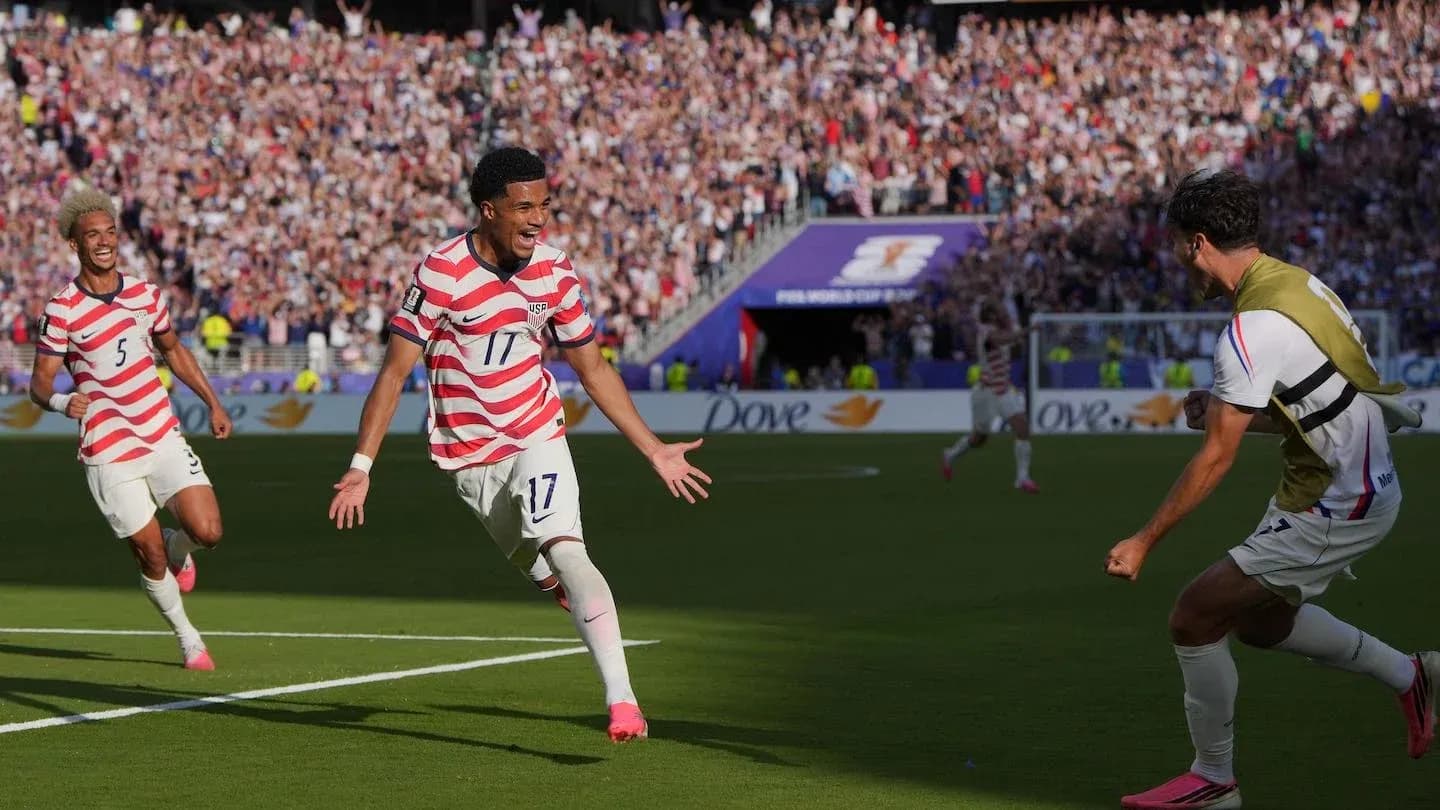
USA then killed the contest at 82', when Malik Tillman (USA) scored a Normal Goal to make it 2-0, a crucial moment given their numerical disadvantage. Late substitutions from USA were clearly game-management tools: at 87', S. Berhalter (IN) came on for S. Dest (OUT); at 88', R. Pepi (IN) came on for C. Pulisic (OUT); and at 90+5', G. Reyna (IN) came on for W. McKennie (OUT), all aimed at refreshing legs and shoring up central areas in the final minutes.
Card totals locked: USA: 1 Red Card; Bosnia & Herzegovina: 2 Yellow Cards; Total: 3 cards.
III. Tactical Breakdown & Personnel
USA’s 4-3-3 was built on a clear spine. Matthew Freese (USA) started in goal, behind a back four of Alexander Freeman, Chris Richards, Tim Ream, and Antonee Robinson. In front, Tyler Adams anchored the midfield with Weston McKennie and Malik Tillman as dual number eights. Up front, Sergiño Dest and Christian Pulišić flanked Folarin Balogun.
The structure allowed USA to create a 2-3 base in build-up: Richards and Ream split, Adams dropped between or just ahead of them, with the full-backs stepping high. This gave USA enough width to stretch Bosnia & Herzegovina’s front two, forcing their midfield three to choose between pressing wide or protecting the half-spaces. When Bosnia & Herzegovina stayed compact, USA circulated via 415 total passes (83% accuracy: 346 accurate), waiting for Pulišić or Dest to receive on the half-turn between the lines.
Bosnia & Herzegovina’s 5-3-2, with Nikola Vasilj (Bosnia & Herzegovina) in goal, Amar Dedić and Sead Kolašinac as wing-backs and a central trio of Nikola Katić, Tarik Muharemović, and Stjepan Radeljić, was designed for defensive solidity. In midfield, Armin Gigović, Ivan Šunjić, and Kerim Alajbegović tried to screen the central channels, while Edin Džeko and Ermedin Demirović led the line. The back five often flattened into a low block, but USA’s willingness to commit full-backs and eights forward created overloads on the flanks, pulling one of the wide center-backs out and opening seams for Balogun’s diagonal runs.
USA’s attacking efficiency is reflected in the shot profile: 8 total shots, 6 inside the box, 2 on target, and 2 blocked. The key was not volume but shot quality and timing — especially the pre-interval strike and the late clincher while down to ten men. Bosnia & Herzegovina took 10 shots (5 inside the box, 5 outside), with 3 on target and 3 blocked, but their 0.25 xG underscores how USA kept most of these efforts to low-probability zones.
Defensively, USA balanced aggression with control. They committed only 7 fouls compared to Bosnia & Herzegovina’s 13, suggesting a disciplined pressing scheme that relied more on positioning than on last-ditch interventions. After Balogun’s dismissal, the 4-3-3 morphed into a compact 4-4-1, with one wide forward dropping to form a second line of four. This preserved central compactness, forcing Bosnia & Herzegovina’s possession into harmless wide areas.
In goal, Matthew Freese (USA) made 3 saves, aligning with Bosnia & Herzegovina’s 3 shots on target and underlining his steady contribution behind a largely well-organized defense. Nikola Vasilj (Bosnia & Herzegovina), by contrast, recorded 0 saves, a product of USA’s ruthlessly efficient finishing — their 2 shots on goal both found the net. Interestingly, the goals prevented metric shows -1.73 for both teams, suggesting that both goalkeepers conceded more than the model expected from the quality of shots faced, but the tactical impact differed: USA’s structure limited high-quality chances against, while Bosnia & Herzegovina’s deeper block still allowed USA to create and convert the key moments.
IV. The Statistical Verdict
From a statistical lens, the match confirms USA’s superior tactical execution. Despite trailing in possession (48% vs 52%), USA produced nearly four times Bosnia & Herzegovina’s xG (0.92 vs 0.25), illustrating how their 4-3-3 consistently engineered better shooting situations. Their passing was marginally more precise — 415 passes at 83% accuracy versus Bosnia & Herzegovina’s 446 at 82% — but the real difference lay in field positioning and verticality rather than raw circulation.
Bosnia & Herzegovina’s 13 fouls and 2 Yellow Cards (plus the booking for S. Barbarez) reflected mounting frustration as their possession failed to break down USA’s compact block, especially once the Americans reorganized after the Red Card. USA’s single Red Card for Folarin Balogun introduced jeopardy, yet their response — tightening distances, smart substitutions, and continued counter-attacking threat — turned what could have been a turning point into a tactical validation.
Ultimately, USA’s 2-0 victory at Levi's Stadium was less about dominance on the ball and more about controlling space, timing their surges, and maximizing the value of each attack. Bosnia & Herzegovina’s shape offered stability but not incision, and over 90 minutes, that strategic contrast decided the tie.