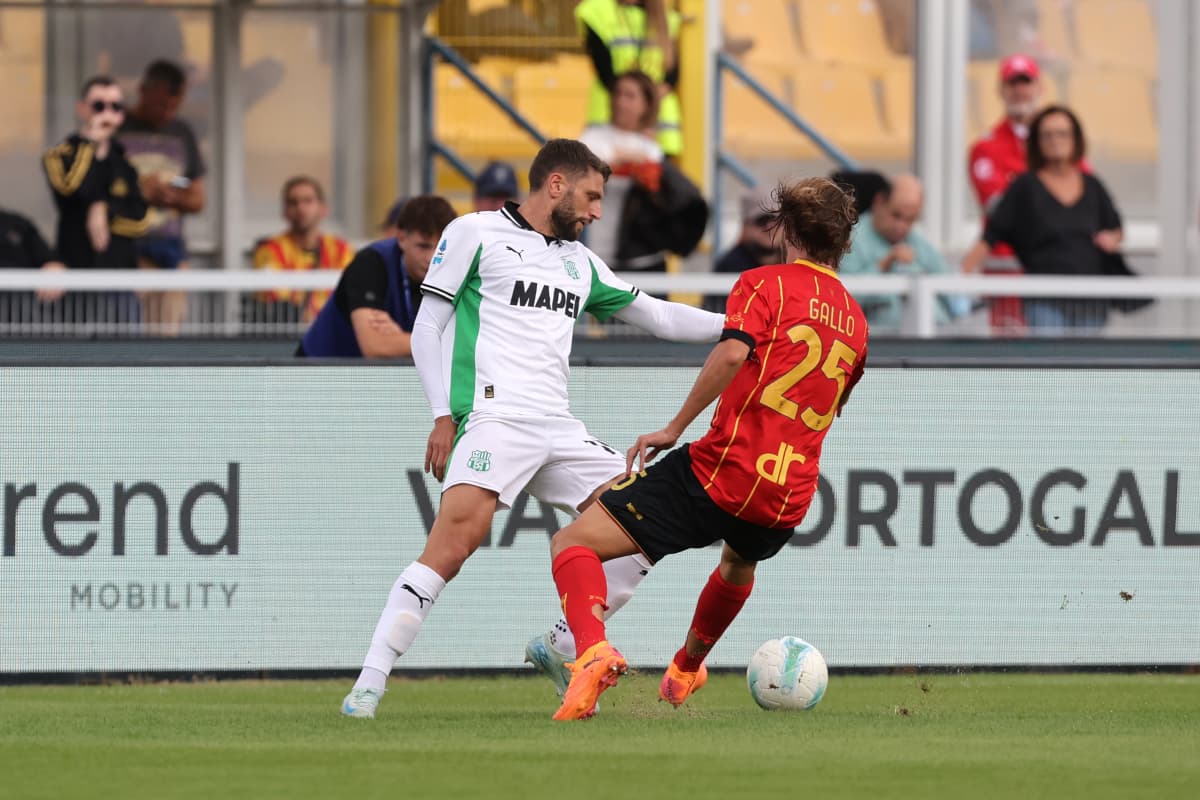
Sassuolo vs Lecce: A Tactical Clash in Serie A
Under the evening lights of MAPEI Stadium – Città del Tricolore, a chaotic, season-defining Serie A narrative unfolded. Sassuolo, 11th in the table heading into this game with 49 points and a goal difference of -3 (46 scored, 49 conceded overall), met a desperate Lecce side sitting 17th on 35 points and a goal difference of -23 (27 for, 50 against overall). The stakes were asymmetrical but clear: for Sassuolo, consolidation and expression; for Lecce, survival and resistance. The 3–2 away win that followed felt less like a routine late-season fixture and more like a tactical stress test for both teams’ identities.
I. The Big Picture – Systems, context, and seasonal DNA
Fabio Grosso doubled down on Sassuolo’s season-long blueprint, rolling out the familiar 4-3-3 that has been his side’s default in 35 league outings. S. Turati sat behind a back four of W. Coulibaly, Pedro Felipe, T. Muharemovic and U. Garcia. In midfield, K. Thorstvedt, N. Matic and I. Kone formed a technically strong but physically mixed trio. Up front, D. Berardi and A. Lauriente flanked M. Nzola.
The structure matched the statistics: heading into this game Sassuolo had averaged 1.3 goals for at home and 1.4 goals against at home, a side that leans into risk and accepts chaos. Only 4 home clean sheets and 6 home games without scoring underlined their volatility.
Opposite them, Eusebio Di Francesco set Lecce in a 4-2-3-1, a shape that has underpinned 21 league matches this season. W. Falcone was shielded by D. Veiga, J. Siebert, Tiago Gabriel and A. Gallo. The double pivot of Y. Ramadani and O. Ngom sat beneath a line of three – S. Pierotti, L. Coulibaly and the direct threat of L. Banda – all servicing lone forward W. Cheddira.
Lecce’s season numbers told of a side constantly walking a tightrope: on their travels they had scored 0.8 goals per game and conceded 1.4, with 5 away clean sheets but 9 away games without scoring. Their margin for error was tiny; their game plan here needed to be razor sharp.
II. Tactical Voids – Absences and disciplinary shadows
Both squads arrived with notable holes. Sassuolo’s defensive and rotational depth was thinned by the absences of D. Boloca (muscle injury), F. Cande and E. Pieragnolo (both knee injuries), and long-term issues for F. Romagna and A. Vranckx (both listed as inactive). S. Walukiewicz’s leg injury further constrained Grosso’s options at centre-back. The consequence: Pedro Felipe and T. Muharemovic were almost locked-in starters, with little like-for-like cover if the game demanded structural change.
Lecce’s list was shorter but still significant. M. Berisha (thigh injury) and R. Sottil (back injury) were unavailable, trimming Di Francesco’s attacking rotation and limiting his ability to alter the front line’s profile mid-game. That pushed even more responsibility onto L. Banda and W. Cheddira to carry transition and finishing.
Disciplinary profiles also shaped the emotional temperature of the contest. Sassuolo are a late-card team: 29.63% of their yellows arrive between 76–90 minutes, a period when games often fracture. Their red-card distribution is telling too: 50.00% of reds between 46–60 minutes and another 25.00% in the final quarter of normal time. With N. Matic already owning 7 yellows and 1 red this season, and K. Thorstvedt on 8 yellows, the double pivot and advanced midfielder walked a familiar disciplinary tightrope.
Lecce mirrored that late-game volatility. An impressive 29.85% of their yellows also come in the 76–90 minute window, while their reds are split evenly: 50.00% between 46–60 minutes and 50.00% between 91–105 minutes. Y. Ramadani (9 yellows) and Danilo Veiga (9 yellows) embody that edge, combining aggression with risk. The statistical backdrop made a frantic, card-strewn finale almost inevitable.
III. Key Matchups – Hunter vs Shield, and the Engine Room
The most intriguing “Hunter vs Shield” duel was conceptual rather than purely individual. Sassuolo’s front three – spearheaded by the creative axis of Berardi and Lauriente – attacked a Lecce defence that, on their travels, had conceded 26 goals in 19 matches. Lauriente, with 7 goals and 9 assists overall, is Sassuolo’s leading chance-creator, averaging 54 key passes and 79 dribble attempts across the season. His duel with D. Veiga on Lecce’s right was a constant tactical fault line: Veiga, with 95 tackles and 14 blocked shots, thrives on contact, but his 9 yellows underline how easily that duel can tilt towards fouls and set-piece danger.
In the “Engine Room”, the battle between N. Matic and Y. Ramadani set the tone. Matic’s 1,699 completed passes at 86% accuracy and 20 key passes this season make him Sassuolo’s metronome, dictating tempo from deep. Ramadani, by contrast, is Lecce’s disruptor: 90 tackles, 46 interceptions and 11 blocked shots. His job was to cut the passing lanes into Kone and Thorstvedt, forcing Sassuolo wide and away from the half-spaces where Berardi thrives.
Further up, Thorstvedt’s dual profile – 4 goals, 4 assists, 32 interceptions and 13 blocked shots – offered Sassuolo a rare two-way presence between the lines. His ability to time late runs into the box and then immediately counter-press was a direct test of Lecce’s defensive midfield screen and the positioning of Tiago Gabriel and J. Siebert.
For Lecce, L. Banda’s role was pivotal. With 4 goals, 4 assists and 83 dribble attempts, he is their chaos generator. His duels with W. Coulibaly and Pedro Felipe were the away side’s best route to destabilise Sassuolo’s back line, especially given the home side’s tendency to concede 1.4 goals per game at home.
IV. Statistical Prognosis – xG logic and defensive frailty
Even without explicit xG numbers, the season data sketches the underlying probabilities. Heading into this game Sassuolo’s overall scoring average of 1.2 goals per match (1.3 at home) against Lecce’s overall concession rate of 1.4 (1.4 away) pointed to a home side likely to generate a healthy shot volume. Conversely, Lecce’s modest attacking output – 0.7 goals overall, 0.8 away – faced a Sassuolo defence conceding 1.3 per match overall and 1.4 at home, a unit that offers chances even when territorially dominant.
The 3–2 scoreline ultimately fit that statistical silhouette: a game where attacking quality and defensive looseness on both sides inflated the chance count. Sassuolo’s penalty record – 2 taken, 2 scored overall – suggested they are typically ruthless from the spot, though the presence of A. Pinamonti on the red-card list with 1 missed penalty this season is a reminder that even their forwards can falter under pressure.
Following this result, the tactical verdict is clear. Sassuolo remain a high-variance side: capable of carving opponents open through Lauriente and Berardi, yet repeatedly undermined by a defence that concedes too frequently for a team with European aspirations. Lecce, meanwhile, survive and compete not through control but through intensity: Ramadani’s ball-winning, Banda’s verticality, and a back line that, while statistically porous, can bend without quite breaking.
In narrative terms, this match crystallised both teams’ seasonal identities. Sassuolo played the protagonists but left with nothing; Lecce embraced the role of opportunistic underdog and walked out of Reggio Emilia with three points that matched not just their need, but the underlying logic of their campaign.