Cremonese Defeats Udinese 1–0 in Tense Serie A Clash
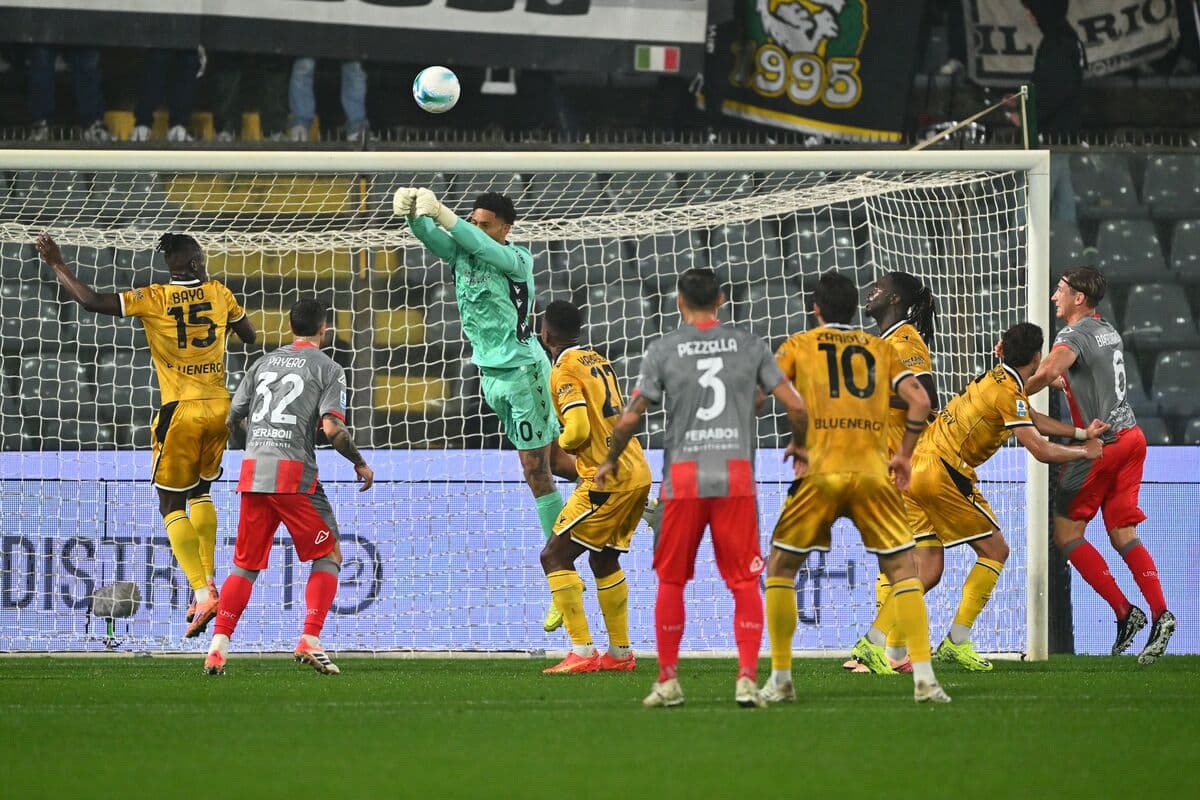
Under the evening lights of the Bluenergy Stadium – Stadio Friuli, Udinese and Cremonese closed out a tense Serie A chapter with a narrow 1–0 away win for the visitors. Following this result, the table snapshots tell their own contrasting stories: Udinese sit 10th on 50 points, with an overall goal difference of -2 (45 scored, 47 conceded), a mid-table side still searching for consistency. Cremonese, 18th on 34 points and carrying an overall goal difference of -22 (31 for, 53 against), remain trapped in the relegation zone, but this victory on their travels feels like a lifeline rather than a consolation.
Both coaches mirrored each other structurally in a 3-5-2, but the personalities inside those shapes gave the match its texture. Kosta Runjaic’s Udinese leaned into their season-long identity: a side more dangerous on their travels than at home. Heading into this game they had averaged 1.5 away goals but only 0.9 at home, a split that again surfaced as they failed to score in Udine. Marco Giampaolo’s Cremonese arrived with a more fragile attacking record – just 0.7 away goals on average – but with a clear plan to compress space and play off the intelligence of their front two.
The tactical voids were significant before a ball was kicked. Udinese were stripped of creativity and vertical threat by the simultaneous absence of Nicolò Zaniolo (back injury) and J. Ekkelenkamp (leg injury), while K. Ehizibue (suspension) and A. Zanoli (knee injury) removed natural wide options and depth on the right. Runjaic responded by pushing H. Kamara and J. Arizala high as wing-backs, asking them to provide width and penetration that Zaniolo usually supplies between the lines.
Cremonese had their own structural wounds: F. Baschirotto, W. Bondo, F. Ceccherini and F. Moumbagna were all missing, depriving Giampaolo of defensive aggression and midfield legs. Yet the coach compensated with a rugged back three of S. Luperto, M. Bianchetti and F. Terracciano, shielded by a combative central trio where M. Thorsby and A. Grassi did much of the dirty work.
Discipline and timing shaped the emotional tone of the contest. Across the season, Udinese’s yellow cards spike between 61–75 minutes (27.94%) and 76–90 minutes (22.06%), a pattern of late-game strain that hints at physical and emotional fatigue. Cremonese, by contrast, show their own late volatility: 26.09% of their yellows arrive in the 76–90 window, while their red-card profile is bizarrely back-loaded, with 66.67% of reds coming between 91–105 minutes. This is a team that often walks the tightrope in closing stages. Yet on this particular night, Cremonese managed that edge better, staying compact and cynical without tipping into self-destruction.
The “Hunter vs Shield” duel was always likely to revolve around two forwards: Keinan Davis for Udinese and Federico Bonazzoli for Cremonese. Davis came into the fixture as Udinese’s premier reference point: 10 goals and 4 assists overall, 38 shots with 25 on target, and a bruising 310 duels contested, 146 won. He is not just a finisher but a fulcrum, drawing 47 fouls and linking play with 29 key passes. Against a Cremonese defence that had conceded 28 away goals heading into this game (1.5 on average), the script suggested he would find space between Bianchetti and Luperto.
Instead, the Shield won. Giampaolo’s back three stayed narrow, denying Davis central pockets and forcing him to receive with his back to goal, far from the penalty spot where he is most dangerous. Thorsby dropped intelligently into the half-spaces, cutting off the straight pass into Davis’s feet. Without Zaniolo’s ability to drive at defenders and create chaos, Udinese’s main hunter was starved of the kind of service that has underpinned his season.
On the other side, Bonazzoli played the role of assassin rather than volume shooter. With 9 goals and 1 assist overall, 55 shots and 31 on target, he arrived as Cremonese’s most reliable finisher. Up against an Udinese defence that had conceded 21 at home (1.1 on average), the question was whether he could exploit transitional moments rather than sustained pressure. Supported by the tireless running of J. Vardy, Bonazzoli’s movement between C. Kabasele and O. Solet repeatedly asked questions of Udinese’s back three. One such movement, combined with a quick midfield release, proved decisive in a game of few clear chances.
The “Engine Room” battle was equally compelling. With Zaniolo absent, the creative burden for Udinese fell onto J. Karlstrom and L. Miller in central zones, and A. Atta as a connector. Their task was to progress the ball through Cremonese’s compact 3-5-2 block and find Kamara or Arizala early enough to isolate Pezzella and T. Barbieri. But Cremonese’s own engine, symbolised by A. Grassi’s positional discipline and Thorsby’s running, kept Udinese’s midfield circulating in front of the block rather than through it.
Off the bench, Giampaolo had a key card in J. Vandeputte – one of Serie A’s most productive creators with 5 assists and 53 key passes overall – and forwards like M. Djuric and A. Sanabria to change the attacking profile. Even if Vandeputte did not start, his presence on the bench exerted tactical gravity: Udinese could not over-commit to pressing wide areas without fearing a late, fresh playmaker arriving to exploit tired legs.
From a statistical prognosis perspective, the result aligns uncomfortably with both teams’ seasonal DNA. Udinese, despite an overall scoring rate of 1.2 goals per game, have failed to score in 10 matches this campaign, 7 of those at home. That pattern resurfaced here, underlining how dependent their attacking ceiling is on having both Davis and at least one high-level creator like Zaniolo on the pitch. Cremonese, for their part, continue to live on a knife-edge: they score just 0.8 goals per game overall but keep 11 clean sheets, the same total as Udinese. Their survival model is clear – stay in games, trust Bonazzoli’s efficiency, and lean on a disciplined, occasionally cynical defensive block.
Following this result, the tactical takeaway is stark. Udinese’s 3-5-2 remains structurally sound but creatively fragile without its missing playmakers; they need more penetration from central midfield to match the work rate of their wing-backs. Cremonese, though still 18th, have shown that their 3-5-2 can travel: organised, patient, and reliant on sharp front-two movement. In a league where margins are thin and xG often hovers around parity, their ability to turn a low-chance game into three points may yet define whether that -22 goal difference becomes a footnote to survival or a tombstone to relegation.