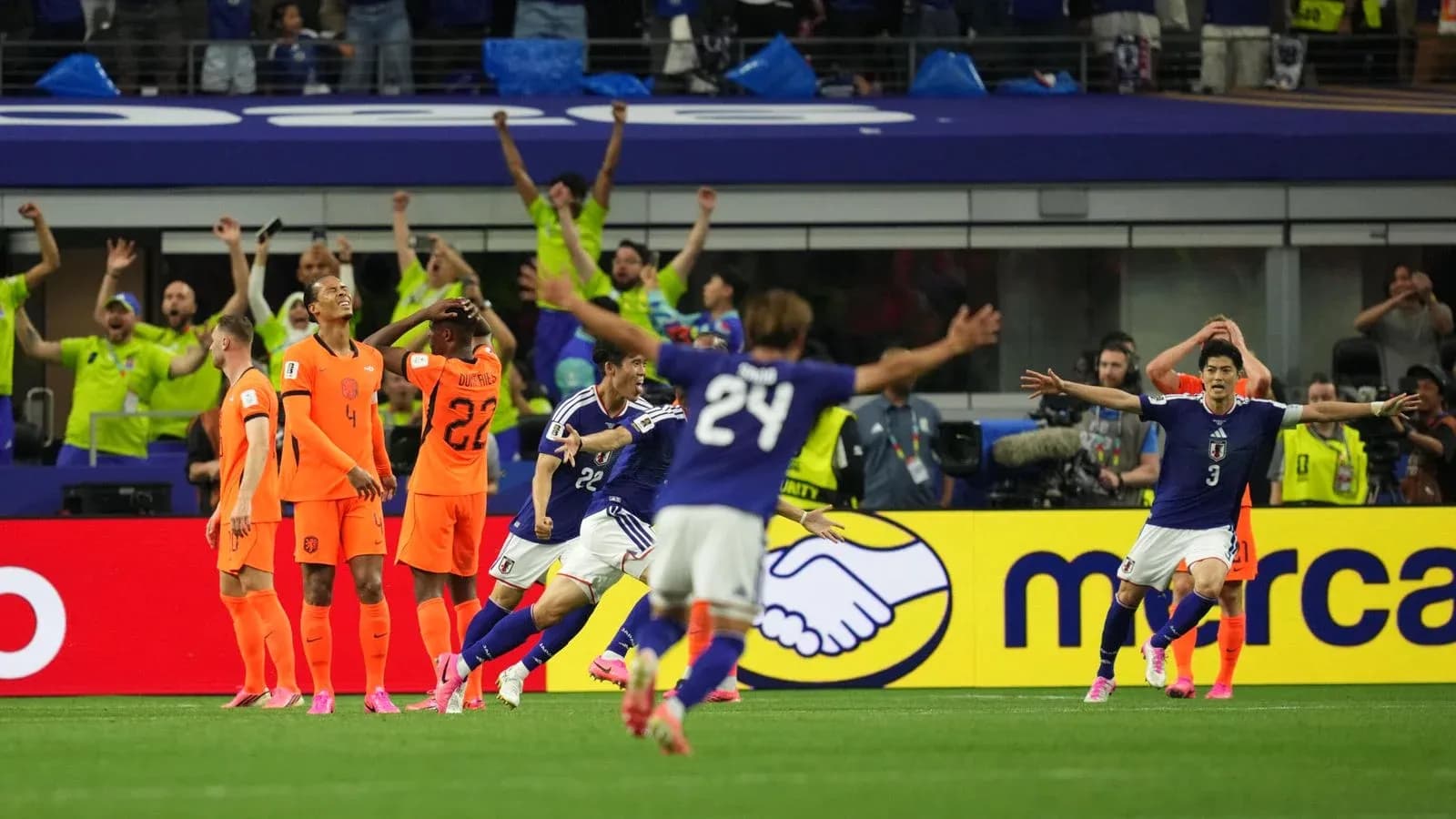
Netherlands vs Japan: Tactical Insights from World Cup's Thrilling 2–2 Draw
The World Cup’s first night in Arlington delivered a tactical chess match disguised as a 2–2 thriller. At AT&T Stadium, Netherlands and Japan opened their Group F campaigns with contrasting shapes and shared ambition, leaving the group table finely poised and the narrative wide open.
Heading into this game, both sides carried a similar statistical DNA: high-scoring, vulnerable, and untested in clean-sheet terms. Overall this campaign, Netherlands have played 1 match, scoring 2 and conceding 2, while Japan mirror them almost exactly on their travels with 2 goals for and 2 against. The goal difference for both is 0, and that symmetry translated onto the pitch.
I. The Big Picture – Structure and Intent
Ronald Koeman stayed loyal to a 4-3-3 that has already become the Netherlands’ default: one match, one use of the shape. Virgil van Dijk anchored a back four with D. Dumfries providing width on the right and M. van de Ven balancing on the left. In front, a midfield trio of F. de Jong, T. Reijnders and R. Gravenberch set up a technical engine designed to dominate the ball and feed a fluid front three of C. Gakpo, D. Malen and C. Summerville.
Hajime Moriyasu answered with a 3-4-2-1, also used in all of Japan’s World Cup minutes so far. H. Ito, S. Taniguchi and T. Watanabe formed a back three behind a hard-running band of four: R. Doan and K. Nakamura wide, with K. Sano and D. Kamada inside. Ahead of them, T. Kubo and D. Maeda floated behind A. Ueda, a front line built for sharp transitions rather than sterile possession.
The formations told the story: Netherlands looking to stretch Japan horizontally with wingers and full-backs, Japan looking to compress the centre and spring forward through Kubo and Maeda.
II. Tactical Voids and Discipline
There were no listed absentees for either side, which made this a pure selection battle rather than a patchwork XI. The real voids were structural.
For Netherlands, the weakness was the space behind Dumfries. With the home side (in designation) having played 1 match at home, scoring 2 and conceding 2, their home average of 2.0 goals for and 2.0 goals against already hinted at an open game. The 4-3-3’s aggression down the right often left J. P. van Hecke and Van Dijk exposed to diagonal runs from Maeda and Kubo.
Disciplinary trends underline a developing pattern. Overall this campaign, Netherlands have yet to keep a clean disciplinary slate: they have received yellow cards in three distinct late-game windows. Between 61-75 minutes, 76-90 minutes and 91-105 minutes, they have 1 yellow in each band, each accounting for 33.33% of their total yellows. It paints a picture of a side that becomes stretched and reactive as the match wears on. C. Summerville and M. Depay both feature among the competition’s early carded players, reinforcing the sense that Koeman’s attacking options defend on the edge.
Japan, by contrast, have no recorded yellow or red cards across any minute band so far. Their discipline supports Moriyasu’s controlled, collective approach: aggressive in pressing lanes, but rarely overstepping into fouls that draw cards.
III. Key Matchups – Hunter vs Shield, Engine Room Battles
Hunter vs Shield
C. Summerville has emerged as Netherlands’ early headline act. In total this campaign, he has 1 goal from 1 shot on target, an 8.3 rating, and 7 duels contested with 5 won. His dribble profile – 1 attempt, 1 success – suggests quality over volume, picking his moments rather than spamming take-ons. Operating from the right in the 4-3-3, he repeatedly asked questions of H. Ito’s side of Japan’s back three.
Japan’s defensive “shield” is collective rather than individual star power. On their travels, they have conceded 2 goals in 1 match, an away average of 2.0 goals against, identical to their away goals scored. That balance hints at a back line comfortable in chaos: they will trade chances if it allows them to keep their transition threat alive. The duel between Summerville and the Ito–Taniguchi–Watanabe axis is central to any tactical preview of their next encounters; if Japan cannot isolate Summerville, they will be forced deeper, blunting their counter-attacking edge.
On the other side, A. Ueda leads a Japanese attack that has already shown it can hurt opponents in limited touches. With Japan’s away goals for total at 2 from a single outing, Ueda’s presence pins centre-backs, creating pockets for Kubo and Maeda to exploit. Van Dijk’s leadership and aerial dominance are vital here: if he wins the first contact consistently, Japan’s 3-4-2-1 loses its vertical punch.
The Engine Room
The midfield battle is where this fixture truly breathed. R. Gravenberch has quietly become the Netherlands’ creative metronome. In total this campaign, he has 2 assists from 25 passes with 2 key passes and an 88% accuracy. His dribbling – 3 attempts, 2 successes – allows him to glide past the first press and connect midfield to the front three. Positioned as the right-sided No. 8, he constantly probed the half-space behind K. Sano and D. Kamada.
For Japan, T. Kubo and Koki Ogawa headline the assist charts. Kubo, starting as one of the two attacking midfielders, has 1 assist from 16 passes at 75% accuracy, plus 1 interception, showing his dual role as creator and presser. Ogawa, introduced from the bench, needed just 15 minutes and a single key pass to register his own assist. Moriyasu has, therefore, a clear “impact sub” profile: Ogawa can replace Maeda or Ueda to attack tired legs and disorganised lines.
The duel between Gravenberch’s passing lanes and Kamada’s ability to screen them will shape how much control Netherlands can exert in future group matches. If Kamada and Sano can block Gravenberch’s vertical supply, Koeman’s side may be forced into predictable wide deliveries, which suit Japan’s back three.
IV. Statistical Prognosis – What This 2–2 Draw Tells Us
Following this result, the standings underline how little separates these sides. In Group F, Netherlands sit on 1 point with a total goal difference of 0 after 1 match (2 scored, 2 conceded). Japan also have 1 point, 2 goals for and 2 against, and a total goal difference of 0. Both have failed to keep a clean sheet, and both have yet to fail to score: 0 clean sheets and 0 matches without a goal for each.
Neither team has taken a penalty so far; the data lists 0 total penalties for both, with 0 scored and 0 missed, so spot-kicks remain an unknown variable rather than a weapon or weakness.
Without xG numbers, we are left to infer from structure and outputs. Netherlands’ home average of 2.0 goals for and 2.0 against suggests high xG at both ends: they create, but their aggressive full-backs and late-game indiscipline open doors. Japan’s away average of 2.0 goals for and 2.0 against points to a similar profile, but with more emphasis on transition efficiency than sustained pressure.
The tactical verdict is of two sides that will light up the group: Netherlands with a ball-dominant, wing-driven 4-3-3 powered by Gravenberch and Summerville; Japan with a disciplined, shape-shifting 3-4-2-1 that can hurt anyone if Kubo and Ogawa find the right moments. In a tournament defined by fine margins, this 2–2 draw felt less like dropped points and more like a warning: both of these teams have the tools to grow into serious knockout threats.