Mexico Dominates Ecuador in Knockout Clash
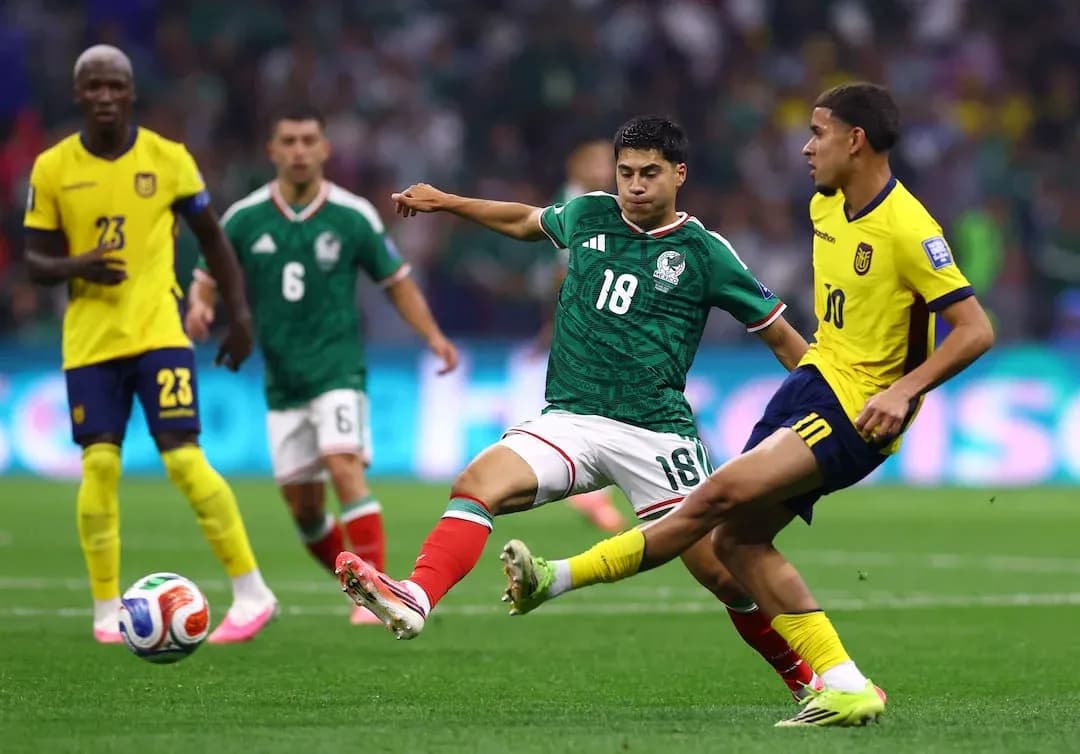
Under the lights of Estadio Banorte in Mexico City, this Round of 32 tie felt less like a cautious knockout opener and more like a statement of intent. Mexico, already the most convincing side of Group A with 9 points and a total goal difference of +6 from the group phase, carried that authority straight into a 2–0 win over Ecuador that was effectively secured by half-time.
This was a meeting of contrasting seasonal identities. Heading into this game, Mexico had played 4 matches in total, winning all 4. At home they had played 3, winning all 3, scoring 5 and conceding 0; on their travels they had played 1, also winning it, with 3 goals for and 0 against. The defensive line was pristine: overall 8 goals scored and 0 conceded, every match a clean sheet. Ecuador arrived more fragile. Across 4 games in total they had 1 win, 1 draw and 2 defeats, scoring 2 and conceding 4. At home they had 2 goals for and 1 against; away they had failed to score in 2 matches and conceded 3. Mexico’s perfect record and Ecuador’s blunt away attack framed the tactical story before a ball was kicked.
Mexico's Formation
Javier Aguirre doubled down on Mexico’s most trusted shape, rolling out the familiar 4-3-3 that had already been used 3 times this tournament. R. Rangel anchored the side in goal, shielded by a back four of J. Gallardo, J. Vasquez, C. Montes and J. Sanchez. In front, a compact midfield trio of L. Romo, E. Lira and G. Mora formed a hard-working triangle designed to compress space around the ball and trigger aggressive counter-pressing.
The front line was the heart of Mexico’s attacking plan. On the left, J. Quinones — one of the World Cup’s standout performers — started nominally as a forward but roamed like a wide playmaker. Heading into the tie, he had 3 goals and 1 assist in total, with 9 shots (5 on target) and 106 passes at 80% accuracy. His 7 key passes and 6 successful dribbles from 8 attempts told the story of a player who can both break lines off the dribble and release runners at the right moment. On the opposite flank, R. Alvarado arrived as the competition’s leading creator: 3 assists in total, 10 key passes and 140 completed passes at 82% accuracy. Between them, they formed a dual-threat supply line into central striker R. Jimenez, whose role was to pin Ecuador’s centre-backs and open channels for the wingers to attack the half-spaces.
Ecuador's Setup
Across the halfway line, Sebastian Beccacece’s Ecuador lined up in a 4-4-2 that has been their default structure, used in 3 of their 4 matches. H. Galindez started in goal, behind a back four of P. Hincapie and A. Franco as full-backs, with W. Pacho and J. Ordonez as the central pairing. The double pivot of M. Caicedo and P. Vite was flanked by N. Angulo and J. Yeboah, while G. Plata and E. Valencia led the line.
On paper, Ecuador’s back line carried pedigree but also risk. A. Franco and P. Hincapie arrived as two of the World Cup’s most card-prone defenders. Franco, already the leading figure for yellow cards, had 2 yellows in total and 7 fouls committed across 4 appearances, though he also showcased defensive value with 8 tackles, 1 blocked shot and 4 interceptions. Hincapie combined front-foot defending — 12 tackles, 2 blocked shots, 4 interceptions and 24 duels won out of 47 — with volatility, having collected both a yellow and a red card in the tournament. That disciplinary profile mirrored Ecuador’s wider pattern: their yellow cards were spread aggressively across the 31–45', 46–60', 61–75' and 76–90' windows, and they had also seen a red card in the 91–105' range. This is a team that tends to live on the edge, particularly as games stretch.
Disciplinary Records
Mexico’s own disciplinary record hinted at a different rhythm. They had picked up yellow cards only in the 16–30' and 61–75' bands, each accounting for 50% of their total yellows, and their solitary red card had come deep into extra time, between 91–105'. That pattern underlined a side that is intense in bursts but generally controlled across the standard 90 minutes — a useful trait in knockout football.
The “Hunter vs Shield” duel was always going to tilt green. Mexico’s attack, averaging 2.0 goals per game in total, 1.7 at home and 3.0 on their travels, was up against an Ecuador defence that conceded 1.0 goals per match overall, but a worrying 1.5 away. Ecuador’s away record — 0 goals scored, 3 conceded, 0 wins and 2 defeats — made it clear that if Mexico scored first, the visitors would be forced into a game state they are ill-equipped for: chasing against a side that has yet to concede in the tournament.
Midfield Battle
The “Engine Room” battle pitted Mexico’s ball-playing and pressing midfield against Ecuador’s more transitional core. L. Romo and E. Lira were tasked with smothering M. Caicedo’s attempts to launch quick breaks and with cutting supply into E. Valencia’s channels. With Mexico having failed to score in 0 matches and keeping 4 clean sheets in total, the structure around C. Montes and J. Vasquez has been calibrated to deny central progression and funnel attacks wide, where full-backs Gallardo and Sanchez can engage aggressively.
From a statistical prognosis, everything pointed towards a Mexican win with a narrow but comfortable margin — and the 2–0 full-time scoreline reflected exactly that balance. Mexico’s perfect form (4 wins in 4, 8 scored, 0 conceded overall), their proven 4-3-3 template and the creative axis of Quinones and Alvarado gave them multiple routes to goal. Ecuador’s issues — 3 matches in total without scoring, 4 goals conceded, and a disciplinary profile led by Franco and Hincapie’s cards — suggested they would struggle to sustain pressure without leaving gaps.
Following this result, the narrative is clear: Mexico’s defensive perfection and multi-layered attack have translated seamlessly from the group stage into knockout football. Ecuador, brave but blunt and increasingly stretched, ran into a side whose structure, form and discipline were simply too strong over 90 minutes.