
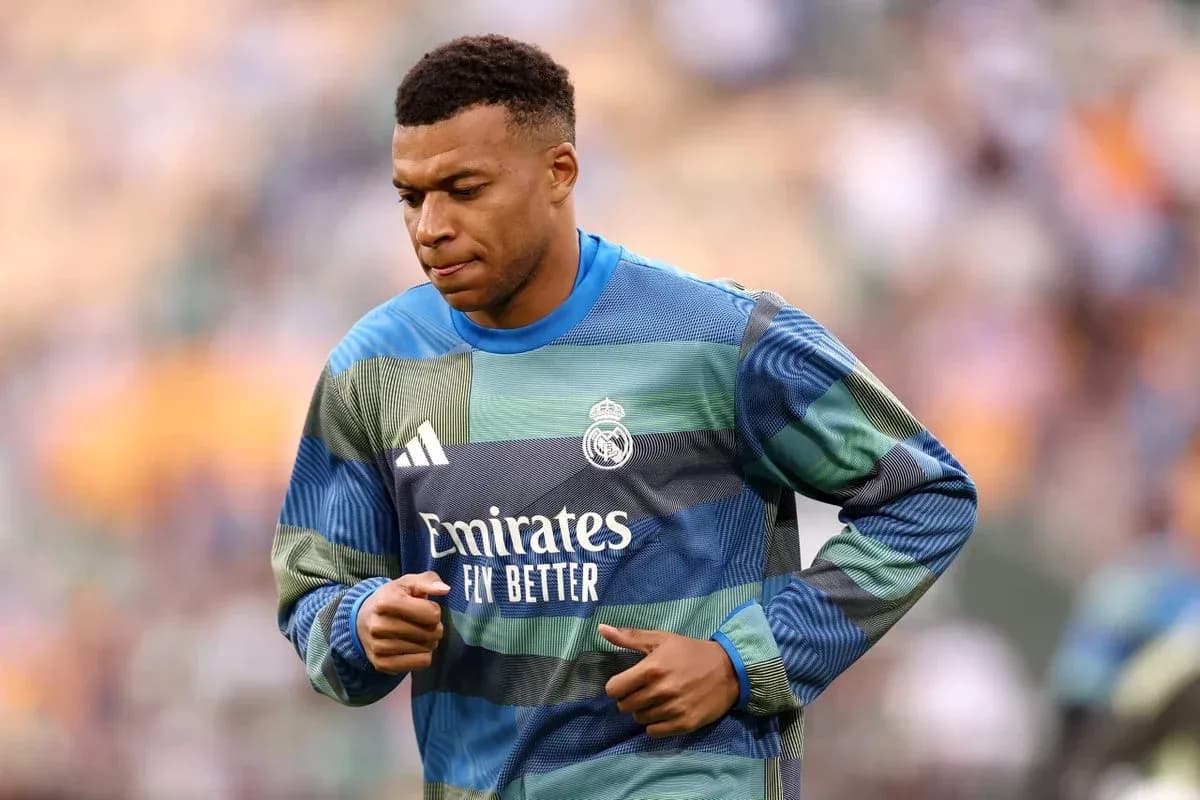
Kylian Mbappe's Impact at Real Madrid: A Double-Edged Sword
As Real Madrid’s players file through the Bernabeu tunnel, they walk past a sentence that now feels less like a motto and more like a warning.
No player is as good as all of you together.
Alfredo Di Stefano’s words were meant as a hymn to collective greatness. Right now, they read like an accusation.
The club that spent years bending its future around Kylian Mbappe finally has him. The club that lifted La Liga and the Champions League in 2024, then added the most coveted forward of his generation, should have been untouchable. Instead, it is drifting towards a second straight season without a major trophy, with boos raining down on its biggest stars and a dressing room that keeps leaking tension.
Vinicius Junior, Jude Bellingham, Mbappe himself. Even Florentino Perez, architect of the modern galactico era. All have felt the whistle and the jeer. Aurelien Tchouameni and Federico Valverde literally came to blows on the training ground last week. This is not the atmosphere the club imagined when Mbappe finally arrived on a free transfer — plus a vast signing fee — in June 2024.
And yet, if you strip the emotion away and look at the numbers, the man in the eye of the storm has done almost everything he was bought to do.
A superstar delivering… and still on trial
Since he pulled on the white shirt, Mbappe has been Madrid’s primary source of goals. He has scored 77 times across La Liga and the Champions League, more than double any team-mate since his arrival. He won the Golden Boot in 2024-25. He has outperformed his expected goals by seven, turning half-chances into decisive moments.
When Madrid went out to Bayern Munich in the Champions League quarter-finals last month, he was one of the few who met the occasion. Two goals across the tie, 15 in the competition overall. Only Cristiano Ronaldo’s record of 17 from 2013-14 sits meaningfully above him in the modern era.
This is not the output of a flop.
Yet the Bernabeu made its verdict clear in the first home game after that European exit. Mbappe was booed, singled out, folded into a general anger that has spilled beyond the pitch.
The France captain has been dragged into a series of off-field flashpoints. The Athletic reported a row with a member of the coaching staff before the trip to Real Betis on April 24, cited by sources as another crack in a fragile atmosphere. His decision to travel to Italy with his partner while injured irritated some inside the club and fed the perception of distance.
His camp responded with a statement, insisting that “a portion of the criticism is based on an over-interpretation of elements related to a recovery period strictly supervised by the club, and does not reflect the reality of Kylian’s commitment and daily work for the team.”
The goals say one thing. The mood says another. And a question that once sounded unthinkable is now being asked quietly in press boxes and loudly in fan bars: has this journey been worth it?
The case against: a genius who tilts the whole team
When Mbappe’s move from Paris Saint-Germain was finally edging towards reality two years ago, one member of Carlo Ancelotti’s staff pointed to a different column of numbers: his defensive work.
The concern was blunt. How do you keep balance in a side already built around high-end attackers if your new superstar barely defends?
Those fears have not gone away. They have been borne out.
Across La Liga and the Champions League, Mbappe is the Madrid player with the fewest tackles, interceptions and ball recoveries per 90 minutes. The more telling metric is his lack of “true” tackle attempts — the sum of tackles won, tackles lost and fouls committed that shows how often a player actually goes into challenges.
In La Liga, among 461 outfield players, he ranks 461st. Last. Around 0.6 attempts per game.
For a forward, defensive numbers do not have to be sparkling. But they cannot be that low without consequences, especially when you add him to Vinicius Jr, Bellingham and Rodrygo, all of whom also need the ball, the spotlight and certain zones of the pitch.
That is where the second problem begins.
Mbappe and Vinicius Jr are both left-sided predators. Both like to receive wide, then drive inwards. The touchmaps tell the story: their footprints overlap heavily on that flank. There have been bursts of chemistry, moments when the two have combined and the Bernabeu has roared at the possibilities. Those moments have not become a pattern.
The understanding Vinicius once had with Rodrygo, with clearly defined roles and lanes, has not been replicated with Mbappe. Too often, they occupy the same spaces. Too often, one of the two is standing in the other’s favourite zone.
That is not just a tactical puzzle. It is a planning question. Who looked at the squad and decided that two dominant left-sided attackers, both used to being the main man, would simply figure it out?
The numbers at team level are uncomfortable. Madrid scored 87 league goals in 2023-24, a season without a clear No 9. Bellingham floated as a false nine, Joselu came off the bench as a traditional target, and the attack spread itself across the front line.
Last season, with Mbappe on board, they scored 78. This year, with three games left, they sit on 70. The team has a superstar reference point now. The total output has not exploded with him; if anything, it has flattened.
If Mbappe hoovers up chances and goals but compresses the rest of the attack, how much is the trade-off helping? And what happens when the next generation of high-potential forwards arrives and finds the left half-space already occupied, permanently?
Then there is the human side, the one Di Stefano would probably have cared about most.
Mbappe came in as a leader by status and salary. He is the highest-paid player at the club, the man Perez publicly praised for making “a great effort” to join after years of flirtation and rejection. But his long courtship, and particularly his 2022 decision to stay at PSG, left scars among supporters. For some, he arrived not as a saviour, but as someone who finally gave in.
In the hardest stretches of these past two seasons, he has not always projected the emotional presence Madrid expect from their standard-bearers. In a dressing room that has lost voices like Karim Benzema, Toni Kroos and Luka Modric, that absence feels louder.
The case for: Madrid knew what they were buying
Strip away the noise, and one fact remains: Mbappe is still one of the best players on the planet.
He is 27, in his peak years. He is about to lead France into a World Cup summer where he may well be the standout figure. He already owns one World Cup winner’s medal, earned at 19, and in 2022 he became only the second man after Geoff Hurst to score a hat-trick in a final, dragging his country back from the brink before losing to Lionel Messi’s Argentina.
He has always thrived most when he is the undisputed protagonist. For France, that status is clear. Earlier this season under Xabi Alonso at Madrid, when he was given a more central role ahead of Vinicius Jr, he looked liberated again. The shoulders loosened. The performances followed.
There are obvious areas to improve. Defensive work rate is one. But Madrid knew what they were buying: a devastating finisher, a transition monster, a player who bends games around his runs and his shots.
He has three years left on his contract. He has the time and the platform to reshape his relationship with the Bernabeu, if the club decide to build around him rather than next to him.
And even amid the criticism, he has not vanished off the pitch. In mixed zones and interviews he has generally spoken clearly and assertively. After Vinicius Jr accused Benfica winger Gianluca Prestianni of racist abuse in their Champions League play-off first leg in February, Mbappe publicly backed his team-mate with a firm, articulate defence. Prestianni denied racism and received a six-game UEFA ban for homophobic conduct instead, but Mbappe’s stance inside that storm underlined his willingness to step into uncomfortable debates.
Leadership is not just shouting in the dressing room. At Madrid, it is also about how you carry the shirt in the world. On that front, he has often been closer to the version the club thought they were signing.
The Cristiano Ronaldo echo
Madrid have been here before with a generational forward whose presence warped everything around him.
Cristiano Ronaldo arrived in 2009 as the most expensive player in history. In his first two seasons, Madrid won only a Copa del Rey. The Champions League, the trophy he was supposed to deliver on demand, stayed out of reach until 2014.
The journey was not smooth. In September 2012, after scoring twice against Granada, Ronaldo refused to celebrate and later said: “I’m sad and the people at the club know it.” It sounded like a crack in the relationship. Some wondered whether the experiment was worth the strain.
From that point, he went on to win four Champions League titles with Madrid and left in 2018 as their all-time leading scorer.
No two careers are identical, and invoking Ronaldo is not a guarantee of anything for Mbappe. But it is a reminder of how long it can take for a superstar forward and a demanding club to truly align — and how volatile the ride can look from the outside while that process is still underway.
Right now, Di Stefano’s quote hangs over this Madrid side like a challenge. The club chased the individual for years and finally got him. The individual has, by most measures, delivered. The collective has not.
The question for Madrid is no longer whether Mbappe is good enough. It is whether they are willing to reshape everything — tactics, hierarchy, even their patience — to make sure that, this time, “all of you together” includes him at the heart of something that actually wins.





