France vs Senegal: World Cup 2026 Match Analysis
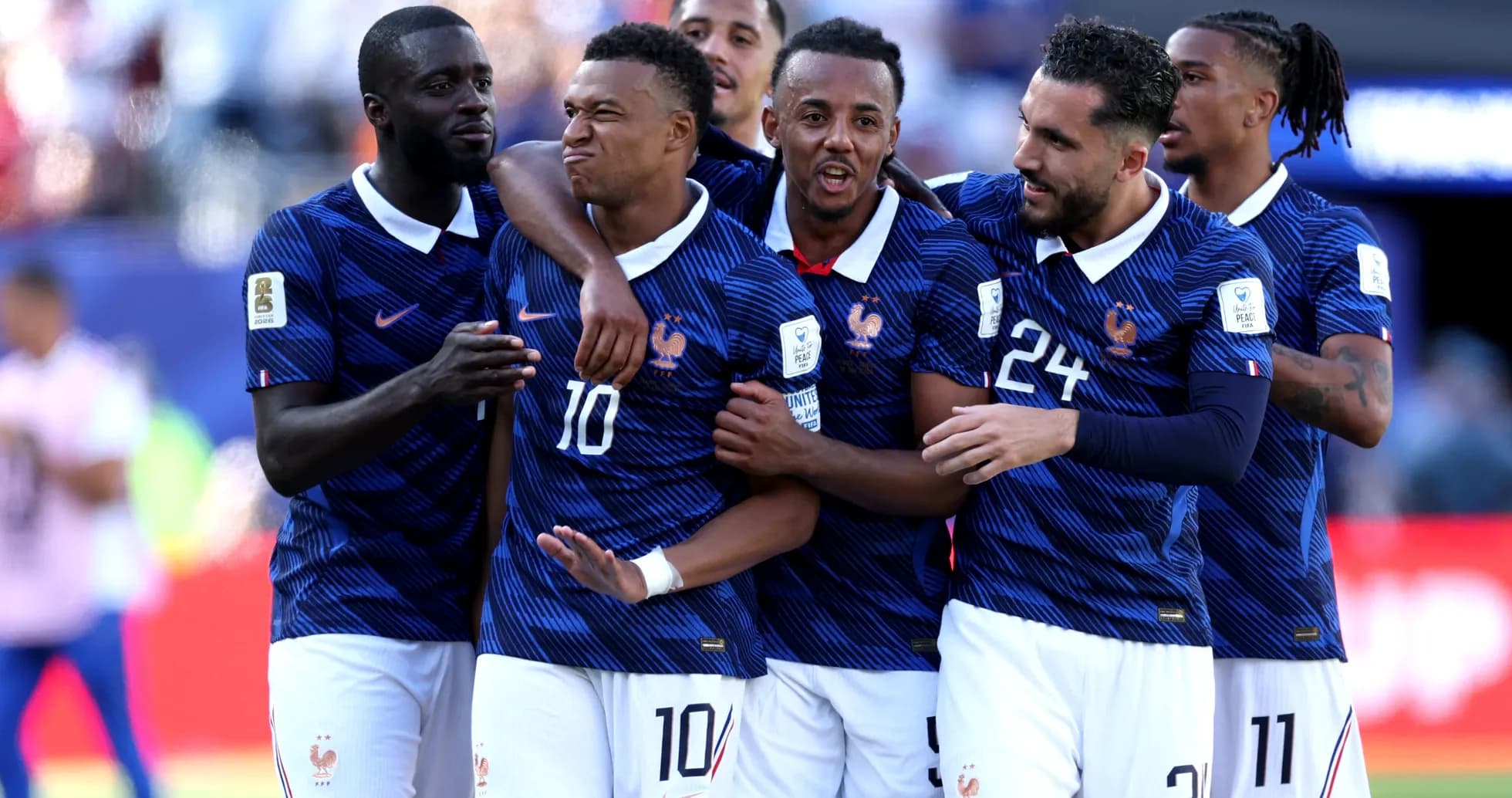
MetLife Stadium in East Rutherford hosted a meeting of contrasts: an established tournament heavyweight against a rising African power, both unveiling their World Cup 2026 identities in Group I. France, designated as the home side, emerged 3-1 winners over Senegal, a result that instantly shaped the group’s hierarchy. Following this result, France sit 2nd in Group I on 3 points with a goal difference of +2 (3 goals for, 1 against), while Senegal are 3rd with 0 points and a goal difference of -2 (1 goal for, 3 against).
I. The Big Picture – France’s controlled aggression vs Senegal’s vertical threat
Both coaches mirrored each other on the tactics board with a 4-2-3-1, but the systems carried very different personalities.
Didier Deschamps’ France lined up with a back four of J. Kounde, D. Upamecano, W. Saliba and T. Hernandez in front of M. Maignan. The double pivot of A. Tchouameni and A. Rabiot gave structure, while a fluid trio of M. Olise, O. Dembele and D. Doue worked behind K. Mbappe as the lone forward. It was a side built to dominate territory and create repeated one‑v‑one situations for its wide players, with Mbappe as the spearhead.
On their travels, Senegal under Bouna Thiaw Pape also set up in a 4-2-3-1, with E. Mendy behind a defence of K. Diatta, K. Koulibaly, M. Niakhate and M. Diouf. The midfield axis of I. Gueye and P. Gueye was tasked with screening, while I. Sarr, L. Camara and S. Mane supported N. Jackson. This XI was designed to compress space, then explode forward through Sarr and Mane once possession was turned over.
Heading into this game, the broader season numbers underlined the contrast. Overall this campaign, France have played 1 match, winning 1, scoring 3 and conceding 1. At home, that single outing has yielded 3 goals for and 1 against, an average of 3.0 goals scored and 1.0 conceded per home match. Senegal, by contrast, have played 1 match away, losing it 3-1; on their travels they average 1.0 goal scored and 3.0 conceded. The scoreline in East Rutherford aligned almost perfectly with those early statistical signatures.
II. Tactical Voids – What was missing, and how discipline shaped the tone
There were no listed absentees for either side in the data, which meant both coaches were close to full strength and could lean into their preferred 4-2-3-1 structures. With no suspensions or injuries flagged, there were no obvious tactical voids forced by circumstance; any gaps were by design rather than necessity.
From a disciplinary perspective, the season statistics show no yellow or red card patterns yet for either team – every time segment from 0-15 to 76-90 minutes is blank. That absence of card data suggests this France side have not yet been stretched into reckless challenges, while Senegal’s aggression has not translated into notable disciplinary issues either. In this match, that meant both could press and counter-press without the shadow of accumulated suspensions or a reputation for late-game indiscipline.
Crucially, neither team has taken a penalty in the competition so far. France’s penalty record shows 0 taken, 0 scored, 0 missed; Senegal’s is identical. There is no evidence yet of either side leaning on spot-kicks as a scoring crutch, nor of any costly misses under pressure.
III. Key Matchups – Hunter vs Shield, and the battle for the engine room
Hunter vs Shield was defined by K. Mbappe’s cutting edge against a Senegal defence anchored by K. Koulibaly and M. Niakhate. Mbappe arrives in this World Cup as one of its early headline acts. In total this campaign, he has played 90 minutes, scored 2 goals from 4 shots (all 4 on target), with an 8.2 rating. His output is ruthless: 2 goals from 4 attempts, backed by 93% passing accuracy in just 16 passes, and 6 dribble attempts. He is not just a finisher but a volume threat who forces defensive lines to retreat.
Senegal’s back line, however, has already been breached 3 times in 1 away match, conceding 3.0 goals on average on their travels. The 3-1 defeat that defines their away record so far underlines a vulnerability when defending sustained pressure. Koulibaly and Niakhate are strong in duels, but the collective record – 3 goals conceded in 1 away outing – shows that the shield is still calibrating against top-tier attacking talent.
France’s supporting cast around Mbappe deepens the threat. B. Barcola, coming from the bench, has already scored 1 goal in 10 minutes of action, with 1 shot on target, 7 passes at 85% accuracy and 2 successful duels out of 3. He offers Deschamps a late-game change of angle: fresh pace and direct running against tiring full-backs. For Senegal, I. Mbaye has been a bright spark in limited minutes – 1 goal from 1 shot on target, 8 passes at 87% accuracy and 1 successful dribble in just 15 minutes. He gives Bouna Thiaw Pape a dynamic option to stretch defences when chasing the game.
In the engine room, the confrontation is more nuanced. A. Tchouameni and A. Rabiot form a balanced French double pivot: Tchouameni as the positional anchor, Rabiot as the connector who steps into higher lines. Their job is to suffocate the spaces where S. Mane and I. Sarr thrive. On the other side, I. Gueye and P. Gueye must simultaneously track Mbappe’s movements between the lines and prevent O. Dembele and M. Olise from receiving on the half-turn.
Senegal’s most creative spark statistically has been I. Ndiaye. In total this campaign he has 1 assist in 17 minutes, 10 passes at 90% accuracy and 1 key pass, plus an interception that hints at his work rate without the ball. His introduction from the bench changes the rhythm of Senegal’s attacks, adding a link player between midfield and the front line. How France’s pivot reacts to Ndiaye’s arrival – whether Tchouameni steps out or the back four squeezes – will often decide whether Senegal can sustain pressure or are forced into hopeful, direct balls.
IV. Statistical Prognosis – France in control, Senegal dangerous in transition
Following this result, the statistical picture is clear. Overall, France average 3.0 goals scored and 1.0 conceded per match, with 1 win from 1. Their biggest win so far is exactly this 3-1 scoreline. They have yet to keep a clean sheet, but they have also never failed to score. The profile is of a side that will trade the occasional concession for overwhelming attacking volume.
Senegal, overall, average 1.0 goal scored and 3.0 conceded, with 1 loss from 1 on their travels. They have not yet been shut out, but their defensive record – 3 goals conceded in a single away match – is a concern against elite opposition. Their biggest defeat is that same 3-1, underlining a pattern: they can hurt teams in moments, but struggle to control 90 minutes.
Without xG values, the eye test of the data still points in one direction. France create and convert at a higher rate, with Mbappe already on 2 goals and Barcola offering impact from the bench. Senegal’s best hope lies in compressing central spaces, surviving the first wave, and then leveraging the vertical running of Sarr, Mane and the late introductions of Ndiaye and Mbaye.
The tactical balance of this matchup, as revealed by the early tournament numbers, favours France’s structured aggression over Senegal’s intermittent surges. If the pattern of 3.0 goals scored vs 3.0 conceded on Senegal’s travels holds, every prolonged spell of French possession will feel like a test of how long the Senegalese shield can resist the hunter’s relentless pressure.