France Dominates Senegal 3-1 with Tactical Mastery
France’s 3-1 win over Senegal at MetLife Stadium unfolded as a controlled, system-driven performance from Didier Deschamps’ side, built on their 4-2-3-1 structure and a clear superiority in shot quality and territorial control. While the scoreline stretched late, the tactical story is one of France gradually tightening their grip on the game before decisive second-half interventions from Kylian Mbappé and the bench.
Both teams mirrored each other in formation, but not in usage. France’s 4-2-3-1 was possession-oriented and vertically aggressive, while Senegal’s version was more transitional, looking to spring forward through Sadio Mané and Ismaïla Sarr from a compact base.
In build-up, France used Aurélien Tchouaméni and Adrien Rabiot as a double pivot to create a 2-4 base with the centre-backs Dayot Upamecano and William Saliba. Theo Hernández provided consistent width and high positioning on the left, with Jules Koundé more conservative on the right, forming an asymmetrical back three in possession. This allowed Michael Olise and Ousmane Dembélé to drift into half-spaces, leaving the wide channels to the full-backs and opening central lanes for Mbappé.
The underlying numbers underline France’s territorial control: 53% possession, 575 passes with 505 accurate (88%), and 11 total shots, 8 of them on goal. The shot map profile is particularly telling: 7 shots inside the box against only 4 from outside, reflecting a clear emphasis on working high-value chances rather than speculative efforts. Their xG of 1.79 matches the eye test of a side repeatedly getting into dangerous central positions between Senegal’s lines.
Senegal, also nominally in a 4-2-3-1, defended deeper and narrower. Kalidou Koulibaly and Moussa Niakhaté anchored a compact back line, with the double pivot of Idrissa Gana Gueye and Pape Gueye tasked with screening Mbappé’s drops and Olise’s interior movements. In possession, however, Senegal were more direct: 502 passes (430 accurate, 86%) but only 6 shots total, with just 2 on goal and an xG of 0.53. That gap in shot volume and quality reflects how rarely they could sustain pressure in the French half.
France’s pressing was selective rather than frantic. The relatively low foul count (5) shows they controlled transitions without resorting to constant tactical fouling, relying instead on the athleticism and anticipation of Upamecano and Saliba to win duels early. When they did lose the ball, Tchouaméni and Rabiot were quick to collapse centrally, forcing Senegal wide and away from Nicolas Jackson’s preferred channels.
First Half
The first half, which finished 0-0, was a chess match of structure. France circulated the ball well, but Senegal’s compact 4-4-2 out-of-possession shape (with Mané stepping up alongside Jackson) closed central lanes and forced France to recycle. The lack of cards and relatively low foul count from both sides (Senegal committed 9) underlined a disciplined, controlled contest rather than a chaotic one.
Second Half
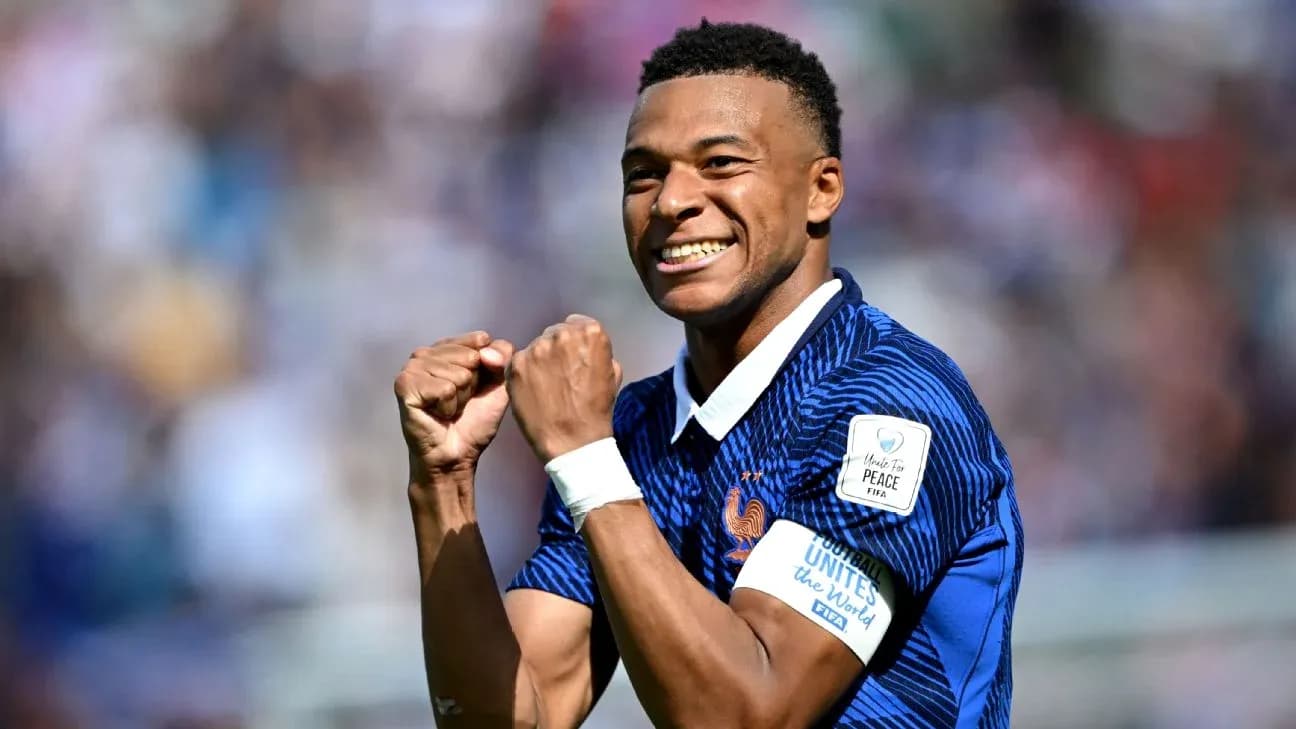
The game’s tactical hinge came around the hour mark. At 60', a VAR intervention cancelled a potential France penalty involving Mbappé, but the incident signalled that France were starting to break Senegal’s lines with more frequency. Six minutes later, Mbappé finally punished the stretched block: his goal at 66', assisted by Michael Olise, was the product of France’s positional play working as designed—Olise finding a pocket, Mbappé attacking space with timing and precision.
From there, Deschamps leaned into his bench to add fresh verticality. At 80', Bradley Barcola (IN) came on for Ousmane Dembélé (OUT), injecting direct running and 1v1 threat against a tiring Senegal back line. The impact was immediate. In the 82nd minute, Barcola scored France’s second, finishing a move assisted by Rabiot. The pattern reflected France’s attacking principles: the double pivot recycling, full-backs providing width, and the substitute winger attacking the space between full-back and centre-back.
On the opposite bench, Bouna Thiaw Pape sought to rebalance the game with a flurry of changes: Ibrahim Mbaye (IN) for Ismaïla Sarr (OUT) at 75', Habib Diarra (IN) for Lamine Camara (OUT) at 76', Ahmadou Bamba Dieng (IN) for Nicolas Jackson (OUT) and Iliman Ndiaye (IN) for Pape Gueye (OUT) both at 83', then Pathé Ismaël Ciss (IN) for Idrissa Gana Gueye (OUT) at 88'. The pattern was clear: more attacking profiles and fresh legs to chase the game. These substitutions did eventually yield a goal—Mbaye scoring in added time—but only after France had already taken a decisive 3-0 lead.
France’s third goal, Mbappé’s second at 90+6', came in a phase where Senegal had committed more bodies forward. With structure loosened and spaces appearing in transition, Mbappé exploited the stretched field to seal the result. Senegal’s consolation arrived at 90+5', when Ibrahim Mbaye, assisted by Iliman Ndiaye, converted one of the few clean attacking moments Senegal managed to construct, reflecting the slight late-game shift in momentum as France briefly relaxed their defensive block.
In goal, Mike Maignan (France) had a relatively controlled evening, facing only 2 shots on goal and making 2 saves. The modest workload reflects France’s strong defensive structure more than any lack of threat from Senegal’s individuals. At the other end, Edouard Mendy (Senegal) was far busier, registering 5 saves against 8 French shots on target. The negative goals prevented values for both teams’ statistics underline that the finishing outstripped the underlying xG at both ends, but the volume and quality of France’s chances meant the scoreline aligned more closely with their attacking dominance.
Statistically, the verdict is clear. France’s 3-1 win is supported by superior xG (1.79 vs 0.53), more shots (11 vs 6), more shots on goal (8 vs 2), and a small but meaningful edge in possession and passing accuracy. Their 6 corner kicks to Senegal’s 4 further illustrate sustained territorial pressure. Senegal’s 9 fouls to France’s 5 show a side increasingly forced into reactive defending as they tried to disrupt France’s rhythm.
Tactically, France’s 4-2-3-1 proved more cohesive and multi-layered, with clear roles in each line and effective use of substitutions to maintain intensity. Senegal’s mirror system lacked the same connectivity between midfield and attack, relying heavily on individual transitions rather than sustained positional play. In the context of a World Cup group-stage opener, this was a statement of control and structural maturity from Deschamps’ team.