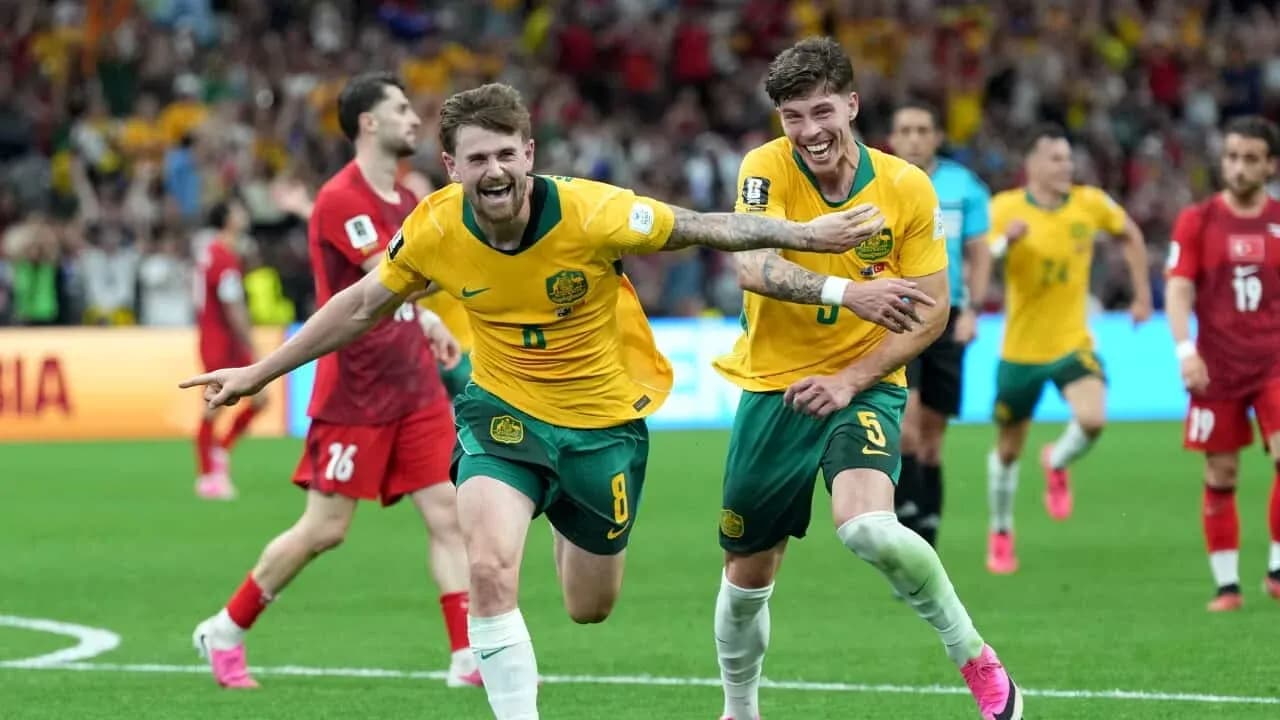
Australia's Tactical Triumph Over Türkiye in World Cup Opener
Under the closed roof of BC Place in Vancouver, Australia’s 2–0 win over Türkiye felt less like an upset and more like the unveiling of a new tournament identity. Heading into this game, both sides were statistical blank slates at World Cup level, but the 90 minutes under Jesús Valenzuela’s supervision have already redrawn the contours of Group D.
Australia leave Matchday 1 with 3 points, a goal difference of +2 (2 scored, 0 conceded) and a clear stylistic imprint. Their overall record now stands at 1 win from 1, with all of their goals and their clean sheet coming at home in this fixture. Türkiye, by contrast, open their campaign with 0 points, a goal difference of -2 (0 scored, 2 conceded overall, both away), and the uncomfortable feeling that their technical talent has been dulled by structural imbalances.
I. The Big Picture: Shapes, Structure, and Territorial Truth
Tony Popovic’s choice of a 5-4-1 was not a retreat; it was a platform. With Patrick Beach behind a back five of Jacob Italiano, Alessandro Circati, Harry Souttar, Cameron Burgess and Jordan Bos, Australia built a tall, physically imposing wall that Türkiye’s 4-2-3-1 found difficult to disorganise.
The Socceroos’ season statistics, even at this early stage, underline the clarity of that approach. At home they average 2.0 goals for and 0.0 goals against, with 1 clean sheet from 1 and no failures to score. Their biggest home result so far is this exact 2-0, and the lineup data confirms Popovic’s commitment: the 5-4-1 has been used in 1 of 1 matches.
Vincenzo Montella’s Türkiye mirrored their qualifying blueprint with a 4-2-3-1: Uğurcan Çakır in goal; a back four of Zeki Çelik, Merih Demiral, Abdülkerim Bardakcı and Ferdi Kadıoğlu; a double pivot of İsmail Yüksek and Hakan Çalhanoğlu; and an advanced band of Arda Güler, Orkun Kökçü and Barış Alper Yılmaz behind Kerem Aktürkoğlu. On paper, it is a shape designed for territorial dominance and fluid occupation of the half-spaces. In practice, against this Australian block, it too often became sterile circulation in front of a set defence.
Statistically, Türkiye’s away profile after this match is stark: on their travels they average 0.0 goals for and 2.0 goals against, with 0 clean sheets and 1 failure to score. Their biggest away loss is this 2-0; their only formation used so far is the 4-2-3-1.
II. Tactical Voids and Disciplinary Undercurrents
There are no recorded absentees in the data, so this was close to full-strength against full-strength. The tactical voids, therefore, were structural rather than personnel-based.
For Australia, the main risk area remains the potential isolation of Mohamed Touré as the lone forward. In a 5-4-1, the single striker can easily be marooned, but Popovic mitigated that by pushing Nestory Irankunda and Paul Okon-Engstler high and narrow from the midfield line, turning the shape into a 3-4-3 in possession. The numbers support their influence: Irankunda, already among the top scorers, has 1 goal from 2 shots (both on target), while Okon-Engstler, among the top assist providers, has 1 assist, 32 passes at 81% accuracy, and 2 key passes. His 3 tackles, 2 successful blocks and 3 interceptions underline how much defensive work he folded into his creative role.
For Türkiye, the biggest tactical void was the lack of vertical connection from the double pivot into the advanced midfielders. Çalhanoğlu and Yüksek found themselves playing in front of Australia’s midfield line rather than between lines, forcing Güler and Kökçü to drop deeper and diluting the threat around the box.
Disciplinary patterns hint at late frustration. Türkiye’s season card data shows that 100.00% of their yellow cards so far have arrived in the 76-90 minute window, a clear late-game surge of irritation rather than early-game aggression. Yunus Akgün embodies this: in 35 minutes off the bench he committed 1 foul, drew contact, and picked up 1 yellow card. He appears in both the top yellow and top red card lists, but crucially he has no red card; that duplication reflects listing logic, not an expulsion. Australia, by contrast, have no yellow or red cards recorded in any minute range, suggesting a controlled defensive performance rather than a desperate one.
III. Key Matchups: Hunter vs Shield, Engine Room vs Enforcer
The “Hunter vs Shield” duel in this match was less about a single striker and more about Australia’s emergent attacking trio against Türkiye’s central defence. Touré’s role was to occupy Demiral and Bardakcı, allowing Irankunda to knife in from midfield and Okon-Engstler to arrive late. With Australia’s home goals-for average at 2.0 and Türkiye’s away goals-against average at 2.0, the data pointed toward exactly the kind of two-goal margin that unfolded.
On the other side, Türkiye’s offensive talent ran into Australia’s shield: Souttar and Burgess as the aerial sentries, Circati as the cover defender, and Italiano and Bos stepping out aggressively to meet wide threats. The absence of any goals conceded overall (0.0 goals against on their travels and at home combined) and the clean sheet total of 1 underline how well that unit functioned.
In the “Engine Room” battle, Okon-Engstler’s duel with Türkiye’s double pivot was decisive. His 8 duels with 4 won, plus those 3 tackles and 2 blocked shots, meant that Çalhanoğlu and Yüksek were repeatedly forced sideways. For Türkiye, the enforcer role was shared; no single midfielder emerges from the data with a standout defensive line, and that lack of a dominant ball-winner left their back four more exposed whenever Australia broke.
IV. Statistical Prognosis and Tactical Trajectories
Following this result, the statistical prognosis for both squads is sharply diverging. Australia’s overall numbers – 1 win from 1, 2.0 goals scored per match, 0.0 conceded, 1 clean sheet, 0 failures to score – describe a side whose defensive solidity gives their young creators a safe platform to take risks. The 5-4-1 is not a purely reactive shape; with Irankunda’s 1.00 goals per appearance so far and Okon-Engstler’s blend of pressing and playmaking, it becomes a springboard for vertical, direct football.
Türkiye’s overall picture – 1 loss from 1, 0.0 goals scored, 2.0 conceded, 0 clean sheets, 1 failure to score – warns of a team caught between its technical aspirations and its structural needs. The 4-2-3-1 will remain Montella’s default, but the data and the eye test both argue for a more assertive ball-winner in midfield and clearer patterns to get Güler and Kökçü receiving between the lines rather than in front of the block.
In a tournament where small samples quickly harden into narratives, Australia emerge from BC Place as a side with a defined defensive identity and two breakout midfielders already shaping the World Cup’s early story. Türkiye, meanwhile, must turn possession into penetration, and do it quickly, before their promising squad becomes another case study in unfulfilled potential.