World Cup 2026: Iran Faces Protests and Politics in Los Angeles
The World Cup has seen turmoil before. It has never seen this.
In Los Angeles tonight, Iran open their 2026 campaign against New Zealand with a war raging between their country and the host nation, protesters promising to “make it hell”, and a head coach reportedly under orders from his own government to stop the match if dissent spills too loudly from the stands.
This is football on a fault line.
Taremi’s warning: “The tension undermines the joy”
Iran captain Mehdi Taremi did not try to dress it up. Their build-up has been chaotic, their mood heavy.
Visa problems have dogged members of the delegation. Travelling fans have seen match tickets stripped away. The team have been forced to move their base to Mexico rather than stay in the United States. All of it framed by the reality that this is the first World Cup in which a host nation is at war with one of the participants.
“I have felt the tension from the first moment we arrived at this World Cup,” Taremi said. “This kind of tension, it undermines that joy and it undermines the message of Fifa and our people, which is that football brings about peace. I feel like this World Cup could have provided a better atmosphere than it has.”
For a player whose job is to live in the penalty area, he suddenly finds himself at the centre of something far larger than a group-stage opener.
“We’re going to make it hell”
Outside the camp, anger is boiling.
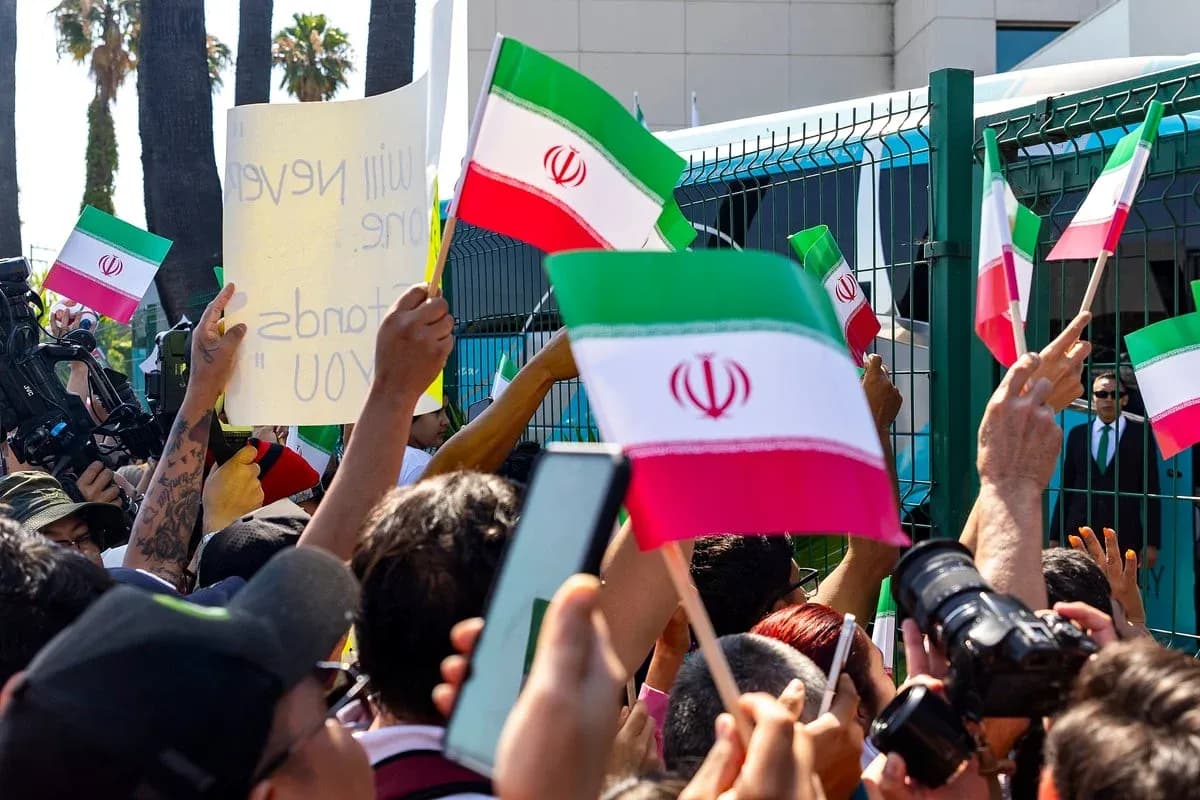
Iranian protesters, many of them part of the diaspora in California, have vowed to turn SoFi Stadium into a stage of defiance against the regime in Tehran. Their plan is clear: boo the anthem, turn their backs, and reveal pre-revolutionary flags that Fifa have banned from stadiums.
“We’re going to make it hell,” one activist told the Daily Mail, outlining how buses would roll in from San Diego, Orange County and cities across Los Angeles. The intention is to drown out the anthem, to ensure the old flag – not the current one – dominates the television pictures.
“I know Fifa banned it [the flag] but we will make a way to get it in. So we're going to see this flag, not the terrorist regime’s flag.”
For Iran’s players, that means stepping into an arena where their own compatriots will be jeering the symbols under which they play.
The coach caught in the middle
In the eye of the storm stands Amir Ghalenoei.
The Iran head coach has been given explicit instructions from the government to halt the match if pre-revolutionary flags are brandished or if negative chanting against the regime is clearly audible. It is a surreal prospect: a World Cup game stopped not for a VAR check or a medical emergency, but for political dissent echoing from the seats.
Ghalenoei tried to push all of that to the margins when he spoke on Friday.
“We don’t pay attention to any of the hype and anything that goes on around us,” he said. “We are here to represent the respectful people of Iran, be it the Iranians inside Iran or the Iranian diaspora.
“We are not political people... football is separate from politics.”
The words are familiar. The reality is not. In Los Angeles, the line between football and politics is not just blurred; it is being dragged across the pitch.
A World Cup first – and a campaign on the brink
Kieran Jackson has already called it what it is: the most surreal and perilous World Cup campaign in the tournament’s 96-year history.
Never before has a host been at war with a competing nation. Never before has a coach arrived at a World Cup with instructions that could see him try to stop a game if the crowd turns on his government. Tonight’s match against New Zealand could, in theory, be broken apart by a chorus of boos or a sea of forbidden flags.
Inside SoFi Stadium, Fifa will cling to its preferred script of unity, diversity and football as a bridge. Outside, protesters will try to torch that narrative in full view of the world.
On the pitch, 22 players will attempt to play a football match. Off it, Iran’s team walk into a contest that may say far more about a nation’s fracture lines than its finishing. The whistle in Los Angeles will not just start a game; it will test how much strain a World Cup can take before it cracks.