USA Dominates Paraguay 4-1 in World Cup Opener
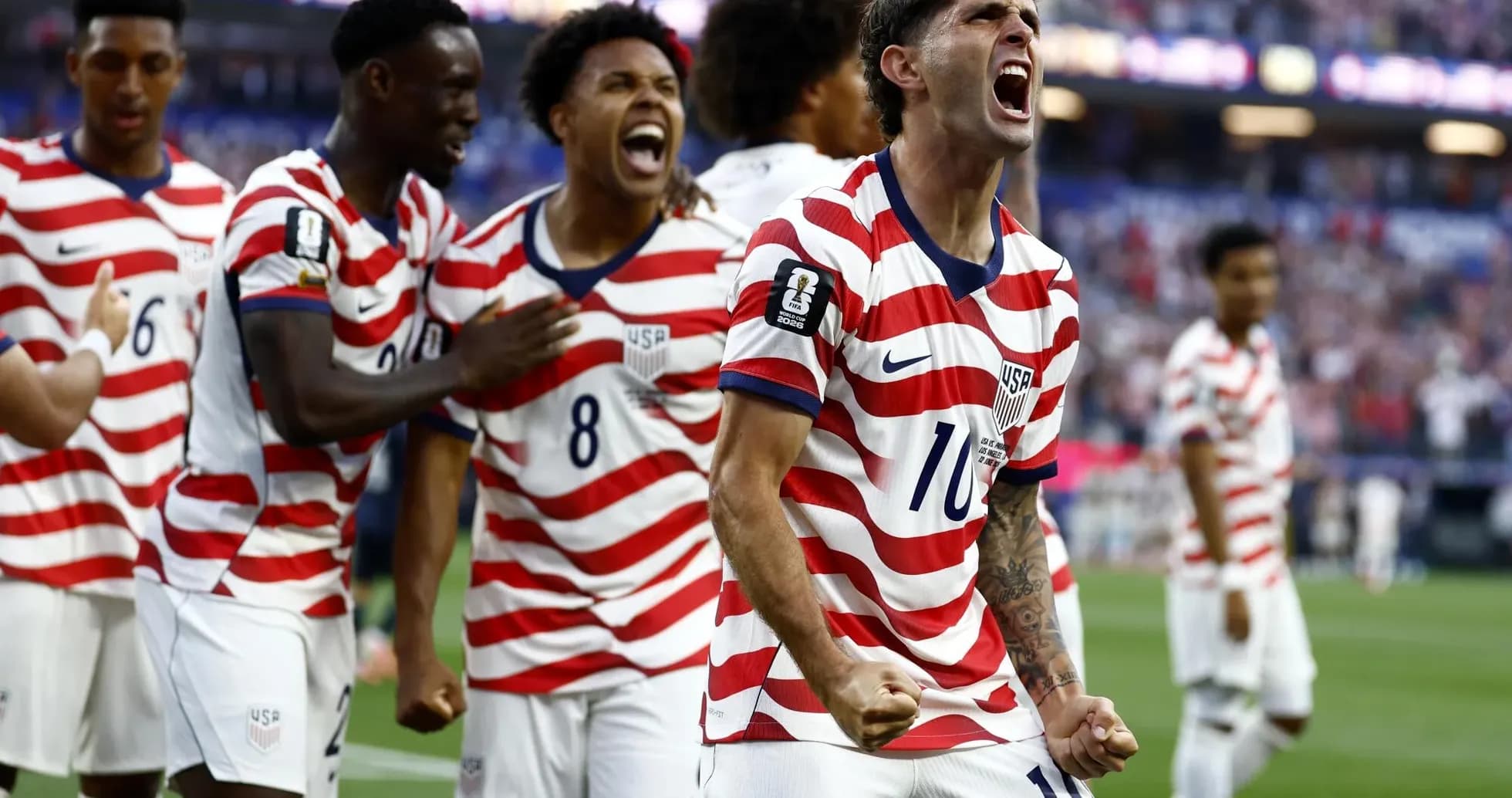
USA’s 4-1 win over Paraguay at SoFi Stadium was built on structural control and a clear superiority between the lines. Mauricio Pochettino’s 4-2-3-1 dominated the ball (65% possession), pinned Paraguay’s 4-4-2 deep for long stretches, and translated territorial pressure into a 3-0 half-time lead that effectively decided the World Cup group-stage opener.
Paraguay’s Gustavo Alfaro set up in a compact, line-of-four midfield intended to protect the central lane, but USA’s rotations around Tyler Adams and Malik Tillman consistently pulled that block apart. With 596 total passes to Paraguay’s 320 and a much higher accuracy (508 accurate at 85% versus 230 at 72%), USA controlled tempo, field position, and the rhythm of transitions.
I. Tactical structure and buildup
In possession, USA’s 4-2-3-1 behaved like a 2-3-5 in settled attacks. Full-backs Alexander Freeman and Antonee Robinson pushed high, with Adams dropping between or alongside centre-backs Chris Richards and Tim Ream to form the first line of buildup. This gave USA a stable 3v2 or 4v2 advantage against Paraguay’s front pair of Antonio Sanabria and Julio Enciso, allowing clean progression through the thirds.
Malik Tillman operated as the more advanced pivot, often stepping beyond Paraguay’s first midfield line to receive on the half-turn. Ahead of him, the trio of Sergiño Dest, Weston McKennie, and Christian Pulišić constantly interchanged, dragging Paraguay’s flat midfield out of shape. Pulišić, nominally from the left, frequently moved inside to the left half-space, forcing right-back Juan Cáceres and right midfielder Damián Bobadilla into difficult handovers. That overload helped create the pressure that led to the early own goal at 7', setting the tone for USA’s territorial dominance.
Paraguay tried to maintain a narrow 4-4-2 mid-block, with Andrés Cubas screening in front of Gustavo Gómez and Omar Alderete. But with only 35% possession and just 320 passes, they struggled to get pressure on the ball high enough. USA’s centre-backs were rarely rushed, and Adams had time to dictate distribution, switching play and feeding full-backs early to stretch the block.
II. Final-third patterns and chance creation
The shot profile underlines USA’s territorial control: 16 total shots to Paraguay’s 9, with USA taking 13 shots inside the box. The home side combined patiently around the area before accelerating with vertical runs from Folarin Balogun and late box arrivals from McKennie.
Balogun was central to the attacking plan. His constant movement across the front line prevented Paraguay’s centre-backs from setting a stable line. The disallowed goal at 28' (ruled out by VAR for offside) was an early warning of the spaces USA were finding between and behind Gómez and Alderete. Just three minutes later, the same dynamic produced the 31' goal: Balogun finishing from a Pulišić assist after another incisive combination.
The 45+5' strike, again from Balogun, this time assisted by Tillman, showcased USA’s ability to sustain pressure into added time. With Paraguay pinned deep, second balls around the box were consistently recovered by Adams and Tillman, allowing repeated waves of attack. USA’s 3 corner kicks to Paraguay’s 1 reflected that sustained field tilt.
In the second half, Pochettino adjusted the attacking structure through substitutions rather than shape. At 46', Sebastian Berhalter replaced Pulišić, with USA protecting the lead while maintaining central control. Later, at 72', Tim Weah and Ricardo Pepi came on for Dest and Balogun, refreshing the front line without altering the fundamental 4-2-3-1. The late 90+8' goal from Giovanni Reyna, assisted by Freeman, was emblematic: USA still had the legs and structure to push full-backs high and find the extra man in wide channels even in stoppage time.
III. Paraguay’s approach and attacking limitations
Paraguay’s 4-4-2 never truly settled as an attacking platform. With only 9 total shots and just 1 on goal, their threat was sporadic. They relied heavily on transitions and individual quality from Miguel Almirón and Enciso rather than sustained possession.
The introduction of Mauricio at 46' for Bobadilla slightly improved their attacking clarity, and Paraguay’s best moment came at 73', when Mauricio scored from an Enciso assist. That move reflected a more direct, vertical approach, using Enciso’s mobility to exploit the channels. Subsequent attacking substitutions — Alex Arce for Sanabria at 62' and Ramón Sosa for Almirón at 79' — were attempts to inject pace and physicality, but USA’s defensive structure in a settled 4-4-2 block (with wide players tracking back) limited clear entries into the box; Paraguay managed only 4 shots inside the area.
Paraguay’s 5 blocked shots indicate that when they did get into shooting positions, USA’s back line and midfield screen were quick to step out and contest. Ream and Richards held a relatively high line, trusting Adams to cut off passing lanes and Robinson to cover depth on the left.
IV. Defensive organisation and discipline
USA’s defensive game was built on proactive positioning rather than last-ditch interventions. They conceded only 1 shot on target and 0.51 xG, a product of controlling where Paraguay could shoot from (5 attempts from outside the box). The back four stayed compact, with Freeman and Robinson narrowing in when the ball was central, forcing Paraguay wide and into less dangerous crossing situations.
Paraguay, by contrast, defended more reactively and increasingly desperately. Their 17 fouls to USA’s 13 and 5 yellow cards to USA’s 1 tell the story of a side consistently late to duels. Cards for Cáceres (Tripping at 10'), Almirón (Diving at 53'), Diego Gómez (Holding at 79'), Arce (Roughing at 88'), and Junior Alonso (Holding at 90+3') illustrated both structural strain and frustration as they chased the game.
USA’s only booking, Tyler Adams for Roughing at 59', came as Paraguay briefly gained momentum after Mauricio’s goal. Yet even in that phase, USA’s midfield line held, preventing sustained pressure on the back four.
V. Statistical verdict and game-state management
The underlying numbers reinforce the tactical picture. USA’s 1.27 xG versus Paraguay’s 0.51 suggests the scoreline slightly overperformed the underlying chance quality but remained directionally accurate given the shot volume and territorial control. Both goalkeepers’ raw shot-facing numbers were low — USA allowed just 1 shot on goal, Paraguay 6 — reflecting how effectively USA controlled space and how little Paraguay could disrupt USA’s buildup.
USA’s 85% pass completion and 596 passes speak to a side comfortable circulating the ball, resetting attacks, and managing game states once ahead. Paraguay’s 72% over 320 passes is typical of a team forced into more direct, lower-percentage balls under pressure.
Overall, USA’s 4-2-3-1 offered superior connections between lines, more varied final-third patterns, and greater control of transition moments. Paraguay’s 4-4-2, while disciplined in theory, lacked the pressing cohesion and on-ball quality to disrupt that structure, leaving them largely chasing shadows in a tactically one-sided group-stage opener.