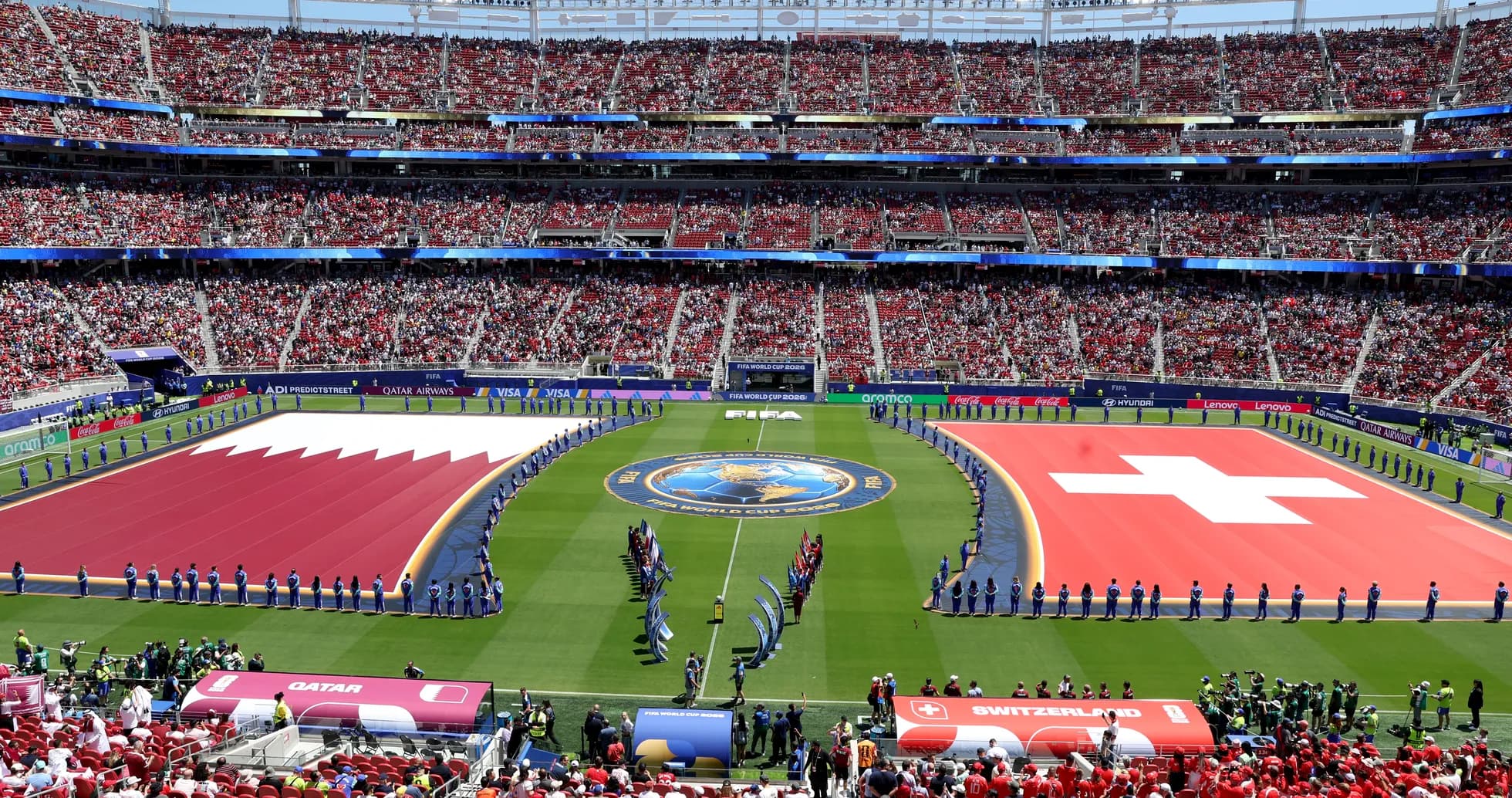
Qatar Holds Switzerland to 1-1 Draw: Tactical Analysis
Qatar’s 1-1 draw with Switzerland at Levi's Stadium was a classic example of defensive resilience and opportunistic attacking against a far more dominant territorial and shooting side. Switzerland controlled the game structurally, but Qatar, under Julen Lopetegui, maximised a compact 4-3-3 block and late-game adjustments to steal a point in Group Stage - 1 of the World Cup.
Switzerland’s 4-3-3, built around Granit Xhaka as the central organiser, delivered exactly the profile the numbers suggest: 68% possession, 575 passes with 522 accurate (91%), and a huge 26 shots. The Swiss shape was very positional: Ricardo Rodríguez advanced from left-back to create a back three in build-up with Manuel Akanji and Nico Elvedi, allowing Denis Zakaria to push higher on the right and Michel Aebischer to occupy the right half-space. Remo Freuler supported circulation from the left interior channel, helping Xhaka to keep the ball moving and pin Qatar deep.
Qatar’s 4-3-3 was much more conservative, almost a 4-5-1 without the ball. Pedro Miguel and Boualem Khoukhi stayed narrow to protect the central lane in front of Mahmud Abunad, with Homam Al-Amin more reserved than a typical attacking full-back. In midfield, Assim Madibo and Jassem Gaber Abdulsallam worked horizontally to screen Xhaka and cut passing lanes into Breel Embolo’s feet. The front three, led by Akram Afif, initially pressed in short bursts but mostly dropped to form two compact banks, conceding wide areas and trusting central density.
Penalty Sequence
The game’s early tactical hinge came with Switzerland’s penalty sequence. At 16', a VAR check confirmed a penalty for Switzerland, and at 17' Embolo converted. From a tactical lens, this rewarded Switzerland’s insistence on attacking the inside channels: Embolo repeatedly dropped between Qatar’s lines, dragging centre-backs out and creating space for Rubén Vargas and Dan Ndoye to attack. Once ahead, Switzerland could further slow and stretch Qatar, forcing them into long defensive phases.
Yet, despite the volume of Swiss pressure, Qatar’s low block functioned with discipline. Switzerland generated 18 shots inside the box, but many came from crowded situations where Qatar’s central defenders and midfielders collapsed around the ball. The blocked shots tally (9 for Switzerland, 0 for Qatar) underlines how often Swiss attempts were smothered by Qatari bodies rather than cleanly struck. Qatar accepted territorial inferiority (32% possession, 275 passes, 196 accurate at 71%) to preserve central compactness.
The key individual defensive performance came from Mahmud Abunad (Qatar). He made 5 saves and, crucially, his goals prevented figure of 0.43, against Switzerland’s xG of 3.24, shows how much he overperformed expectation. Switzerland repeatedly engineered good-quality chances, but Abunad’s positioning and reactions kept Qatar alive. On the other side, Gregor Kobel (Switzerland) faced far less volume — just 4 shots on goal — making 3 saves, with Qatar’s xG at only 0.76. Structurally, Switzerland’s back four and pressing prevented Qatar from creating sustained pressure until very late.
Substitutions and Tactical Changes
Lopetegui’s substitutions at 60' were a clear tactical pivot. Three changes in one window — Ahmed Alaaeldin (IN) came on for Yusuf Abdurisag (OUT), Karim Boudiaf (IN) came on for Jassem Gaber Abdulsallam (OUT), and Ahmed Fathi (IN) came on for Ayoub Al Oui (OUT) — re-energised Qatar’s midfield and right side. Boudiaf added more physicality and ball-winning in the centre, allowing Qatar to step a few metres higher and contest second balls more aggressively. Alaaeldin provided fresher legs to run in behind and hold up occasional clearances, giving Afif a partner to combine with rather than operating in isolation.
Murat Yakin responded at 65' with a double change: Johan Manzambi (IN) came on for Dan Ndoye (OUT) and Fabian Rieder (IN) came on for Michel Aebischer (OUT). The idea was to refresh the wide and midfield lines while maintaining the same structural dominance. However, as the game moved into its final quarter, Qatar’s risk profile increased. At 79', Mohamed Naceur Almanai (IN) came on for Assim Madibo (OUT), trading some defensive stability for more legs and forward thrust from midfield. Switzerland answered with Zeki Amdouni (IN) for Rubén Vargas (OUT), keeping a direct threat in the front line.
The decisive tactical swing arrived in the final minutes. At 88', Hassan Al Haydos (IN) came on for Edmilson Junior (OUT), adding fresh creativity and set-piece threat for Qatar. Switzerland, perhaps thinking more about game management, introduced Miro Muheim (IN) for Ricardo Rodríguez (OUT) and Ardon Jashari (IN) for Remo Freuler (OUT) at 89', slightly disrupting their established rhythm in the left channel and midfield control.
Equaliser
Qatar’s equaliser at 90+4' encapsulated their late-game shift. After spending most of the match in a reactive posture, they committed more men forward in the final moments, and from a rare advanced sequence Homam Al-Amin delivered the assist for Boualem Khoukhi’s finish. It was a classic scenario of a team that had defended deep all game suddenly taking advantage of a brief lapse in concentration and structure from a dominant opponent.
Discipline and Statistics
Discipline played a subtle tactical role. Qatar collected two yellow cards — 16' Mahmud Abunad (Qatar) — Time wasting, and 23' Jassem Gaber Abdulsallam (Qatar) — Foul — reflecting both their defensive posture and attempts to slow the tempo. Switzerland’s single booking — 42' Denis Zakaria (Switzerland) — Foul — came from aggressive defending high, typical of their front-foot approach.
Statistically, the verdict is stark. Switzerland’s xG of 3.24 against Qatar’s 0.76, their 26-7 shot advantage, 10-3 in corners, and 575-275 pass dominance all point to a game they controlled and, on balance, should have won. Their defensive index was strong in terms of limiting clear Qatari chances; Qatar had just 5 shots inside the box compared to Switzerland’s 18. However, the combination of Abunad’s shot-stopping, Qatar’s central compactness, and late-game substitution impact produced a result that diverged sharply from the underlying numbers.
From a tactical perspective, Switzerland showed a clear, possession-heavy identity but lacked the ruthlessness to match their territorial superiority. Qatar, conversely, delivered a pragmatic, low-possession game plan, leaned heavily on their goalkeeper and defensive structure, and were rewarded for staying in the match long enough to capitalise on a late, well-executed attacking pattern.