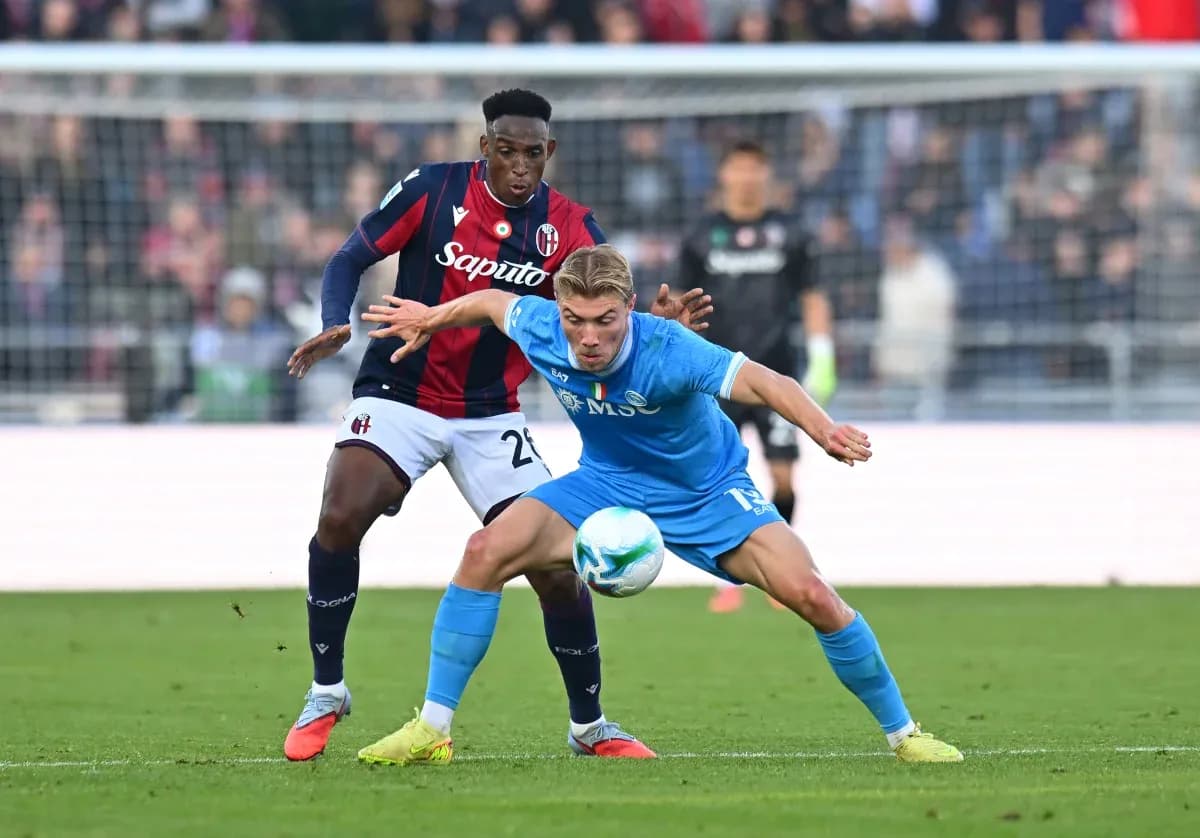
Napoli vs Bologna Tactical Analysis: A 3-2 Away Win
Napoli’s 3-4-2-1 against Bologna’s 4-3-3 at Stadio Diego Armando Maradona produced a tactically sharp away win that was more about control of key zones than volume of chances. Despite Napoli edging possession 52% to 48% and outshooting Bologna 14–10, the visitors managed the decisive moments better, aligning their structure with a more efficient attacking plan and a compact defensive block.
Napoli’s back three of G. Di Lorenzo, A. Rrahmani and A. Buongiorno were tasked with initiating play, but the build-up was often funneled through the right. Di Lorenzo, nominally the right-sided centre-back, repeatedly stepped out into full-back zones, with M. Politano high and wide as a traditional winger. This created a right-sided overload, but also left space behind for Bologna’s left flank to attack in transition. The early opener at 10' for Bologna – F. Bernardeschi finishing from a J. Miranda assist – was emblematic: Bologna’s 4-3-3 sprang quickly into those wide spaces once possession was won.
Midfield Dynamics
In midfield, S. Lobotka and S. McTominay formed the double pivot in front of the back three, with M. Gutierrez providing width on the left. Lobotka’s role was to recycle and stabilize (Napoli completed 484 passes, 425 accurate at 88%), but Bologna’s front three pressed selectively, screening central lanes and forcing Napoli into predictable wide circulation. Napoli’s 11 shots inside the box point to territorial dominance, yet their xG of 0.75 underlines that many of these were from crowded or suboptimal angles rather than clear-cut chances.
Bologna's Defensive Setup
Bologna’s 4-3-3 under Vincenzo Italiano was disciplined and vertically oriented. The back four of Joao Mario, E. Fauske Helland, J. Lucumi and J. Miranda stayed relatively narrow, conceding crosses but protecting the central corridor. In front of them, T. Pobega, R. Freuler and L. Ferguson formed a compact triangle that limited the space between the lines for Napoli’s front trio Giovane, Alisson Santos and R. Hojlund. Offensively, Bologna’s plan revolved around early progression into the front three and exploiting full-back channels. The penalty at 34', converted by R. Orsolini after VAR confirmed Juan Miranda’s involvement in the box at 33', came from precisely this pattern: a quick attack into wide space forcing a high-stakes defensive action.
Second Half Adjustments
Napoli’s attacking structure improved after the break. At 45', Di Lorenzo’s goal – stepping into the box from his right-centre-back role – reduced the deficit and reflected Conte’s intention for his wide centre-backs to be aggressive in the final third. The equaliser at 48' from Alisson Santos, assisted by R. Hojlund, showcased a more direct central combination: Hojlund dropping and linking, Santos attacking the channel between centre-back and full-back. This was Napoli at their most coherent, pinning Bologna back and turning possession into genuine penalty-box presence.
Yet Bologna’s defensive resilience, even while accumulating four yellow cards (João Mário, Federico Bernardeschi, Eivind Helland, Jhon Lucumí all booked for “Foul”), underpinned their ability to ride out this storm. They committed 12 fouls to Napoli’s 10, but these were largely tactical interruptions that broke Napoli’s rhythm at key moments rather than signs of disorder. Their back line allowed only 5 shots on target and forced Napoli into a low-yield shot profile relative to volume.
Substitutions and Tactical Shifts
The substitutions tilted the tactical balance again. For Bologna, the sequence between 64' and 82' was decisive: N. Zortea (IN) came on for Joao Mario (OUT), J. Rowe (IN) for F. Bernardeschi (OUT), then N. Moro (IN) for T. Pobega (OUT), S. Sohm (IN) for L. Ferguson (OUT), and T. Heggem (IN) for E. Fauske Helland (OUT). Italiano effectively refreshed all three midfield roles and both flanks of the back four. This injected energy into the press and restored the compactness that had frayed early in the second half. Rowe’s introduction in particular added direct running and vertical threat, culminating in his 90' winner: a classic late-transition goal, exploiting Napoli’s stretched shape as they chased the match.
Conte’s response for Napoli at 76' and beyond – E. Elmas (IN) for Giovane (OUT), B. Gilmour (IN) for S. Lobotka (OUT), then L. Spinazzola (IN) for M. Politano (OUT) at 85' and P. Mazzocchi (IN) for M. Gutierrez (OUT) at 87' – was aimed at refreshing the wide lanes and adding more progressive passing from deep. However, these changes also subtly altered the balance: removing Lobotka reduced Napoli’s control in the first phase of build-up, and the later full-back-style introductions pushed the wing-backs very high, leaving the back three more exposed to counters. When J. Rowe struck at 90', it was the logical consequence of Bologna repeatedly finding space behind an increasingly aggressive Napoli line.
Goalkeeping Performance
In goal, V. Milinkovic-Savic for Napoli faced only 4 shots on target but conceded 3, with a goals prevented figure of -0.82, suggesting he underperformed relative to the quality of chances faced. Napoli’s defensive index on the day was therefore weaker than their overall form in possession might imply. Bologna’s goalkeeper M. Pessina, with 3 saves and the same goals prevented value of -0.82, also conceded more than the model would expect, but was better shielded by a block that limited Napoli to low-quality attempts despite their territorial advantage.
Statistical Analysis
Statistically, the contrast between xG and actual scoreline is revealing. Napoli’s xG of 0.75 against 2 goals points to a degree of overperformance in finishing, notably through Di Lorenzo and Alisson Santos converting half-chances. Bologna’s xG of 1.32 for 3 goals is closer to parity, reflecting that their chances – the Bernardeschi opener, Orsolini’s penalty, and Rowe’s late strike – were cleaner, better-constructed situations. Passing numbers were close (Napoli 484 passes, 425 accurate at 88%; Bologna 458 passes, 386 accurate at 84%), underlining that this was not a one-sided territorial contest but a game decided by how each side used similar levels of possession.
Ultimately, Bologna’s 3-2 away win, consistent with a 1-2 half-time scoreline and sealed at 90', came from a clearer strategic identity: compact mid-block, sharp wide transitions, and proactive in-game management from Vincenzo Italiano. Napoli, despite structural promise in their 3-4-2-1 and a brief second-half surge, could not align their possession dominance with defensive stability or sustained high-quality chance creation.