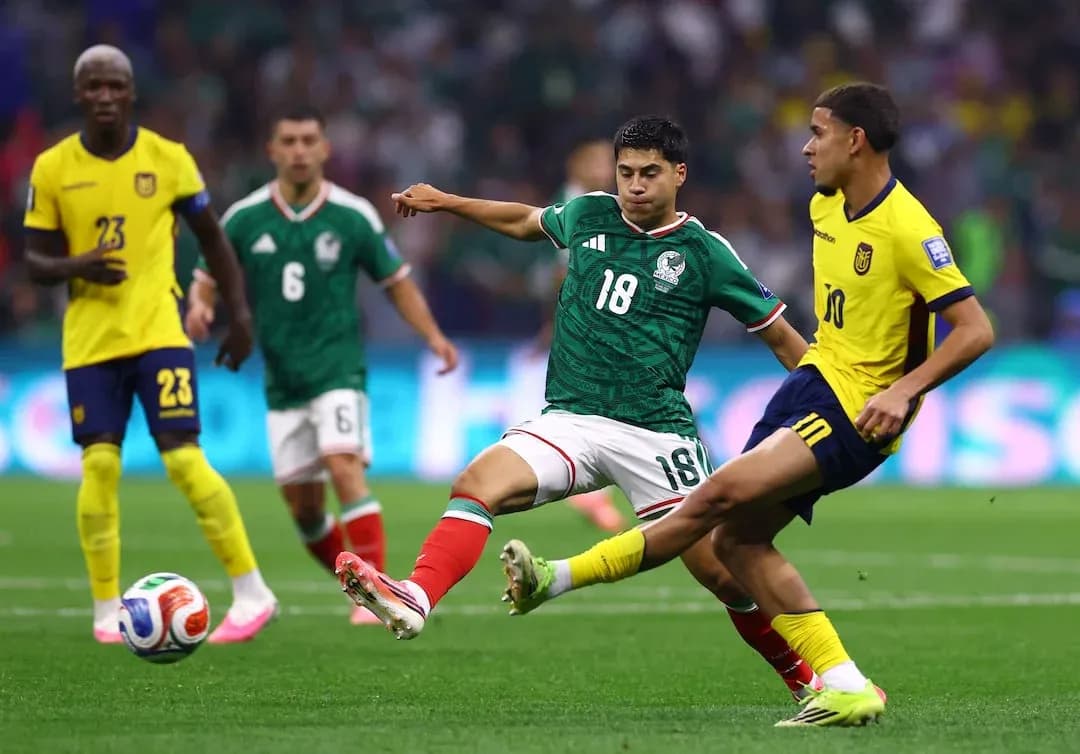
Mexico's Tactical Mastery Secures 2-0 Victory Over Ecuador
Mexico’s 2-0 win over Ecuador at Estadio Banorte in this World Cup Round of 32 tie was a classic example of a team using structure and vertical clarity to overcome a possession deficit. Javier Aguirre’s 4-3-3 side ceded the ball (43% possession) but controlled the key spaces, struck twice in the first half, and then managed the game with discipline and compactness. Sebastian Beccacece’s Ecuador, in a 4-4-2, had more of the ball (57%) and more corners (8-3) but rarely broke Mexico’s central block, finishing with just one shot on goal and ending with ten men after late frustration boiled over.
Mexico’s attacking plan in the 4-3-3 was built around direct connections between the front three and the advanced midfielder. Julián Quiñones, starting wide left, and Roberto Alvarado on the right stayed high and narrow in possession, almost as inside forwards, allowing full-backs Jesús Gallardo and Jorge Sánchez to provide the width from deeper positions. Luis Romo, as the most advanced midfielder ahead of Erik Lira and Gilberto Mora, frequently stepped into the right half-space to create a triangle with Alvarado and Raúl Jiménez, giving Mexico a stable platform to play forward quickly after regains.
First Goal
The first goal on 22 minutes encapsulated this design: J. Quinones scored for Mexico, assisted by R. Alvarado. The pattern reflects Mexico’s emphasis on early forward passes into the channels, with the winger attacking the box rather than hugging the touchline. Nine minutes later, at 31', the roles inverted: R. Jimenez made it 2-0, assisted by J. Quinones. That interchange showed how comfortable Mexico’s front three were rotating positions; Jiménez often dropped between the lines to link play, freeing Quiñones to make penetrative runs inside the Ecuadorian full-back.
Defensive Structure
Out of possession, Mexico’s 4-3-3 became a very compact 4-1-4-1. Lira sat as the single pivot, screening passes into Enner Valencia and Gonzalo Plata, while Romo and Mora stepped out selectively to press Ecuador’s double pivot of Moisés Caicedo and Pedro Vite. With Total Shots at 15-7 in Mexico’s favour and Ecuador limited to just one shot on target, the defensive structure was effective: the back four held a relatively high line but did not over-commit to wide presses, instead channelling Ecuador outside and then defending crosses with the aerial presence of César Montes and Johan Vásquez.
In goal, Raúl Rangel (Mexico) was largely protected by this block, needing to make only 1 save, but that single intervention was critical to preserving the clean sheet and is reflected in Mexico’s goals prevented figure of -0.57, indicating that the one significant chance Ecuador created was marginally above the difficulty of the average shot they faced. Hernán Galíndez (Ecuador) also recorded 1 save, but with Mexico’s expected goals at 1.02 and two goals conceded, his own goals prevented metric of -0.57 underlines that Mexico finished slightly above the model’s expectation, helped by the precision of their first-half attacks.
Ecuador’s Strategy
Ecuador’s 4-4-2 had a clear idea: build through Moisés Caicedo as the central reference and progress via the wide midfielders John Yeboah and Nilson Angulo, then look early for the runs of Enner Valencia and Gonzalo Plata. Their 407 total passes, with 340 accurate at 84%, show they succeeded in circulating the ball, but Mexico’s mid-block denied them vertical progression. Too many Ecuador passes were in front of Mexico’s midfield three, and with only 5 shots inside the box and 7 total shots, their possession was sterile.
In-Game Adjustments
Beccacece’s in-game adjustments at half-time were aggressive. At 46', Alan Franco (OUT) was replaced as Yaimar Medina (IN) came on for Ecuador, and J. Ordonez (OUT) made way as A. Preciado (IN) came on, effectively refreshing the right side of the defence to push the full-back higher and support wide overloads. Later, at 59', E. Valencia (OUT) was replaced as K. Rodriguez (IN) came on, adding fresh running in behind. Double changes at 79' — J. Yeboah (OUT) with J. Caicedo (IN) and N. Angulo (OUT) with K. Paez (IN) — further tilted Ecuador towards a more attacking, risk-taking shape, often resembling a 4-2-4 in the final minutes.
Aguirre responded pragmatically. On 58', G. Mora (OUT) was replaced as B. Gutierrez (IN) came on for Mexico, injecting energy in midfield to sustain the press. At 73', L. Romo (OUT) was replaced as O. Vargas (IN) came on, keeping the three-man midfield fresh and mobile. Two more key attacking substitutions on 74' and 80' — R. Jimenez (OUT) for S. Gimenez (IN), J. Quinones (OUT) for O. Pineda (IN), and R. Alvarado (OUT) for I. Reyes (IN) — shifted Mexico into a more conservative posture. With the original front three off, Mexico’s shape in the final ten minutes was closer to a 4-5-1, with fresh legs to defend wide spaces and attack only sporadically in transition.
Discipline and Control
Discipline became a decisive subplot for Ecuador. Their first yellow came at 45+1': A. Franco (Ecuador) — Tripping, a sign of frustration as Mexico closed out the half at 2-0. In stoppage time at the end of the match, the tension escalated: at 90+3', K. Paez (Ecuador) — Tripping; at 90+5', P. Hincapie (Ecuador) — Unsportsmanlike conduct, earning a straight red and leaving Ecuador with ten men; and at 90+9', M. Caicedo (Ecuador) — Tripping. Mexico, by contrast, finished without a single card, underscoring both their control of duels and their composure in game management.
Match Statistics
Statistically, the match underlines Mexico’s efficiency. With 15 Total Shots to Ecuador’s 7, 3 Shots on Goal to Ecuador’s 1, and an xG of 1.02 versus Ecuador’s 0.73, Mexico turned a relatively balanced chance profile into a clear 2-0 margin by executing their best opportunities early. Their 319 passes, 249 accurate at 78%, reflect a more direct, vertical style compared to Ecuador’s higher-volume circulation. The 10-14 foul count and 0-3 Yellow Cards, 0-1 Red Cards split illustrate how Ecuador’s late push and frustration translated into indiscipline rather than clear chances.
Overall, Mexico’s 4-3-3 provided superior structure in both phases: compact without the ball, incisive with it. Ecuador’s 4-4-2, despite territorial and possession advantages, could not disorganize Mexico’s central block and ultimately unraveled in the closing stages, tactically and emotionally.