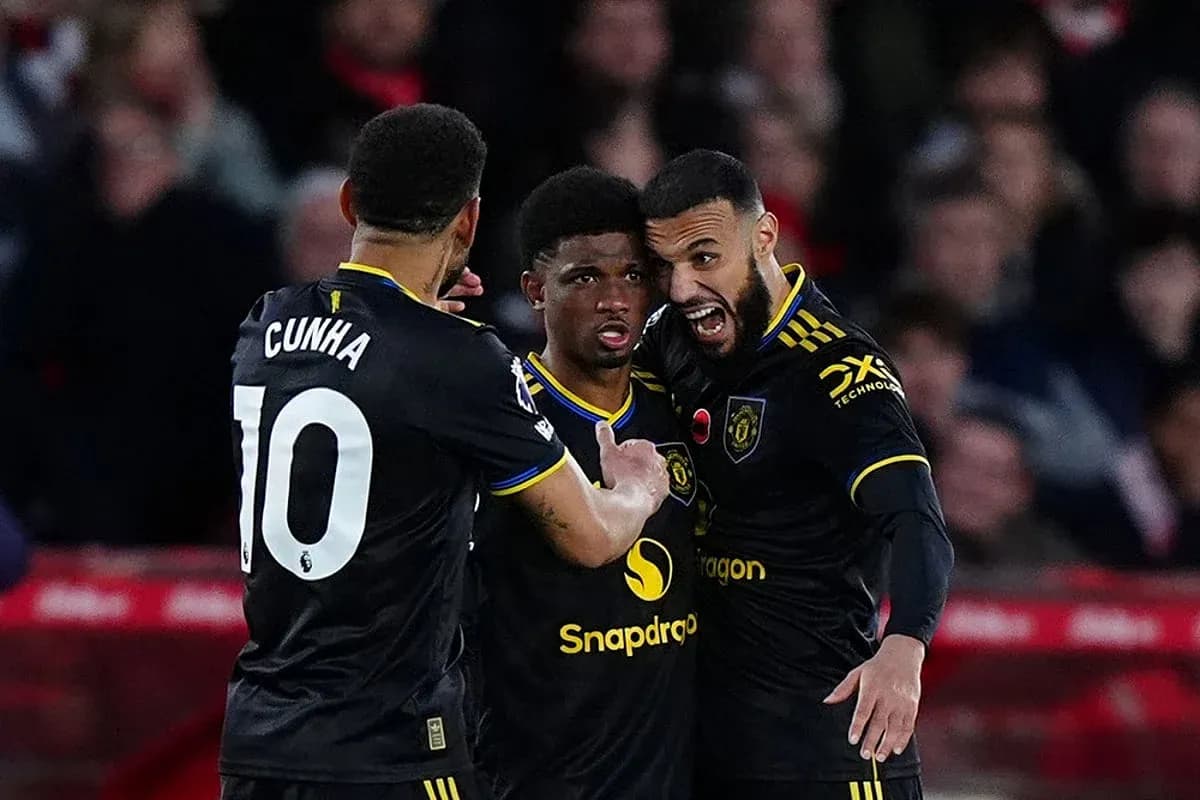
Manchester United vs Nottingham Forest: Premier League Round 37 Preview
Manchester United host Nottingham Forest at Old Trafford in a high‑stakes Premier League Round 37 fixture in 2026: United sit 3rd with 65 points and a +15 goal difference in the league phase, protecting Champions League qualification and an outside chance of climbing higher, while Forest arrive 16th on 43 points and -2 goal difference, looking to lock in safety and avoid being dragged back toward the relegation picture going into the final day.
Head-to-Head Tactical Summary
On 1 November 2025 at the City Ground in the Premier League (Regular Season - 10), Nottingham Forest and Manchester United drew 2-2, with United leading 1-0 at half-time before Forest came back to level over 90 minutes.
On 1 April 2025, again at The City Ground in the Premier League (Regular Season - 30), Forest beat United 1-0, having already led 1-0 at half-time in a controlled home display.
On 7 December 2024 at Old Trafford in the Premier League (Regular Season - 15), Forest won 3-2 after a 1-1 first half, showing they can exploit United even away in Manchester.
In cup play, on 28 February 2024 in the FA Cup 5th Round at The City Ground, United edged a tight tie 1-0 after a 0-0 first half, leaning on defensive discipline and game management.
Earlier, on 30 December 2023 in the Premier League (Regular Season - 20) at The City Ground, Forest beat United 2-1 after a 0-0 first half, turning a balanced opening into a decisive home win in the second period.
Overall, Forest have taken three Premier League wins and one draw from these last four league meetings, with United’s only win in this sequence coming in the FA Cup.
Global Season Picture
- League Phase Performance:
Manchester United are 3rd with 65 points from 36 games in the league phase, scoring 63 and conceding 48 (goal difference +15). At Old Trafford they have 12 wins, 3 draws and 3 losses, with 36 goals for and 22 against, underlining a strong but not flawless home profile.
Nottingham Forest are 16th with 43 points from 36 games in the league phase, scoring 45 and conceding 47 (goal difference -2). Away from home they have 7 wins, 3 draws and 8 losses, with 26 goals for and 25 against, making them a relatively dangerous away side for a lower‑table team. - Season Metrics:
Scope detection shows team statistics and standings both at 36 games, so this is a league‑only dataset and all metrics apply in the league phase.
Manchester United average 1.8 goals scored per match and 1.3 conceded, with 7 clean sheets and only 4 games without scoring. Their card profile shows a tendency to collect yellow cards in the middle and late phases of games (notably 46–60 minutes at 21.31% and 76–90 at 19.67%), and three red cards concentrated after half-time, indicating that intensity and risk increase as matches progress.
Nottingham Forest average 1.3 goals scored and 1.3 conceded per match, with 9 clean sheets but 14 games without scoring, pointing to an inconsistent attack but a defense that can be compact when the game script suits them. Their yellow cards cluster between 46–75 minutes (25.86% from 46–60 and 22.41% from 61–75), with a single red card in the 31–45 range, suggesting they often become more aggressive as they chase or protect game states around the hour mark. - Form Trajectory:
Manchester United’s recent five‑match form string in the league phase is “DWWWL”: a three‑game winning run followed by a draw and then a loss. That pattern signals that while the underlying points accumulation has been strong, they arrive at this match off a setback that slightly interrupts momentum at a critical stage in the Champions League race.
Nottingham Forest’s form string is “DWWWD”: unbeaten in five, with three wins and two draws. This is one of Forest’s strongest runs of the season, and it has likely been the key driver in moving them away from immediate relegation danger heading into the final two rounds.
Tactical Efficiency
Using the in the league phase statistics as a proxy for tactical efficiency, Manchester United present as an attack‑tilted side: 63 goals from 36 games (1.8 per match) against 48 conceded (1.3 per match). They convert possession and territory into goals at a solid rate, but the concession figure underlines a defense that allows chances and can be opened up, especially when chasing games or committing numbers forward.
Nottingham Forest, at 45 goals for and 47 against (both 1.3 per match), are more balanced but less explosive. Their attack is less productive than United’s, but their defensive record is marginally tighter relative to their league position, reflecting a more conservative or reactive game model, particularly effective away where they have 7 wins and a positive away goal difference (26 scored, 25 conceded).
In an “Attack/Defense Index” sense, United’s offensive index is clearly superior, driven by higher scoring averages and fewer matches where they fail to score, while Forest’s defensive index is comparatively resilient for a bottom‑half side, supported by 9 clean sheets and a goals‑against average that matches United’s at 1.3. The clash at Old Trafford therefore profiles as United’s high‑ceiling attack against a Forest unit that, while structurally vulnerable over a season, has repeatedly shown it can frustrate United specifically in recent head‑to‑heads.
The Verdict: Seasonal Impact
For Manchester United, this match is a pivotal late‑season lever. A win would likely cement their top‑four position in the league phase, keep Champions League qualification firmly under their control, and maintain pressure on the sides above going into the final round. Dropped points, however, would reopen the door for chasing teams and could turn the last day into a high‑risk scenario, especially given their recent loss and Forest’s strong head‑to‑head record.
For Nottingham Forest, anything from Old Trafford would be season‑shaping. A victory would almost certainly secure safety and could even allow them to target a mid‑table finish, transforming the narrative from survival to progress. Even a draw would be valuable, adding to an unbeaten five‑game run and pushing them further from the relegation line before the final weekend. A defeat, by contrast, would leave them reliant on results elsewhere and force them to take something from their last match to avoid late‑season tension.
Overall, this fixture functions as a dual‑axis decider: for United, it is about locking in Champions League football and possibly enhancing their standing among the elite; for Forest, it is about converting a strong recent run and a favorable recent head‑to‑head record into definitive safety. The tactical balance—United’s superior attacking metrics against Forest’s compact, upset‑capable profile—means the result will carry disproportionate weight on both the top‑four and relegation narratives in 2026.