
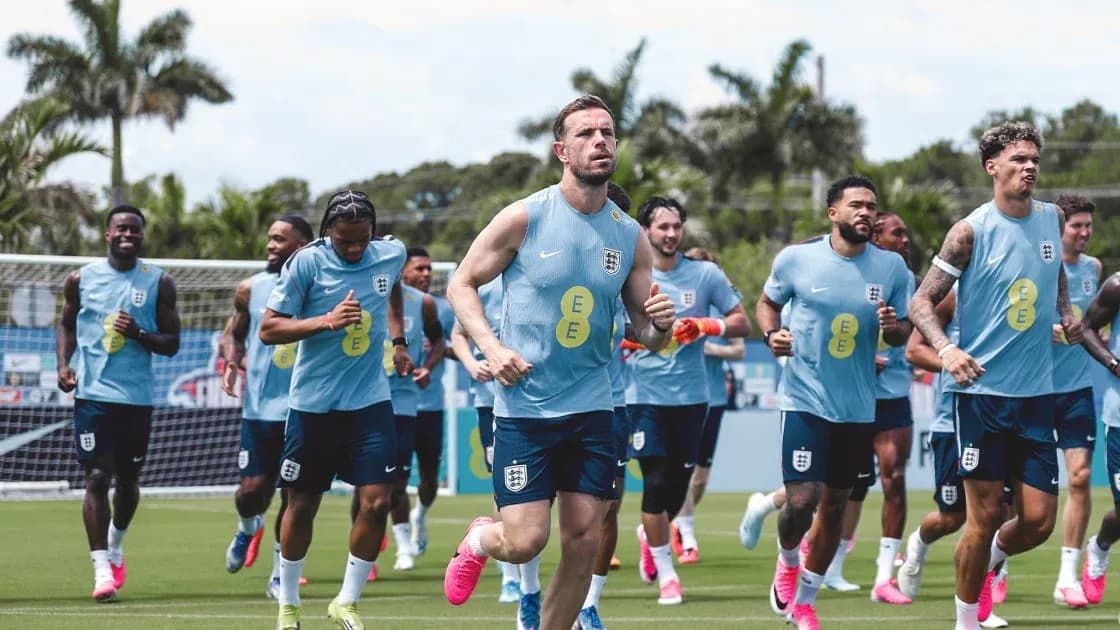
Jordan Henderson on England's Adaptation to Heat Ahead of 2026 World Cup
Jordan Henderson insists England will grow into the heat of the United States as the countdown to the 2026 FIFA World Cup gathers pace.
The Brentford midfielder started in Tampa on Saturday as England edged past New Zealand 1-0 in fierce Florida temperatures, Harry Kane’s header on the stroke of half-time deciding a game played in conditions more suited to a midday training session than a gentle warm-up friendly.
Thomas Tuchel used the occasion to rotate heavily, naming one XI for the first half and another for the second. Henderson got through the opening 45 minutes, a valuable stint in the kind of suffocating humidity England will have to handle if they are to last deep into the tournament.
“You just build your capacity to these conditions,” Henderson told the BBC, speaking with the sweat barely dried. He knows the challenge will vary from city to city. “I know that depends on where you're playing in the country, it can be different all over so it's hard to really adapt but it's about this week to build that capacity, to get used to the heat a little bit.
“The warm-up games will be good for that as well and to get that exposure just best we can, we've got an amazing team behind the team and how much research they've done and tried to cool down and recovery and all that sort of stuff so that's top, top level.
“Hopefully that can give us a little edge as well when we get into the tournament but it's the same for everyone so we've just got to go and try to just concentrate on the football.”
England face Costa Rica on Wednesday at 9pm BST in their final friendly before the World Cup. Then comes the real thing: Croatia in Arlington, Texas, on Wednesday 17 June, another 9pm BST kick-off and another date with the heat.
Brazil sharpen edge as Thiago features
Across the country, Brazil were also putting in the miles – and the minutes – in Cleveland, Ohio, where Igor Thiago led the line in a 2-1 win over Egypt.
Bruno Guimarães struck early, only for Mostafa Zico to hit back quickly and level the contest. The game reset, the tempo rose, and Carlo Ancelotti went to his bench.
Eight changes arrived at half-time, including the introduction of Brentford striker Thiago. The reshuffle injected fresh energy and, not long after the restart, Endrick found the far corner after being picked out by Raphinha to restore Brazil’s lead.
It was enough. Brazil saw it out and now turn towards their Group C opener against Morocco in New York on Saturday 13 June, an 11pm BST start that will test both legs and lungs.
Hickey helps Scotland cruise
In Harrison, New Jersey, Scotland made far lighter work of their assignment. Aaron Hickey played just over an hour as Steve Clarke’s side dismantled Bolivia 4-0, the damage done ruthlessly before the break.
Lawrence Shankland struck, Scott McTominay added another, and Che Adams helped himself to two more as Scotland ran riot in the first half. With the job done early, Clarke could manage minutes and minds ahead of their Group C opener against Haiti in Boston on Sunday 14 June (2am BST).
For Hickey, it was the ideal blend: a strong team performance, a clean sheet, and valuable time in the legs on American soil.
Ajer’s Norway hold Morocco
Back in Harrison later on, Kristoffer Ajer’s Norway were forced to grind. They drew 1-1 with Morocco in a game that demanded concentration rather than flair.
Morocco struck first through Brahim Díaz, seizing an early lead and asking questions of Norway’s back line. The response came after the interval, Martin Ødegaard levelling in the second half to steady Norwegian nerves.
Ajer played 72 minutes, another defender banking crucial experience in the conditions that will define this World Cup.
From Tampa to Cleveland to Harrison, the story is the same: heat, travel, and fine-tuning. The friendlies will soon fade from memory, but the adaptation work done this week could decide who still has running left in their legs when June turns serious.





