Ivory Coast Tops Ecuador 1-0 with Tactical Mastery
Ivory Coast’s 1-0 win over Ecuador at Lincoln Financial Field was a controlled, methodical performance built on a clear 4-4-2 structure and superior shot quality, rather than territorial dominance. Despite trailing slightly in possession (48% to 52%), Emerse Fae’s side generated more threat, translating a 1.52 xG profile and 15 total shots into the decisive late goal, while limiting Ecuador to just one shot on target and 1.01 xG.
Both teams lined up in mirrored 4-4-2 shapes, but their interpretations diverged. Ivory Coast’s back four of Guéla Doué, Wilfried Singo, Emmanuel Agbadou and Ghislain Konan played relatively narrow and compact, with the double pivot of Franck Kessié and Seko Fofana screening central spaces. Wide midfielders Yan Diomande and Bazoumana Touré were key in transitioning quickly, supporting the front pair of Nicolas Pépé and Elye Wahi with diagonal runs and underlaps rather than simply hugging the touchline.
Ecuador, under Sebastian Beccacece, also started 4-4-2 with Hernán Galíndez in goal behind a back line of Alan Franco, Joel Ordóñez, Willian Pacho and Piero Hincapié. The midfield four of John Yeboah, Moisés Caicedo, Pedro Vite and Alan Minda was tasked with circulating possession and drawing Ivory Coast out, but their structure often became too flat, making it easier for Ivory Coast’s central block to hold its shape.
The defensive platforms were decisive. Ivory Coast allowed 12 shots but only one on goal, a reflection of strong penalty-box management from the centre-backs and disciplined midfield protection. Their 10 fouls and three yellow cards – Seko Fofana for “Roughing” at 28', Franck Kessié for “Tripping” at 38', and Guéla Doué for “Tripping” at 40' – underline an aggressive but calculated approach to breaking up Ecuador’s rhythm before it reached the danger zone.
Ecuador, by contrast, committed 13 fouls but collected only one booking, to Jackson Porozo for “Holding” at 73', after he entered as part of a defensive reshuffle. That pattern hints at a side that was often reacting in transition, forced into recovery fouls as Ivory Coast’s forwards and midfield runners attacked space more directly in the second half.
In goal, Yahia Fofana (Ivory Coast) had a relatively quiet but clean outing, needing just 1 save to preserve the clean sheet. The low save count is less a reflection of inactivity and more evidence of how effectively Ivory Coast kept Ecuador at arm’s length, steering most of their 12 efforts into blocked lanes (3 blocked shots) or harmlessly wide. On the other side, Hernán Galíndez (Ecuador) made 3 saves, and the data credits him with 0.22 goals prevented, matching Ivory Coast’s own figure in that metric. This indicates that both goalkeepers dealt competently with what they faced, but the defensive structure in front of Galíndez allowed more clear shooting opportunities than Ecuador could manufacture at the other end.
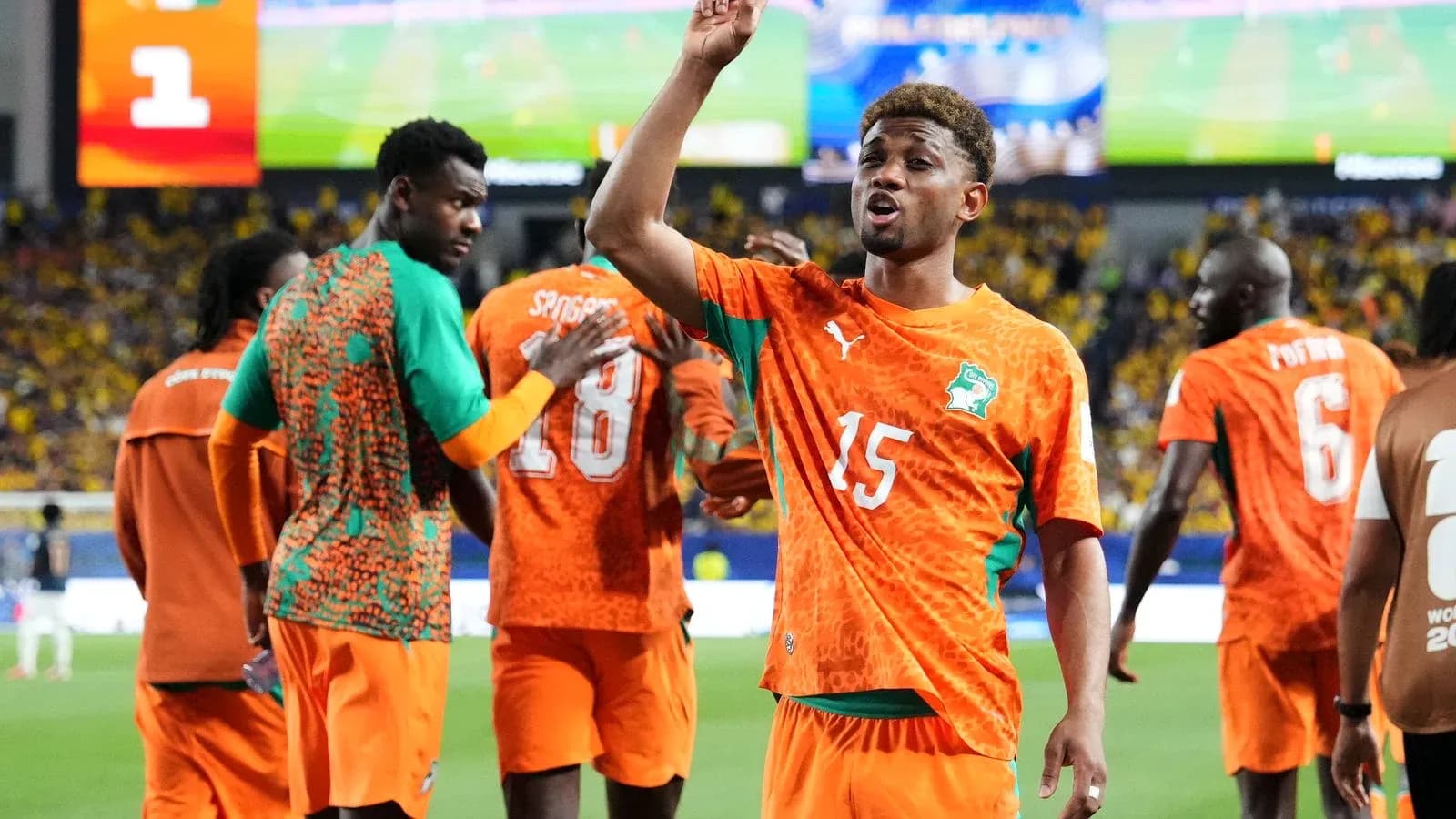
The substitution pattern was central to the tactical story. At 56', Beccacece tried to inject more directness by bringing on Nilson Angulo (IN) for Alan Minda (OUT), while Fae simultaneously reshaped his attack: Ange-Yoan Bonny (IN) came on for Elye Wahi (OUT), and Amad Diallo (IN) replaced Bazoumana Touré (OUT). These twin changes for Ivory Coast effectively shifted the front line from a Pépé–Wahi partnership to a more dynamic, dribble-heavy unit with Bonny and Diallo offering fresh legs and vertical runs.
Ecuador doubled down on defensive adjustments at 62', with Jackson Porozo (IN) for Alan Franco (OUT) and Ángelo Preciado (IN) for John Yeboah (OUT). This moved them towards a more conservative, physically robust back line, but it also reduced their ability to progress the ball cleanly from wide areas, making them increasingly reliant on Moisés Caicedo and Pedro Vite to connect thirds.
Ivory Coast’s final wave of changes at 77' and 89' further sharpened their control. Christ Inao Oulaï (IN) came on for Nicolas Pépé (OUT), adding fresh energy on the flank, and Ibrahim Sangaré (IN) replaced Seko Fofana (OUT), bringing extra defensive stability and ball-winning in midfield. For Ecuador, Kevin Rodriguez (IN) replaced Enner Valencia (OUT) at 77', a like-for-like switch that maintained the front-two structure but did not significantly alter their attacking patterns. At 89', Odilon Kossounou (IN) came on for Guéla Doué (OUT), allowing Ivory Coast to close the game with a taller, more aerially dominant back line for the final minutes.
The winning moment at 90' encapsulated Ivory Coast’s tactical edge. Amad Diallo, introduced just after the hour, delivered the decisive “Normal Goal”, assisted by Wilfried Singo. The involvement of a substitute scorer and a starting defender highlights how Fae’s side blended fresh attacking impetus with overlapping support from the back. Singo’s ability to step out and contribute in advanced zones was a feature of Ivory Coast’s approach, especially once Ecuador’s wide players had been reshuffled and their pressing cohesion weakened.
Statistically, the match confirms the eye test. Ivory Coast outshot Ecuador 15–12, with a 4–1 advantage in shots on goal and parity in blocked shots (3–3). They were slightly behind in possession but efficient with the ball: 470 passes, 397 accurate, for 84% accuracy. Ecuador completed 492 passes with 419 accurate (85%), but their extra possession did not translate into superior territory or quality, as shown by the lower xG (1.01).
Set-piece balance – 3 corner kicks for Ivory Coast against 5 for Ecuador – suggests Ecuador had more territorial phases, yet Ivory Coast’s better shot profile and late-game control were decisive. Both teams posted the same goals prevented value (0.22), underlining that the difference came not from extraordinary goalkeeping heroics, but from Ivory Coast’s superior chance creation and the timing of Fae’s attacking substitutions, which tilted a finely balanced tactical contest in their favour in the closing stages.