FIFA Eases Water Bottle Ban for 2026 World Cup
FIFA has rowed back on its controversial water bottle policy for the 2026 World Cup, allowing supporters to bring a single disposable bottle into stadiums in the United States and Canada after a wave of criticism over fan safety and costs.
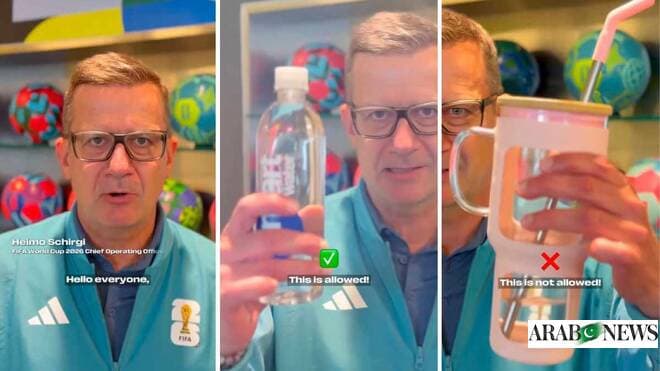
In a video posted on FIFA’s X account, World Cup chief operating officer Heimo Schirgi confirmed that spectators will now be able to carry in one “soft, plastic” factory-sealed disposable bottle of up to 20 ounces (590ml) at any match in the US and Canada.
The governing body described the move as a “clarification” of its rules, but it comes just two days after it had stated that all refillable bottles would be banned under an updated stadium code of conduct — a shift that sparked anger from fans already bracing for high ticket prices and searing summer conditions.
The original stance meant supporters would have been forced to rely entirely on water sold inside venues, a prospect that drew immediate pushback given the expected heat at many open-air stadiums and memories of last year’s FIFA Club World Cup in the United States, where fans complained of intense temperatures while being barred from bringing in their own water.
FIFA has stood firm on one element: hard-sided, reusable bottles remain prohibited.
Schirgi spelled that out in the video, holding up examples of what will and will not be allowed and stressing that the ban on rigid, refillable containers is rooted in safety and security concerns. The organization has repeatedly argued that outside bottles can be used as projectiles and that many of the host venues already restrict them for domestic events.
“Outside bottles are already prohibited at several of these venues for safety considerations, and FIFA is applying this consideration across its tournament stadiums,” the body said in a statement to AFP, adding that the underlying safety concerns “remain valid” despite the tweak to allow soft plastic bottles.
Heat, though, is the looming opponent.
The World Cup, co-hosted by the United States, Canada and Mexico, will be staged in the North American summer, with forecasters warning that fans could face genuine health risks at certain games. A report from the World Weather Attribution research group last month estimated that 26 of the 104 matches are likely to be played in conditions where the Wet Bulb Global Temperature (WBGT) exceeds 26 degrees.
WBGT is a composite measure of heat stress on the human body, combining temperature, humidity, wind and sunlight. When it rises, so does the danger of dehydration, heat exhaustion and heatstroke — not just for players, but for tens of thousands of supporters packed into stands.
Under pressure to show it is prepared, FIFA has pointed to a suite of mitigation measures: misting stations, fans, hydration points and cooling tents spread across what it calls “the stadium footprint.” Those facilities, it insists, will help keep spectators safe even during the hottest kick-off windows.
Inside the grounds, bottled water will be available for purchase, with FIFA stating that prices will “remain consistent with other events held at each stadium.” That line will be watched closely by supporters’ groups, who fear that “consistent” could still mean expensive at many NFL and MLS venues.
The policy shift on disposable bottles does not end the debate, but it does mark a notable concession. With the clock ticking down to 2026, FIFA now has to prove that its balance between security, commercial interests and basic fan welfare can hold once the mercury starts to climb.