Egypt Edges Australia in Penalty Shootout After Dramatic Round of 32 Clash
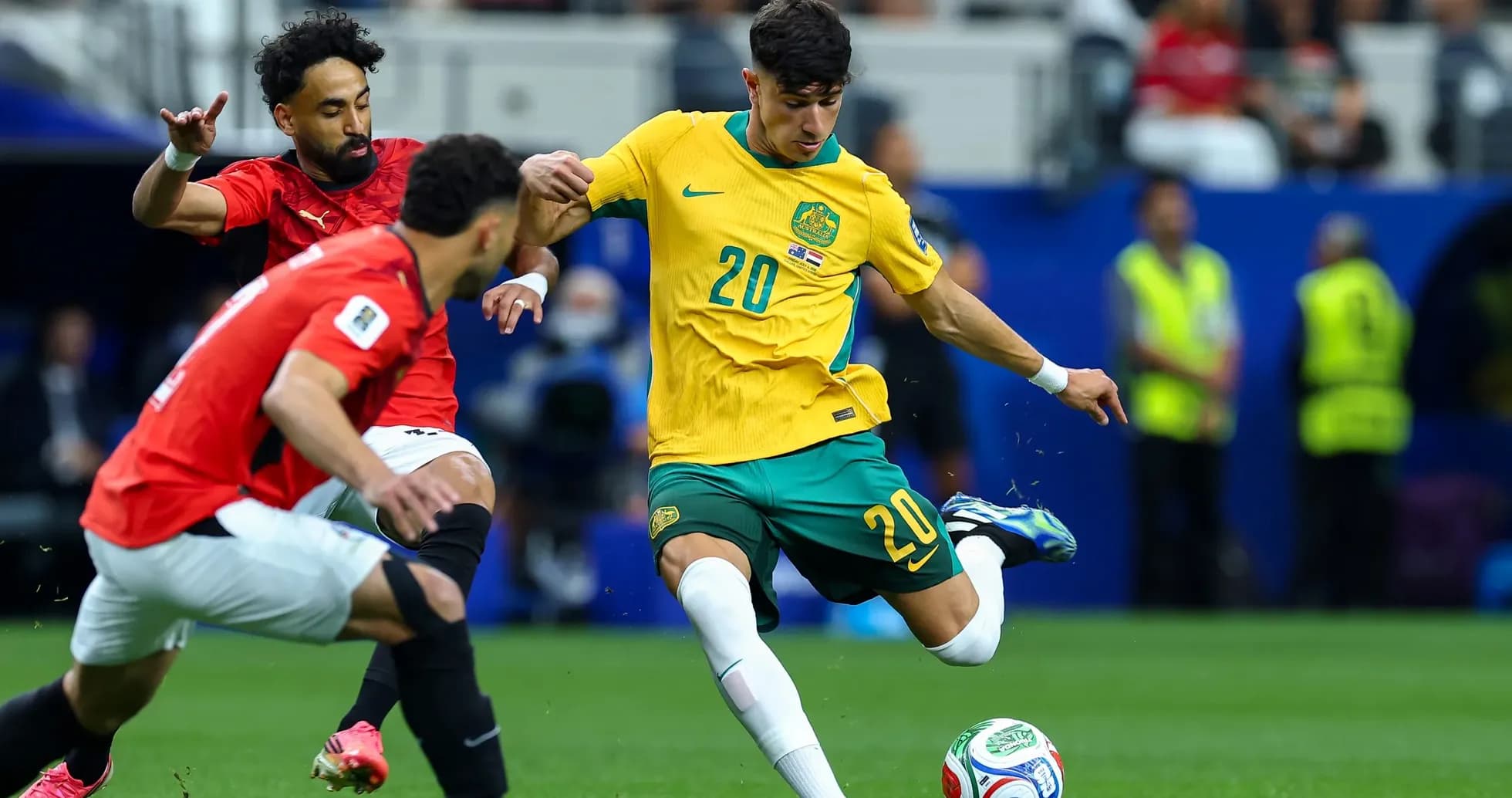
Under the closed roof of AT&T Stadium in Dallas, Australia and Egypt dragged each other through 120 minutes of attrition, only for the Round of 32 to be decided from the spot. Egypt edged the shootout 4–2 after a 1–1 draw, but beneath the drama lay a story of contrasting structures, missing anchors, and star power bending the game’s geometry.
Australia arrived as Group D runners-up, a pragmatic tournament side. Heading into this game they had played 4 matches overall, winning 1, drawing 2 and losing 1. Their overall goals for and against were perfectly balanced at 3–3, giving them a goal difference of 0. At home in this World Cup they had scored 3 and conceded 1, while on their travels they had yet to score and had let in 2. That statistical split already hinted at a team more comfortable when they could impose shape rather than chase chaos.
Tony Popovic doubled down on that identity with a 3-4-2-1 that was more about control than spectacle. P. Beach took the gloves behind a back three of A. Circati, H. Souttar and L. Herrington. Ahead of them, a flat but industrious four of J. Bos, J. Irvine, A. O’Neill and A. Behich gave the Socceroos width without sacrificing compactness, while C. Volpato and C. Metcalfe floated behind the spearhead, the explosive N. Irankunda.
This was not Australia’s first flirtation with a back three in the tournament. Across the campaign they had alternated between 5-4-1 and 3-4-2-1, two matches apiece. The choice here was clearly influenced by personnel. The absence of M. Leckie through a hamstring injury and J. Italiano with ankle problems stripped Australia of two experienced attacking references. Without Leckie’s vertical running or Italiano’s creativity, Popovic leaned into structure: use Irankunda’s pace as the chaos agent and trust the rest to keep the game in a controllable band.
Egypt, by contrast, arrived as Group G’s second-placed side with a more open statistical profile. Heading into this game they had played 4 matches overall, with 1 win and 3 draws, and crucially no defeats. They had scored 6 and conceded 4 overall, for a goal difference of +2. On their travels they had been particularly lively, scoring 5 and conceding 3, an away average of 1.7 goals for and 1.0 against. This was a side that could be hurt, but almost always carried a punch of its own.
Hossam Hassan’s decision to switch into a 4-4-2 at this stage was a nod both to necessity and to his star man. O. Shobeir started in goal behind a back four of M. Hany, Y. Ibrahim, R. Rabia and K. Hafez. The midfield band of four – E. Ashour, H. Fathy, M. Attia and O. Marmoush – was built to shuttle and bite, while up front M. Salah and M. Ziko formed a classic strike partnership: one dropping, one stretching.
The absences Egypt had to absorb were heavy and structural. Hossam Abdelmaguid was suspended, while Mohanad Lasheen, Ahmed Abou El Fotouh and Mohamed Abdelmonem were all out injured. Lasheen’s loss in particular removed a midfield enforcer who had already shown his edge in this World Cup: 13 tackles, 4 successful blocks and 4 interceptions, plus 2 yellow cards accumulated over 270 minutes. Without him, the double pivot lost some bite and aerial aggression, and Hassan compensated by keeping his lines tighter and asking H. Fathy to balance between screening and circulating.
Discipline shaped the emotional temperature of the night. Australia came in with a clear late-game yellow-card trend: 40.00% of their bookings in this World Cup had arrived between 76–90 minutes, on top of a steady 20.00% in each of the 16–30, 31–45 and 46–60 windows. This is a team that tends to grow more desperate as the clock ticks, and in a knockout tie that risk of late cards always hovers over tactical choices – particularly pressing triggers and counter-press intensity.
Egypt’s yellow-card pattern was more front-loaded and then re-emerged in extra time. They had taken 12.50% of their yellows in the opening 0–15, 25.00% in each of the 16–30 and 31–45 windows, then quietened before flaring again with 25.00% between 91–105 and 12.50% between 106–120. That arc mirrored their match approach: aggressive in the opening exchanges, then cautious, then spiky again when legs were heavy and duels turned more reckless.
Within that framework, the key duels that defined the match were almost archetypal.
The “Hunter vs Shield” battle was M. Salah against Australia’s central block of Souttar and O’Neill. Salah came into the Round of 32 as one of the tournament’s most influential creators: in 4 appearances he had logged 338 minutes, 1 goal and 2 assists, with 16 key passes and 13 dribble attempts, 6 of them successful. He drew 9 fouls and had been directly involved in three of Egypt’s six goals overall. To contain him, Australia placed a tall, aerially dominant centre-back in Souttar at the heart of the three, with O’Neill and Irvine screening lanes.
Salah’s tendency to drift into half-spaces and receive to feet forced Australia’s outside centre-backs, Circati and Herrington, into uncomfortable decisions: step into midfield and risk exposing the channel, or hold the line and allow Salah to turn. Every time Salah combined with Marmoush dropping inside or Ziko running the channels, the Australian block had to shift as a unit. Their overall record of conceding just 0.5 goals at home in this World Cup reflected a unit that defends the box well; the problem here was that Egypt, unlike previous opponents, could hurt them before the ball even reached the penalty area.
On the other side, Egypt’s “Shield” was Y. Ibrahim. He came into this tie as one of the World Cup’s leading yellow-card collectors: 2 bookings in 4 appearances, underpinned by 7 tackles, 3 successful blocks and 2 interceptions. He had been involved in 52 duels, winning 22, and his 236 passes at 91% accuracy underlined his importance as both stopper and starter. Against Australia’s lone striker shape, Ibrahim’s reading of when to step into Irankunda’s feet and when to drop with Metcalfe’s runs was critical.
Without a true penalty threat in this tournament – both sides had taken 0 penalties overall, with 0 scored and 0 missed – the game was always likely to be decided in open play margins and, eventually, from the spot. Australia’s overall attacking numbers were modest: 3 goals in 4 matches, an overall average of 0.8 goals per game, with a clear home bias. Egypt, by contrast, had been consistently productive, scoring 1.5 goals per match overall and never failing to score, home or away.
Those trends played out over the 120 minutes. Egypt struck first, reflecting their sharper attacking rhythm, while Australia’s resilience and home-tournament solidity dragged them back into the contest. As fatigue set in, the statistical yellow-card patterns almost came to life: Egypt’s late bookings mirrored their increasingly stretched defensive line, while Australia’s propensity for late cards translated into a series of rugged interventions as they tried to keep Salah and Marmoush away from Beach’s area.
By the time the shootout arrived, the numbers had already framed the probabilities. Egypt’s superior attacking output and their unbeaten record suggested a side more accustomed to living on the edge of tight games. Australia’s campaign profile – low scoring, defensively sound, but with limited cutting edge – hinted at the razor-thin margin they would have to walk.
Following this result, the story of the tie is less about missed destiny and more about statistical gravity. A defensively disciplined Australia, shorn of key attacking pieces, pushed an unbeaten, Salah-led Egypt all the way to penalties. Egypt’s deeper reservoir of attacking threat and their comfort in games that refuse to resolve in 90 minutes finally told, with the shootout merely the last expression of a balance of power that had been tilting, subtly but consistently, in their favour from the moment the ball was first rolled in Dallas.