
England Faces Mexico in World Cup Knockout Clash at Azteca
England walk into the Azteca tonight with the noise already turned up to eleven and the margins already thin.
This World Cup last‑16 tie against co-hosts Mexico was always going to be awkward. Altitude. Hostility. History. Now it carries an extra edge: a patched-up back line, kick-off chaos, and a stadium that has already seen this tournament teeter on the brink of disorder.
Azteca turns up the heat
Mexico City has wrapped its arms around this World Cup, then clenched its fists. The Estadio Azteca will be ferocious. It usually is. At 7,220ft above sea level, it squeezes the lungs and scrambles the rhythm of visiting sides. Thomas Tuchel knows it. So do his players.
The co-hosts arrive fuelled by a raucous win over Ecuador in the last round, a game that brought a weather delay, a crackling atmosphere and, outside the stadium, tragedy. Four fans died in a crush following that victory. Security has tightened ever since.
England’s hotel has become a small fortress. More than 100 riot police in bullet-proof vests are stationed outside, a visible line between a jeering local crowd and a squad trying to shut out the noise. The Mexican National Guard greeted Tuchel’s team on arrival in the capital after earlier incidents in the tournament, when fans used loudspeakers, horns and motorbikes to harass the Ecuador squad.
Tuchel, though, has been careful to separate hostility from welcome. He has spoken of a “respectful and emotional” arrival, of no issues so far. Inside the bubble, England are trying to keep this as just another game. Outside, it feels like anything but.
Quansah thrown into the fire
Team selection has given the night its first jolt. Jarell Quansah, 21 years old and naturally a centre-back, is expected to start at right-back. At the Azteca. In a World Cup knockout game. Against Mexico.
“It's a big game for him, he's got to do the job, it's not ideal,” Gary Neville said on ITV Sport, summing up the unease. Quansah’s emergence had eased England’s injury problems on that flank, with Reece James edging closer to the squad and Djed Spence battling a muscle issue. Now those concerns have flared again.
Tuchel has toyed with the idea of changing shape, perhaps going to a back three to protect his makeshift full-back and better manage the altitude-driven chaos that can swallow teams whole in this stadium. For now, the expectation is that Quansah starts on the right of a back four, a solution born of necessity more than design.
Declan Rice’s return to full fitness offers a significant counterweight. England’s midfield anchor will be vital in a game where players will breathe heavier, recover slower and make decisions a fraction later than they are used to. At this height, small lapses become big problems.
Kick-off confusion and Fifa’s storm
As if the conditions were not enough, England have had to ride out a storm of a different kind. Fifa’s handling of the kick-off time has left a sour taste.
World football’s governing body considered shifting the match forward by six hours because of the threat of stormy weather in Mexico City. Then reversed course. The uncertainty lingered, two days out from a World Cup knockout tie, with players and staff left to prepare for one schedule, then another.
Neville did not hold back.
"I would find it disruptive as a player," he told ITV Sport. "Conditions are huge for England, playing at 12pm in Mexico vs playing at 6pm, it's very different, for our players, it's worse, let's be clear.
“It's a sporting disadvantage to England, there's a sporting integrity issue here. I've never seen a League Two game moved back, Fifa are just willy nilly making it up and moving a game, it feels strange.”
He pointed out that the Azteca has dealt with storms before, with established procedures to take players off, shelter them and resume later if needed.
“To move a game two days out, I've never seen that at any level of football ever," he added.
The governing body ultimately backed down, but the damage was done. Preparation at this level is built on precision. England have had to absorb turbulence that should never have reached them.
Mexico’s countrymen set the tone
The Mexican mood around this tie has not just been forged in football. On Sunday, on the second stage of the Tour de France, Tadej Pogacar deliberately handed victory to his Mexican teammate Isaac Del Toro. It was a gesture, a nod to the moment, and it lit a fuse.
“I’m super proud to have the level to manage these kind of situations," Del Toro said afterwards. “I cannot believe I just did this, just full emotions. You cannot believe how it feels for me, especially for my country.”
Del Toro then turned his eyes to Mexico City and to El Tri.
He urged his footballing compatriots to beat England later that night, praising “these 11 guys ripping it up in the soccer” and insisting “they’re doing amazing.”
It was a snapshot of a nation riding a wave. Cycling in Europe, football at home, one story feeding the other. England will feel all of that when they walk out into the Azteca’s steep, looming stands.
Outnumbered and warned
If the players are braced for a storm, the fans have been formally warned of one. The UK’s top football police chief has urged England supporters in Mexico to “be sensible” and recognise they will be “massively outnumbered” in and around the stadium.
The message is stark: this is not a neutral venue, not even close. Mexico’s three-week build-up, their win over Ecuador and the emotional charge of co-hosting have created a combustible mix. The security presence at England’s hotel, the hostile reception on arrival, the crush outside Mexico’s last game – all of it feeds into a sense that this night needs to be handled carefully on and off the pitch.
Altitude: the invisible opponent
For all the noise, the most dangerous opponent might be the one nobody can see. The altitude at the Azteca has been a talking point all week, and with good reason.
At 2,240m above sea level, players need to breathe more heavily just to draw in the same amount of oxygen. With less oxygen available, their physical performance dips. Sprints are shorter. Recovery is slower. Mistakes creep in.
“It catches you off guard,” as those who have played here put it. The ball travels differently too, zipping and flying in a thinner air that punishes misjudgement. Mexico, who live and train in these conditions far more often, will not waste that advantage.
Tuchel’s staff have tried to prepare: tailored training loads, hydration plans, rotation options. None of it fully replicates what happens when 80,000 Mexicans roar, the lungs burn and the legs suddenly feel heavier than they did a minute ago.
A World Cup wrestling with integrity
While England wrestle with the elements, the World Cup itself is wrestling with its own credibility. In Seattle, Fifa’s extraordinary decision to “suspend” Folarin Balogun’s one-match ban for the USA’s last-16 clash with Belgium has left Belgium “astonished” and reopened questions about sporting integrity.
Fifa had initially confirmed there were no grounds to appeal Balogun’s red card against Bosnia and Herzegovina. The case looked closed. Then, just 32 hours before kick-off, the United States and head coach Mauricio Pochettino received a huge boost, the striker suddenly cleared to play.
The first hints that something might be shifting came on Friday, behind closed doors. The final call landed on Sunday, the same day England and Mexico prepared for their own knockout tie under a cloud of scheduling confusion.
Different cases, same theme: decisions at the very top that feel improvised, opaque and deeply consequential.
Three hours, one cauldron
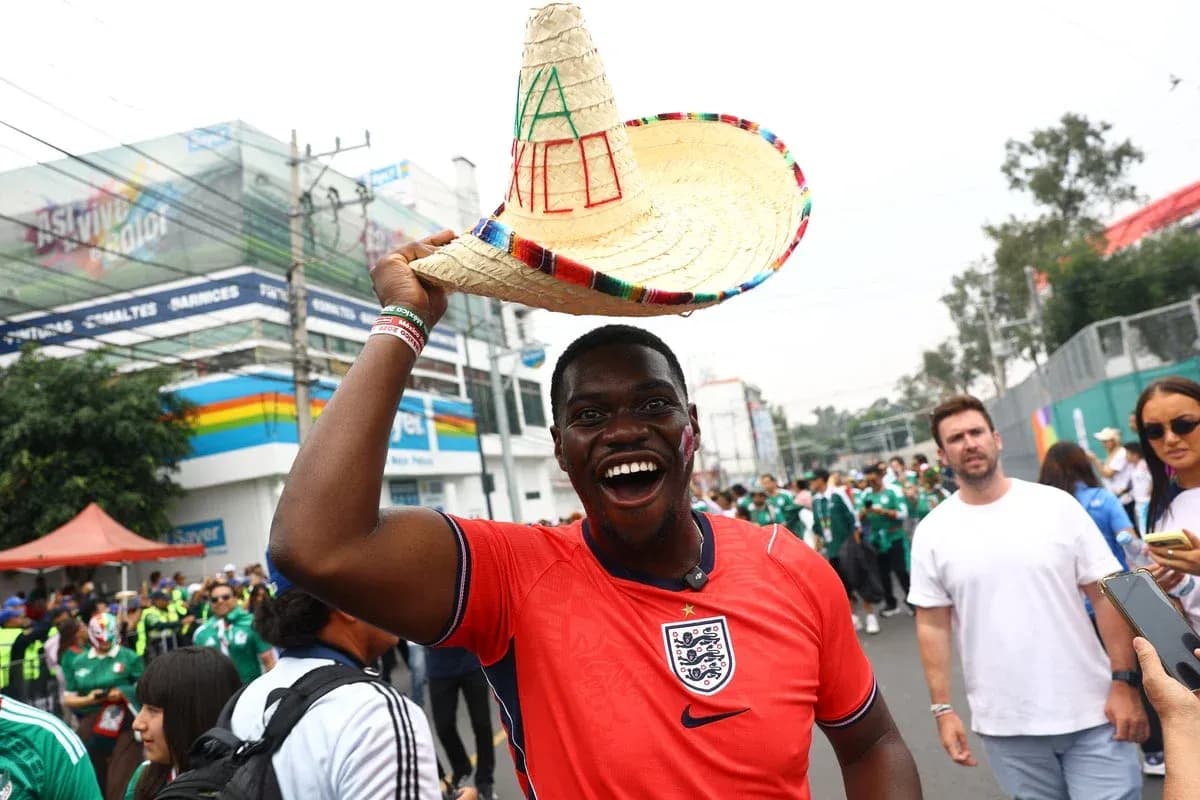
Back in Mexico City, the countdown has begun. Less than three hours to kick-off. Fans are already streaming towards the Azteca, green shirts everywhere, the odd St George’s cross dotted among them.
Score predictions swirl among England supporters awake in the small hours back home. Optimism fights with anxiety. They know the names: Quansah at right-back, Rice back fit, Tuchel on the touchline. They know the numbers: 7,220ft, 2,240m, 12pm versus 6pm, all the little details that could tilt a knockout tie.
The Azteca has staged some of football’s most iconic moments, including Diego Maradona’s infamous double in 1986. Tonight it offers something different: a raw test of nerve, lungs and decision-making for an England side trying to turn a turbulent build-up into a statement performance.
The stage is set. The air is thin. How many of these players will still be standing, and still be standing tall, when the whistle blows on England’s World Cup future?





