Morocco's Tactical Mastery Against Canada in World Cup 2023
Canada’s 4-4-2 against Morocco’s 4-2-3-1 at NRG Stadium produced a match where structure and control belonged largely to Morocco, even if the shot volume suggested a closer contest. Morocco’s 3-0 win in this World Cup Round of 16 tie was built on superior spacing between the lines, cleaner progression through midfield, and ruthless exploitation of transition moments once Canada were forced to chase.
Canada’s initial plan under Jesse Marsch was clear: a front two of Jonathan David and Tani Oluwaseyi pressing Morocco’s first line, with wide midfielders Tajon Buchanan and Ali Ahmed stretching the pitch in a fairly traditional 4-4-2. The aim was to disrupt Morocco’s build-up on the flanks, particularly around Achraf Hakimi and Noussair Mazraoui, and then attack quickly once possession was won. However, with only 45% of the ball and 357 passes at 76% completion (272 accurate), Canada struggled to sustain pressure high up the pitch. Their press often broke one line but not the second, allowing Morocco to play through the first wave and then find space between Canada’s midfield and defence.
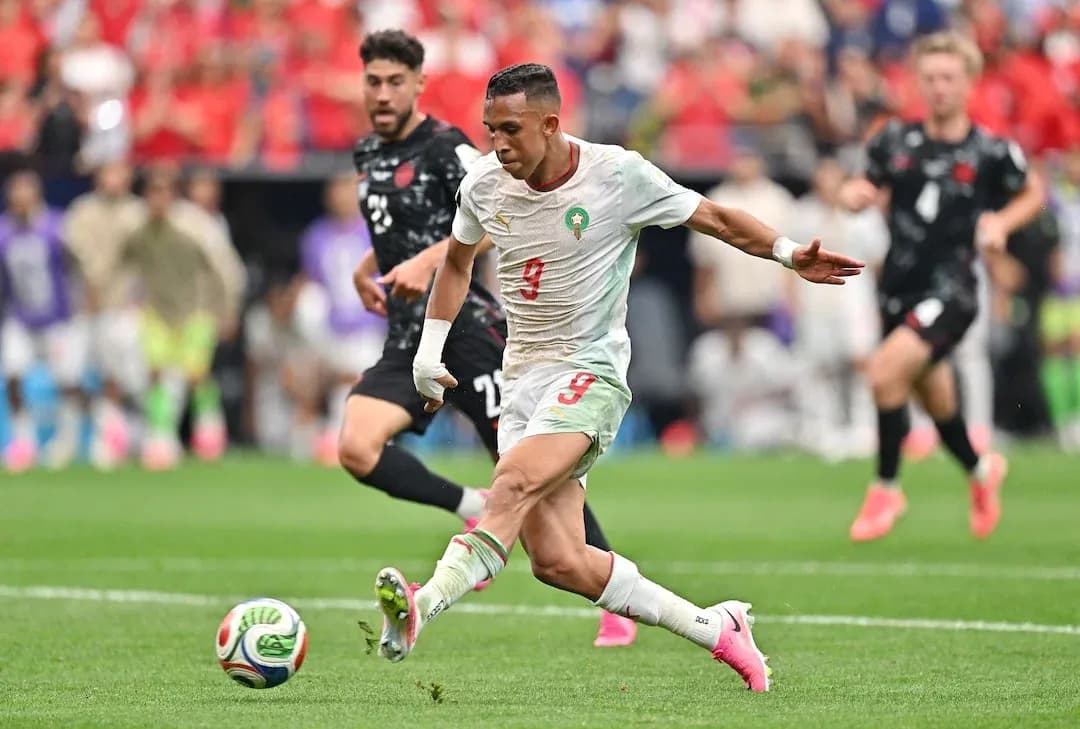
Morocco’s 4-2-3-1, orchestrated by Mohamed Ouahbi, was more stable and better connected. The double pivot of Ayyoub Bouaddi and Neil El Aynaoui provided consistent outlets for circulation, while Azzedine Ounahi, Bilal El Khannouss and Brahim Díaz operated in the half-spaces behind Ismael Saibari. With 55% possession and 472 passes at 82% completion (389 accurate), Morocco could dictate tempo, slowing the game to draw Canada out and then accelerating through the vertical passing of Díaz and Ounahi.
The shot profile underlines the different approaches. Canada generated 11 total shots, with 7 inside the box, but only 3 on target and 3 blocked. Much of their threat came from volume rather than clear, carved-out chances, reflected in an xG of 0.86. Heavy reliance on wide deliveries and set plays (11 corner kicks) meant Morocco’s centre-backs, Issa Diop and Redouane Halhal, could defend facing the ball, rarely being pulled into uncomfortable 1v1s or large spaces. Morocco, by contrast, took just 5 shots (3 inside the box) but placed 4 on target, converting three of them off a more selective, high-quality shot diet for a slightly lower xG of 0.78. Their efficiency was the tactical differentiator: fewer attacks, but more coherent and better-timed.
Defensively, Canada’s aggression without the ball was evident in their 24 fouls and four yellow cards. The back four of Alistair Johnston, Moise Bombito, Luc De Fougerolles and Richie Laryea were repeatedly forced into reactive defending as Morocco found pockets between the lines. The bookings for Richie Laryea, Jonathan David, Luc De Fougerolles and substitute Cyle Larin underscored how often Canada were arriving late into duels, a symptom of being half a step behind Morocco’s circulation rather than simply a matter of individual discipline.
Morocco balanced their attacking ambition with control. They committed 14 fouls and also collected four yellow cards, but their defensive shape was usually intact when Canada attacked. Hakimi and Mazraoui managed the width intelligently, stepping out to engage wide midfielders while trusting the double pivot to protect the central zones. The fact that Canada managed 7 shots inside the box but only 3 on target reflects how often Morocco were able to apply late pressure to disrupt shooting angles rather than allowing free finishes.
In goal, Maxime Crépeau (Canada) faced a brutally efficient Moroccan attack. Canada’s statistics show 1 save and 0.66 goals prevented, which, combined with Morocco’s 4 shots on goal and 3 converted, indicates that when Morocco did hit the target, they did so with precision and power that left little margin for the goalkeeper. At the other end, Yassine Bounou (Morocco) made 3 saves and also posted 0.66 goals prevented, matching Canada’s 3 shots on target. His interventions, particularly on Canada’s better central looks, ensured that the underdog’s route back into the match never materialised despite a relatively even xG.
Set pieces were one of Canada’s main structural levers. With 11 corner kicks to Morocco’s 1, Canada repeatedly loaded the box, looking to exploit Bombito and De Fougerolles in aerial situations. Morocco, however, defended these moments with composure, maintaining clear roles for first-contact headers and second-ball coverage just outside the box, limiting clean second-phase attempts.
As the game wore on and substitutions arrived, the tactical balance tilted further Morocco’s way. The introduction of Soufiane Rahimi and later changes in the Moroccan attacking line added fresh running against a Canadian side already stretched by the scoreline and their high work rate out of possession. Canada’s own changes, including Cyle Larin and Jacob Shaffelburg, aimed to add directness and 1v1 threat, but with Morocco controlling central zones and managing transitions, those adjustments did not significantly alter the underlying dynamics.
Statistically, the match reads as a contest where Canada had territorial and set-piece moments but lacked the structural mechanisms to turn those into truly high-value chances. Morocco’s superior pass completion, possession share, and shot efficiency aligned with their tactical clarity: dominate the middle third, pick the right moments to break, and trust their technical leaders between the lines. The result — Canada 0-3 Morocco — is therefore less about overwhelming volume and more about Morocco’s control of space, rhythm, and decision-making in the final third.