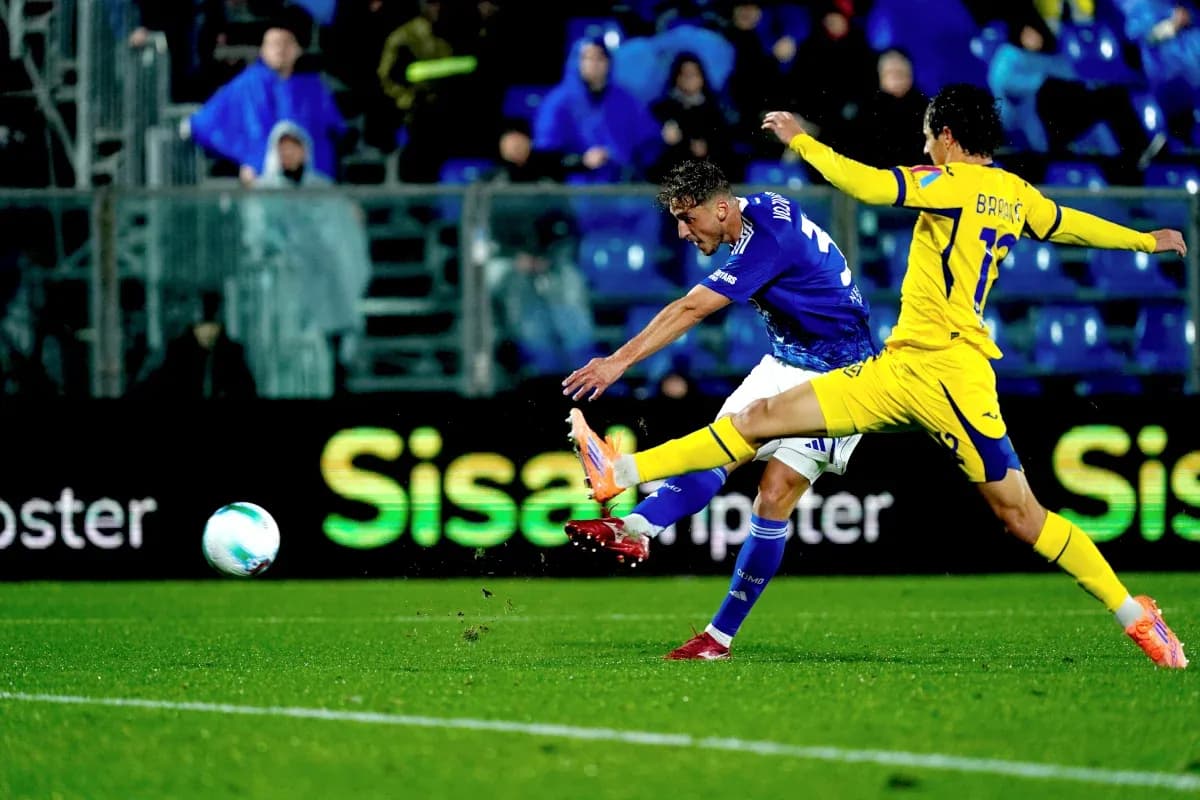
Como Secures Away Win Against Hellas Verona in Serie A Clash
Hellas Verona’s 0-1 home defeat to Como at Stadio Marcantonio Bentegodi was defined by control versus compactness. In a Serie A Round 36 fixture with safety and positioning at stake, Cesc Fabregas’ Como imposed a 4-2-3-1 possession structure that gradually wore down Paolo Sammarco’s 3-5-1-1 block. The contest remained goalless to halftime, but the visitors’ territorial dominance eventually translated into the decisive strike from Anastasios Douvikas on 71 minutes. Verona’s late push, built on wing-back width and direct service into Kieron Bowie, lacked the precision to overturn the deficit, leaving Como to close out a controlled away win.
Disciplinary Log
Chronological, all cards:
- 61' Maxence Caqueret (Como) — Persistent fouling
- 89' Martin Frese (Hellas Verona) — Foul
Card verification: Hellas Verona: 1, Como: 1, Total: 2.
The scoring sequence was sparse but decisive. After a first half in which Como’s structure produced more territory than clear chances, the key interventions came after the interval, framed by an aggressive substitution pattern. Fabregas reshaped his back line and double pivot at 46', introducing I. Smolcic (IN) for M. Vojvoda (OUT), M. Caqueret (IN) for M. Perrone (OUT), and M. Baturina (IN) for J. Rodriguez (OUT), tightening rest defense and improving progression through midfield. The breakthrough arrived on 71': A. Douvikas finished for Como, assisted by centre-back M. O. Kempf, reflecting Como’s ability to commit a defender through the lines against Verona’s back three. Sammarco responded with attacking changes—S. Lovric (IN) for A. Bernede (OUT) at 63', Isaac (IN) for J. Akpa Akpro (OUT) at 80', and I. Vermesan (IN) for R. Belghali (OUT) at 81'—but Verona’s late pressure was punctuated by Martin Frese’s yellow card for “Foul” on 89', underlining a chasing, reactive endgame. Earlier, Caqueret’s caution for “Persistent fouling” on 61' highlighted Como’s willingness to break Verona’s few promising transitions with tactical infringements.
Tactical Overview
Tactically, the match was a duel between Verona’s 3-5-1-1 compactness and Como’s 4-2-3-1 positional play. Verona’s back three of N. Valentini, A. Edmundsson, and V. Nelsson sat relatively narrow, with wing-backs M. Frese (left) and R. Belghali (right) tasked with closing the wide lanes against Como’s full-backs and wingers. In possession, Verona tried to build via R. Gagliardini and A. Bernede as the central pairing, with J. Akpa Akpro providing vertical runs from the right half-space and T. Suslov operating as the link behind K. Bowie.
However, with only 36% of the ball and 277 passes, 202 accurate (73%), Verona’s structure rarely advanced high enough to pin Como back. Much of their threat came from quick outlets into Bowie and the second line arriving from Suslov, supported by wing-back overlaps. The fact they generated 11 total shots, 8 inside the box, and 0.97 xG suggests that when Verona did progress, they reached good zones, but their attacks were sporadic and heavily reliant on crossing and second balls rather than sustained positional pressure.
Como, by contrast, used their 64% possession and 506 passes, 442 accurate (87%), to dictate tempo. The double pivot of M. Perrone and L. Da Cunha in the first half, later refreshed by Caqueret, allowed Como to circulate around Verona’s first line, dragging Bowie and Suslov out of central areas. Full-backs A. Valle and M. Vojvoda—and later A. Moreno and I. Smolcic’s more conservative profile—provided width, while the line of three A. Diao, N. Paz, and J. Rodriguez looked to receive between Verona’s midfield and defense.
The key structural advantage for Como was their ability to create overloads between the lines. As Verona’s wing-backs were pinned by Como’s full-backs, the half-spaces around Gagliardini and Akpa Akpro became vulnerable. The goal encapsulated this: centre-back M. O. Kempf stepping into advanced territory to assist Douvikas showed Como’s comfort in committing a defender through midfield, trusting their rest defense and counter-press to manage transitions.
Defensive Structure
Out of possession, Verona’s 3-5-1-1 contracted into a 5-4-1, with Suslov dropping alongside the midfield line. Their 17 fouls to Como’s 14 underline how often they were a step late in duels as the visitors circulated the ball. The late introduction of Isaac and Vermesan shifted Verona into a more aggressive, multi-forward setup, but it also stretched their midfield coverage, forcing wider pressing lanes and opening central pockets that Como could use to relieve pressure.
Goalkeeper Performance
Goalkeeper reality was symmetrical on the stat sheet but different in context. L. Montipo made 3 saves for Verona, matching J. Butez’s 3 saves for Como. However, Como’s shot profile—11 total shots, 10 inside the box, 0.9 xG—suggests their chances were often closer to goal but controlled in volume, while Verona’s 11 shots and similar xG (0.97) came in more clustered, reactive spells. Both keepers were solid rather than spectacular; the decisive margin came from Como’s superior structural control rather than shot-stopping heroics.
Statistical Summary
Statistically, Como’s performance aligned closely with a high-possession, control-oriented side. Their Overall Form in this match was built on clean passing and territorial dominance: 64% possession, 506 passes, and an 87% accuracy rate indicate a team comfortable circulating under minimal pressing. Their Defensive Index on the day was also strong: allowing 0.97 xG and only 3 shots on target, while committing just 14 fouls and collecting a single yellow card (Caqueret for “Persistent fouling”), points to a disciplined block that largely kept Verona in front of them.
Verona’s Overall Form was more reactive: 36% possession, fewer passes and lower accuracy meant they leaned on direct play and transitions. Defensively, 17 fouls and one yellow card (Frese for “Foul”) reflect a side frequently under pressure but still relatively controlled in the box, as Como’s xG remained under 1. The even saves tally (3 and 3) and nearly equal xG (0.97 vs 0.9) show that in pure chance quality the match was tight; the true separation came in Como’s ability to manage phases, manipulate Verona’s shape, and convert one of their structured attacks into the game’s only goal.