Chelsea Defeats Tottenham 2-1: Tactical Analysis of a Strong Performance
Chelsea’s 2-1 win over Tottenham at Stamford Bridge was a classic case of out-performing the underlying numbers through structure, compactness and moments of quality between the lines. Despite trailing on possession (44% to 56%) and xG (0.63 vs 1.72), Chelsea controlled the game’s most valuable spaces better, particularly in their 4-2-3-1 mid-block, and forced Tottenham into a high-volume but low-yield attacking pattern.
Calum McFarlane’s 4-2-3-1 was clearly built around central stability. The double pivot of Andrey Santos and Moises Caicedo screened the zone in front of Wesley Fofana and Jorrel Hato, allowing the full-backs, J. Acheampong and Marc Cucurella, to step out aggressively to Tottenham’s wide players. With only 4 shots on goal from 9 total, Chelsea were selective rather than prolific, but they converted key attacks with precision, leveraging the technical quality of Enzo Fernandez and Cole Palmer between the lines.
First Goal
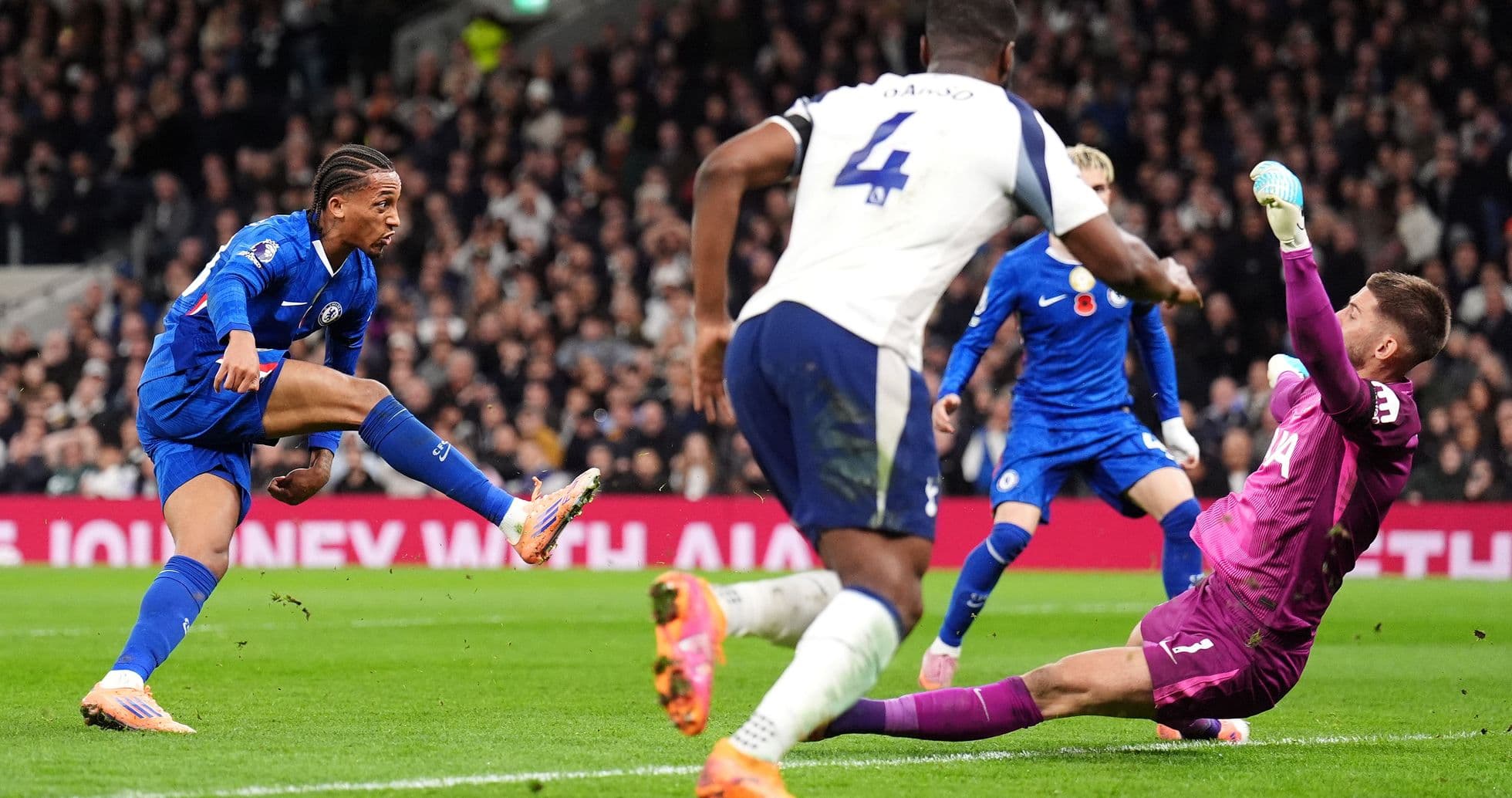
The first goal on 18 minutes encapsulated Chelsea’s offensive idea. P. Neto, nominally starting from the right in the band of three, drifted into the right half-space to receive and combine, then fed Fernandez arriving from the left interior channel. The goal by E. Fernandez, assisted by P. Neto, came from Chelsea breaking Tottenham’s first line and attacking the space behind the double pivot of Rodrigo Bentancur and Joao Palhinha before the centre-backs could step out. It was one of the few times Chelsea fully committed numbers forward, and it produced a clean, high-quality finish despite the overall modest xG.
Out of possession, Chelsea accepted Tottenham’s territorial dominance. Spurs completed 538 passes to Chelsea’s 425, with a higher accuracy (473 accurate, 88% vs Chelsea’s 355 accurate, 84%). But that extra circulation rarely translated into clear central penetrations. Tottenham’s 8 shots inside the box from 9 total illustrate how often they eventually forced the ball into crowded zones rather than slicing Chelsea open in transition. The hosts’ compact 4-4-2 pressing shape (with Liam Delap joining the first line and Palmer tucking in) funneled Spurs wide and then relied on the physicality of Fofana and Hato to deal with crosses and cutbacks.
Second Goal
The second Chelsea goal at 67 minutes was the tactical reward for that structure. With Tottenham pushing higher and their full-backs advanced, Chelsea exploited the gaps around Palhinha. Fernandez, now finding more space as Spurs chased the game, turned provider, assisting Andrey Santos. The move underlined the double pivot’s two-way value: Santos had spent much of the match as a stabiliser in front of the defence, but his late run into the box, arriving from deep, was untracked by a Tottenham midfield increasingly stretched between pressing and covering transitions.
Tottenham's Response
Tottenham’s response was to double down on attacking changes. At 69 minutes, Roberto De Zerbi reshaped his side with a triple substitution: J. Maddison (IN) came on for R. Kolo Muani (OUT), D. Spence (IN) came on for D. Udogie (OUT), and P. M. Sarr (IN) came on for J. Palhinha (OUT). The idea was clear: add creativity between the lines (Maddison), fresh width and overlapping threat (Spence), and a more dynamic runner in midfield (P. M. Sarr). The payoff arrived quickly. On 74 minutes, Richarlison scored for Tottenham, assisted by P. M. Sarr, after Spurs finally managed to combine centrally and then attack the box with a more chaotic, second-ball pattern. It was a direct consequence of Sarr’s vertical energy compared to Palhinha’s more positional game.
However, even as Spurs grew in territory and pressure, Chelsea’s game management and defensive organisation held. Substitutions were used primarily to refresh the defensive structure and add legs to protect the lead. At 74 minutes, T. Chalobah (IN) came on for J. Acheampong (OUT), shoring up the right side. Later, at 81 minutes, M. Sarr (IN) came on for W. Fofana (OUT), a move that suggested a shift towards a more flexible back line and extra midfield cover rather than pure like-for-like defending.
Final Minutes
In the final minutes, McFarlane rotated his attacking line to maintain pressing intensity and offer counter outlets: at 89 minutes A. Garnacho (IN) came on for P. Neto (OUT), D. Essugo (IN) came on for C. Palmer (OUT), and S. Mheuka (IN) came on for L. Delap (OUT). These changes preserved Chelsea’s ability to contest second balls and disrupt Tottenham’s build-up, even as fatigue set in.
Discipline also shaped the match’s rhythm and underlined Tottenham’s frustration. Spurs collected three yellow cards, all for “Foul”: at 28 minutes Pedro Porro (Tottenham), at 43 minutes Micky van de Ven (Tottenham), and at 63 minutes Destiny Udogie (Tottenham). Chelsea, while more compact, were not immune to late-game tension: at 79 minutes Jorrel Hato (Chelsea) was booked for “Time wasting”, at 85 minutes Marc Cucurella (Chelsea) for “Argument”, at 87 minutes Liam Delap (Chelsea) for “Foul”, and at 90+2 minutes Dário Essugo (Chelsea) for “Foul”. The pattern reflects a Tottenham side forced into aggressive defending as they chased the game, and a Chelsea side managing the clock and duels in the closing stages.
Goalkeeping Performance
In goal, R. Sanchez (Chelsea) and A. Kinsky (Tottenham) each finished with 2 saves. The underlying numbers, though, are telling: Tottenham generated 1.72 xG to Chelsea’s 0.63, yet both keepers recorded the same number of saves and both sides finished with 3 shots on goal for Spurs and 4 for Chelsea. The negative goals prevented values for both teams (Chelsea -1.08, Tottenham -1.08) indicate that finishing quality and defensive lapses, rather than outstanding goalkeeping, drove the final scoreline.
Statistically, Tottenham’s higher possession, better passing accuracy, and greater volume of shots inside the box suggest they controlled large stretches of the game. But Chelsea’s compact 4-2-3-1, the double pivot’s positional discipline, and the incisive use of half-spaces through Fernandez, Palmer and Neto produced more efficient chances. The 2-1 scoreline, with Chelsea leading 1-0 at half-time and extending to 2-0 before conceding, reflects a side that managed phases, transitions and substitutions more effectively than the raw numbers alone would predict.