Canada and Bosnia Draw 1–1 in World Cup Clash
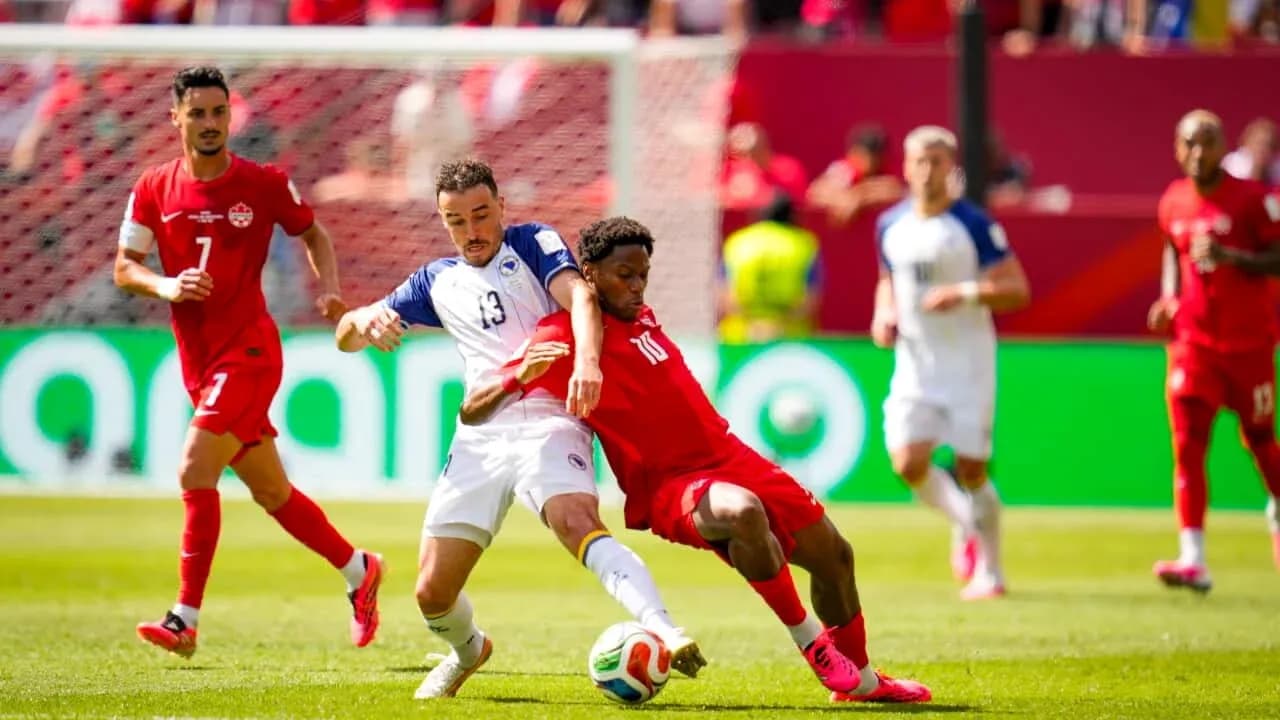
Under the cool Toronto evening at BMO Field, Canada’s World Cup return unfolded as a study in contrasts: structure versus spontaneity, caution versus late risk, and ultimately a 1–1 draw that leaves Group B finely balanced. Following this result, Canada sit 2nd in the group with 1 point and a goal difference of 0, Bosnia & Herzegovina 4th with the same return, but already shaped by very different tactical signatures.
Both coaches opened in a mirrored 4‑4‑2, but the blueprints carried distinct intentions. Jesse Marsch’s Canada were clearly built to control territory and tempo. With M. Crepeau behind a back four of A. Johnston, L. De Fougerolles, D. Cornelius and R. Laryea, the hosts had a defensive line comfortable stepping high, especially with De Fougerolles’ 50 passes and willingness to engage in 22 duels. In front of them, a flat midfield of T. Buchanan, I. Kone, S. Eustaquio and L. Millar was less about chalk-on-boots wingers and more about fluid occupation of half-spaces, feeding the front pair of J. David and T. Oluwaseyi.
Sergej Barbarez, by contrast, leaned into Bosnia & Herzegovina’s traditional steel. The back four of A. Dedic, N. Katic, T. Muharemovic and S. Kolasinac, shielded by a compact midfield of E. Bajraktarevic, B. Tahirovic, I. Basic and A. Memic, formed a low-to-mid block designed to funnel Canada wide and then contest every delivery. Up top, J. Lukic and E. Demirovic were tasked with punishing Canadian errors rather than manufacturing long spells of possession.
The early pattern reflected those intentions. Canada, whose season numbers now show 1.0 goals for and 1.0 against at home on average, tried to impose themselves, but Bosnia’s away profile – also 1.0 goals for and 1.0 against on their travels – hinted at a side comfortable in the role of spoiler. The visitors’ first-half discipline was underlined by the card timings: one yellow between 31–45 minutes (33.33% of their total yellows), another between 46–60 (33.33%), and a final caution in 91–105 (33.33%), a distribution that speaks to a team ready to foul in key phases to break rhythm rather than in panicked clusters.
Within that framework, individual duels defined the narrative.
On Canada’s right, the “Hunter vs Shield” battle pitted the creative thrust of Buchanan and the overlapping runs of Johnston against the defensive leadership of Kolasinac. Kolasinac’s numbers tell a complete story: 21 passes at 71% accuracy, 3 tackles, and crucially 2 blocked shots. Every time Canada tried to isolate him with Buchanan or pull him out with Millar’s switches of play, he read the danger early. His assist in the match – coupled with his presence in both the top scorers and top assists lists – underlines his dual role as defensive anchor and deep playmaker. For Canada, Johnston’s own line – 33 passes at 72% accuracy, 1 key pass, and 1 successful dribble – shows how often he tried to break that line, but Bosnia’s left side rarely fractured.
Centrally, the “Engine Room” duel revolved around Eustaquio and Kone against Tahirovic and Basic. Canada’s plan was clear: use Kone’s vertical running and Eustaquio’s distribution to draw Bosnia’s midfield out and create lanes into David’s feet. Bosnia responded by compressing the central lane and trusting their centre-backs to handle anything aerial. Katic, in particular, was immense: 5 tackles, 2 blocked shots, 3 interceptions and 24 duels contested, winning 15. He repeatedly stepped in front of David and Oluwaseyi, turning promising Canadian combinations into loose balls that Bosnia could clear or turn into counters.
Up front, Lukic embodied Bosnia’s counter-attacking threat. His inclusion among the competition’s early top scorers and carded players is no accident: 1 goal, 3 shots (2 on target), 13 duels with 10 won, and a yellow card reflect a forward who thrives in chaos. He pressed, he fouled when needed, and he attacked the space behind Canada’s high line. For Canada, that high line – with De Fougerolles and Cornelius stepping aggressively – was both weapon and risk. De Fougerolles’ yellow card, one of Canada’s cautions that fall 50.00% in the 0–15 minute window and 50.00% in 46–60, underlines how early and then again early in the second half Canada were willing to stop transitions at source.
The game’s turning point came from the bench. With Canada chasing, Marsch introduced C. Larin and P. David, and the dynamic of the front line shifted. Larin’s cameo was brutally efficient: in total this campaign he has 1 goal from 1 shot, 1 shot on target, and 3 duels with 2 won in just 14 minutes, plus a rating of 7.7. His presence gave Canada a true penalty-box reference, allowing David to drift and link. P. David, meanwhile, delivered the subtlety: 1 assist, 1 key pass, 1 shot, 10 duels contested, and 3 won. He did not dominate, but his willingness to occupy awkward pockets forced Bosnia’s centre-backs to defend facing their own goal for the first time.
Those changes turned a static 4‑4‑2 into something more layered: David between the lines, Larin pinning Katic and Muharemovic, and wide midfielders tucking in to overload central zones. Bosnia responded with deeper lines and more direct clearances to Demirovic, who himself put in 3 tackles and drew 1 foul, a forward doing as much defending as attacking by the final whistle.
Disciplinary patterns framed the closing stages. Canada’s season card profile – 2 yellow cards, split evenly between 0–15 and 46–60 – suggests a side that starts halves aggressively rather than losing their heads late. Bosnia’s spread, with that final yellow in 91–105, hints at a team prepared to absorb pressure and accept tactical fouls as the clock runs down. It is no surprise, then, that neither side saw red; both managed the edge without tipping over it.
From a statistical prognosis standpoint, the draw feels aligned with the early data. Both teams now have, overall, 1 goal for and 1 against, no clean sheets, and no penalties taken or missed. Canada’s home average of 1.0 goals scored and conceded, and Bosnia’s away mirror of 1.0 and 1.0, point to evenly matched units whose margins will be defined not by volume of chances but by ruthlessness in the box.
The early xG story – inferred from shot quality rather than sheer volume – would likely show Bosnia’s first-half chances carrying higher value, with Canada’s late surge driven by the Larin–P. David axis evening the ledger. Defensively, Katic and Kolasinac project as sustainable pillars for Bosnia, while Canada’s back line, led by the combative but occasionally overexposed De Fougerolles, will need better protection from midfield in future group games.
Following this result, both squads emerge with clear identities. Canada are a side whose best version may yet be with Larin and P. David more heavily integrated into the starting picture, adding penalty-box threat and creative unpredictability to a solid 4‑4‑2 shell. Bosnia & Herzegovina, meanwhile, look every inch a tournament team: rugged at the back, opportunistic through Lukic and Demirovic, and anchored by a full-back in Kolasinac who can both block and build.
The tactical preview for their next outings writes itself: can Canada convert territorial control into higher-quality chances earlier, and can Bosnia maintain this defensive intensity when asked to chase a game rather than protect it? On the evidence at BMO Field, both have the tools; what remains is the refinement of timing, risk, and the small details that turn 1–1 stalemates into defining World Cup victories.