Cagliari vs Udinese: A Tactical Breakdown of the 2–0 Defeat
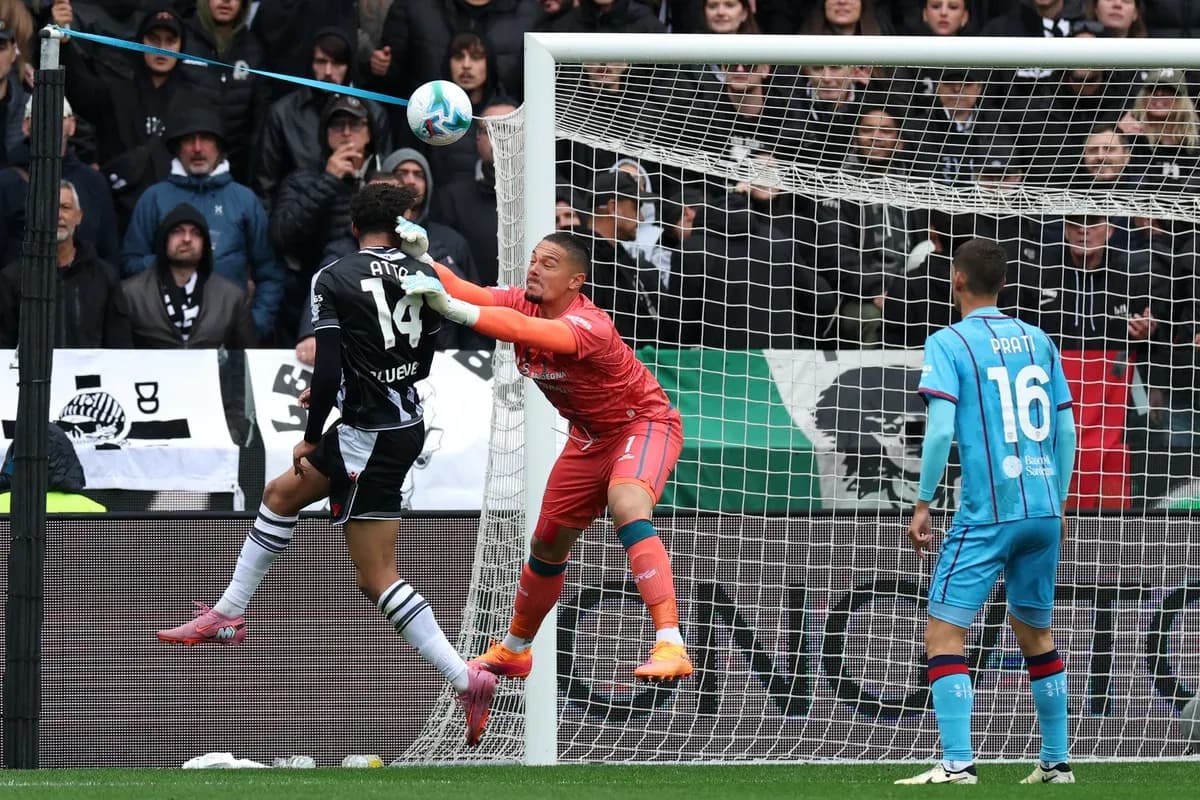
Under the pale early-afternoon light at the Unipol Domus, Cagliari’s season-long tightrope act met Udinese’s upward stride, and it was the visitors who walked away with a 2–0 win that felt like a distilled version of both clubs’ 2025–26 identities.
Following this result, the league table context is stark. Cagliari sit 16th on 37 points from 36 matches, with a goal difference of -15, their campaign defined by narrow margins and a constant flirtation with danger. Udinese, by contrast, are 9th with 50 points and a goal difference of -1, a mid-table side with the statistical profile of a team that can hurt you, especially on their travels.
I. The Big Picture – Structures and Season DNA
Cagliari’s choice of a 5-3-2 under Fabio Pisacane was a clear nod to survival instincts. With 20 goals scored at home and 22 conceded across 18 matches, their Unipol Domus story has been about small numbers and fine details: an average of 1.1 goals scored and 1.2 conceded at home, a team that rarely runs away with a game but also rarely gets blown away. The five-man back line of M. Palestra, J. Pedro, A. Dossena, J. Rodriguez and A. Obert was built as a shield first, platform second.
Udinese, however, arrived with the swagger of a side that travels well. On their travels this season they have scored 27 goals and conceded 26 in 18 away matches, averaging 1.5 goals for and 1.4 against away from home. Kosta Runjaic’s 3-4-3 – B. Mlacic, T. Kristensen and O. Solet as the back three, with K. Ehizibue and H. Kamara wide – was aggressive, almost provocative: three centre-backs, but a front line of N. Zaniolo, A. Buksa and A. Atta designed to stretch every seam of Cagliari’s defensive block.
The first half, which ended 0–0, reflected those seasonal numbers. Cagliari’s midfield trio of M. Adopo, G. Gaetano and M. Folorunsho tried to compress the central lanes, while S. Esposito and P. Mendy worked as running forwards more than classic strikers, asked to chase, press and survive. Udinese, patient and methodical, probed through J. Karlstrom and J. Piotrowski, using Zaniolo between the lines to unsettle Cagliari’s back five.
II. Tactical Voids – Absences and Discipline
The team sheets told their own story of what was missing. Cagliari were without a whole layer of attacking and creative options: G. Borrelli (thigh injury), M. Felici (knee injury), R. Idrissi (knee injury), J. Liteta (thigh injury), L. Mazzitelli (injury) and L. Pavoletti (knee injury) all absent. For a side that overall scores just 1.0 goals per game in total this campaign and has failed to score in 14 matches in total, losing that many forward and midfield profiles narrowed Pisacane’s choices to something close to austerity football.
Udinese’s absences were fewer but significant in structure. J. Ekkelenkamp (leg injury) removed a potential link player in midfield, while A. Zanoli (knee injury) took away depth at the back. Most crucially, C. Kabasele’s suspension for yellow cards deprived Runjaic of an experienced defensive leader. It forced greater responsibility onto T. Kristensen and O. Solet to marshal the line.
Disciplinary trends across the season shaped the emotional temperature of the game. Cagliari are a late-card team: 26.92% of their yellow cards arrive from 76–90 minutes, with a spike of red cards in the same phase (both of their reds this season have come in that late window). Udinese, meanwhile, see 26.87% of their yellows between 61–75 minutes and 22.39% from 76–90, a side that tends to grow more combative as fatigue bites. That shared tendency for late aggression meant the final quarter of an hour was always likely to be played on a disciplinary tightrope.
III. Key Matchups – Hunter vs Shield, Engine Room vs Enforcer
The “Hunter vs Shield” narrative was inverted here. Udinese’s most prolific scorer this season, K. Davis, started on the bench. With 10 league goals and 4 assists, plus 37 total shots and 24 on target, he has been the cutting edge of Runjaic’s attack. His presence among the substitutes was a tactical card to be played against a Cagliari defence that, at home, concedes 1.2 goals on average and has kept 6 clean sheets at the Unipol Domus.
Instead, the early hunting was left to A. Buksa and A. Atta, with Zaniolo drifting into pockets. Zaniolo’s season numbers – 5 goals, 6 assists and 53 key passes – underline his status as Udinese’s creative fulcrum. Here, he was the player who repeatedly tested the seams between Obert and Rodriguez, dragging Cagliari’s line into uncomfortable decisions: follow him into midfield and risk space in behind, or hold position and give him time to turn.
On the other side, Cagliari’s primary creative engine was S. Esposito. With 6 goals, 5 assists and 65 key passes this season, he has been the one to stitch their attacks together. Stationed as a forward in the 5-3-2 but with the instincts of a midfielder, Esposito dropped into the half-spaces to help Gaetano and Folorunsho progress the ball. His duel with Udinese’s central pair, Karlstrom and Piotrowski, was the “Engine Room” battle that would decide whether Cagliari could escape their own half with any coherence.
Defensively, Adam Obert was Cagliari’s enforcer and risk-taker. Across the season he has accumulated 9 yellow cards and 1 yellow-red, with 63 tackles, 18 blocked shots and 40 interceptions – a defender who steps out, intervenes and lives close to the disciplinary line. Against Udinese’s fluid front three, Obert’s aggression was both necessary and dangerous, especially given Cagliari’s late-game card profile.
IV. Statistical Prognosis – xG Shadows and Defensive Solidity
Even without explicit xG data, the season’s statistical scaffolding frames this 0–2 as something close to par. Udinese’s away average of 1.5 goals for and 1.4 against suggests that, on their travels, they play open, chance-rich football. Cagliari’s home profile – 1.1 scored, 1.2 conceded – points to low-margin games where a clinical opponent can tilt the balance.
Udinese’s 11 clean sheets in total, 5 of them away, speak to a side that, when their structure is right, can shut games down after taking a lead. Here, with M. Okoye behind a disciplined back three and a hard-working midfield, they were able to absorb Cagliari’s sporadic pressure and then punish them in transition and set attacking patterns.
Cagliari, by contrast, have failed to score in 14 matches in total this campaign, and this was another entry in that ledger. Their penalty record – 2 taken, 2 scored, 100.00% conversion – never came into play; Udinese’s own perfect penalty record (5 from 5) likewise remained a latent threat rather than an active weapon.
In narrative terms, this match felt less like an upset and more like a statistical inevitability made flesh. A depleted Cagliari, structurally conservative and short on attacking depth, ran into an Udinese side whose away numbers and creative core in Zaniolo are those of a team comfortable dictating terms. The 2–0 scoreline fits neatly within the expected band: Udinese hitting close to their away scoring average, Cagliari once again finding that in a season of narrow margins, they too often end up on the wrong side of them.