Brazil and Morocco's Tactical Duel Ends in 1-1 Draw
Brazil and Morocco opened their World Cup Group Stage campaign at MetLife Stadium with a 1-1 draw that felt like a genuine tactical duel rather than a loose, end-to-end contest. Both sides set up in a mirrored 4-2-3-1, but interpreted the shape very differently: Brazil prioritised structured possession and occupation of the half-spaces, while Morocco leaned into compactness, vertical surges and strong wing-back play from Achraf Hakimi and Noussair Mazraoui.
Brazil’s 54% possession and 501 passes (441 accurate, 88%) underline Carlo Ancelotti’s plan to control rhythm through Casemiro and Bruno Guimarães at the base, with Lucas Paquetá floating as a high playmaker. The front line of Raphinha wide right and Vinícius Júnior off the left looked to isolate full-backs and then attack the box, reflected in Brazil’s 9 shots inside the box out of 12 total. The high volume of shots from close range, combined with an xG of 1.24, shows a focus on engineered, high-quality chances rather than speculative efforts.
Morocco, under Mohamed Ouahbi, accepted a smaller share of the ball (432 passes, 375 accurate, 87%) but matched Brazil’s total shots (12) and actually shaded the underlying threat with an xG of 1.28. Their 4-2-3-1 morphed into a 4-4-1-1 without the ball, with Ayyoub Bouaddi and Neil El Aynaoui screening the back four and Brahim Díaz drifting inside from the right to connect with Ismael Saibari. The fact that Morocco produced an even split between shots inside (6) and outside the box (6) illustrates their dual threat: they were willing to shoot from range but also capable of breaking Brazil’s lines to reach more advanced zones.
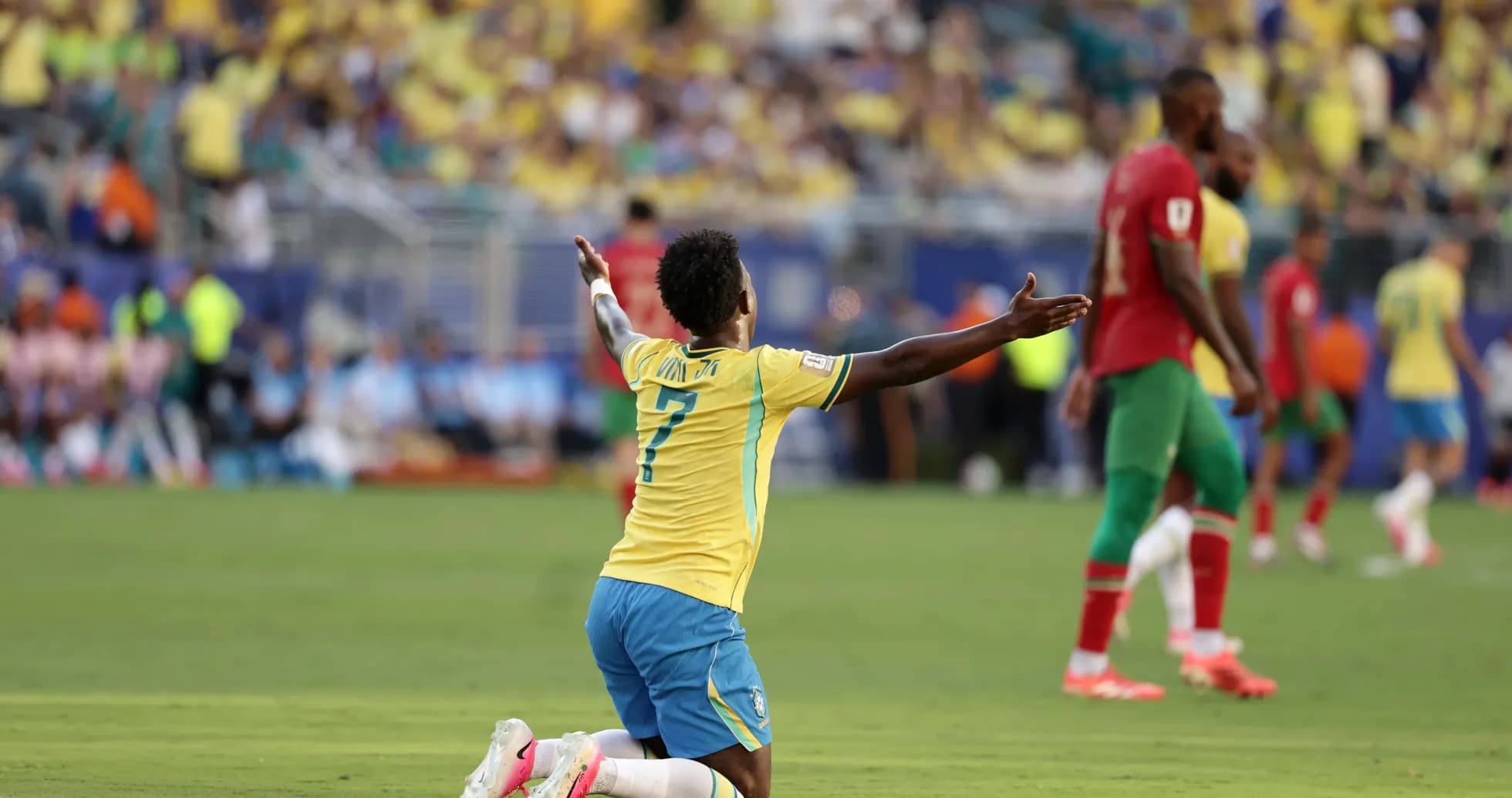
The scoring patterns reflected these tactical identities. Morocco’s opener from Saibari, assisted by Brahim Díaz, came from a well-timed vertical connection through Brazil’s double pivot, exploiting the space between Marquinhos and Gabriel Magalhães. It was a textbook example of Morocco’s plan: absorb, then punch through the centre at speed. Brazil’s equaliser from Vinícius Júnior, set up by Bruno Guimarães, stemmed from sustained pressure and combination play, with Bruno stepping higher to overload Morocco’s midfield line and release Vinícius into a favourable one-v-one.
Defensively, both back fours were heavily involved. Brazil’s 4 blocked shots and Morocco’s 6 show how often central defenders and holding midfielders had to step out to close shooting lanes. Marquinhos and Gabriel Magalhães were tasked with holding a relatively high line to compress the pitch and keep Brazil’s attacking midfielders close to the ball; that risk was visible on Morocco’s transitions but also helped Brazil maintain territorial control and a steady supply of possession in the attacking third.
On the flanks, Brazil’s full-backs played asymmetrical roles. Douglas Santos tended to support Vinícius with overlapping runs and wide width, allowing Vinícius to drive inside, while Roger Ibañez stayed slightly more conservative behind Raphinha, especially before his substitution. Morocco’s response was to keep Hakimi and Mazraoui ready to spring forward once possession was regained, turning wide defensive phases into immediate counterattacking platforms. This dynamic contributed to Morocco’s ability to generate 2 shots on goal from only 12 attempts, as their best looks came at the end of quick, direct moves rather than long spells of pressure.
In midfield, the disciplinary moments for Brazil were revealing. Casemiro’s yellow card for “Foul” at 37' and Roger Ibañez’s yellow for “Foul” at 43' both came as Morocco’s attacking midfielders found pockets between the lines. Those bookings effectively constrained Brazil’s aggression in the second half, encouraging Ancelotti to adjust his personnel early after the break. The double substitution at 46', with Danilo (IN) coming on for Roger Ibañez (OUT) and Fabinho (IN) for Casemiro (OUT), was a clear attempt to stabilise the right side and refresh the holding role without risking a red card.
From that point, Brazil’s structure shifted subtly. Danilo offered more controlled build-up and positional discipline at right-back, while Fabinho’s deeper positioning allowed Bruno Guimarães to push higher more consistently. Later attacking changes — Luiz Henrique (IN) for Igor Thiago (OUT) and Matheus Cunha (IN) for Lucas Paquetá (OUT) at 61', followed by Danilo Santos (IN) for Bruno Guimarães (OUT) at 80' — suggested a move towards fresher legs and more direct running rather than a wholesale tactical re-think. Brazil maintained their 4-2-3-1 shell but rotated the profiles in the advanced line to chase a second goal.
Morocco’s substitutions were equally strategic. At 64', Samir El Mourabet (IN) for Azzedine Ounahi (OUT) and Chemsdine Talbi (IN) for Brahim Díaz (OUT) refreshed the attacking midfield band, with Talbi offering more vertical running compared to Díaz’s playmaking. The triple change at 80' — Ayoube Amaimouni Echghouyab (IN) for Bilal El Khannouss (OUT), Anass Salah-Eddine (IN) for Noussair Mazraoui (OUT) — rebalanced the left side and added defensive energy as Morocco looked to protect the draw while still carrying counterthreat. Soufiane Rahimi (IN) for Ismael Saibari (OUT) at 89' was a late attempt to introduce fresh pace up front for any final transitions.
In goal, Alisson (Brazil) faced relatively few shots on target, with Brazil credited with 1 goalkeeper save, but his positioning and command of the box contributed to limiting Morocco’s 6 blocked shots to efforts from less dangerous angles. Bono (Morocco), with 3 goalkeeper saves, had the busier evening in terms of direct interventions, matching Brazil’s higher volume of shots on goal and preventing the South Americans from converting their territorial advantage into a winning margin. The goals prevented metric, at 0.46 for both sides, underlines that each goalkeeper added similar value relative to the quality of chances faced, even if the raw save counts differed.
The statistical verdict reinforces the sense of a finely balanced tactical contest. Brazil’s slight edge in possession and passing accuracy did not translate into a clear superiority in chance quality, as reflected by the near-identical xG figures (Brazil 1.24, Morocco 1.28). Fouls were close — 15 for Brazil, 14 for Morocco — but only Brazil’s infractions escalated into bookings, subtly shaping second-half risk-taking. Corner kicks (5-0 to Brazil) highlight where the game was played: more often in Morocco’s defensive third, yet without decisive end product.
Both teams will leave MetLife Stadium with mixed feelings. Brazil showed control, structure and the ability to manufacture good positions for Vinícius Júnior, but lacked the final ruthlessness to turn pressure into a second goal. Morocco demonstrated that their compact 4-2-3-1 and transition play can trouble elite opposition, with Saibari and Díaz especially effective between the lines. Tactically, the 1-1 draw felt like an accurate reflection of two well-prepared sides whose contrasting game plans largely cancelled each other out.