Brazil vs Morocco: 1-1 Draw Analysis
Brazil 1-1 Morocco at MetLife Stadium opens Group C with both sides moving to 2 points, Brazil staying second and Morocco remaining top on goal difference after back-to-back draws that leave the group finely balanced rather than allowing either favourite to pull clear.
Match Report
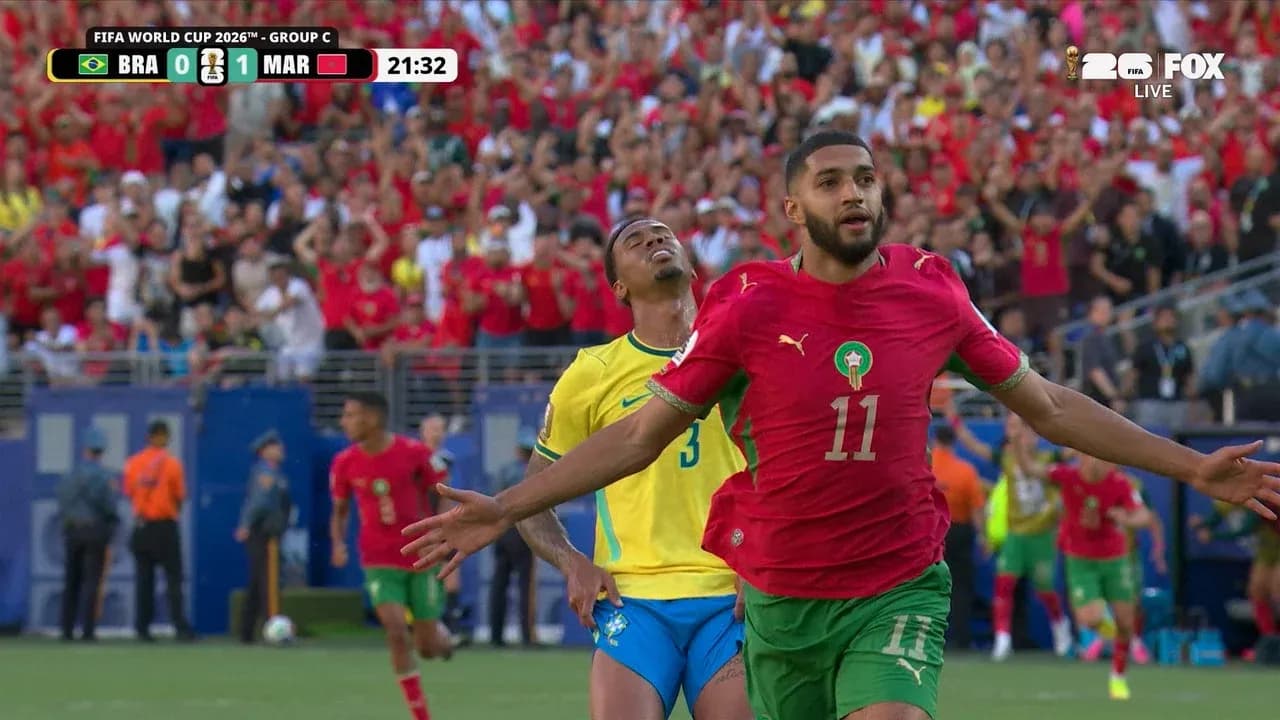
The game’s first major incident came on 21', when Morocco struck the opener. A sharp transition down the right ended with a cut-back into the box and a composed finish: 21' Morocco goal — I. Saibari (assisted by B. Diaz) for 0-1. The move underlined Morocco’s intent to exploit space behind Brazil’s full-backs.
Brazil responded with more aggressive occupation of the half-spaces and were rewarded on 32'. A patient spell of possession drew Morocco’s block narrow before a vertical pass split the lines and released the winger: 32' Brazil goal — Vinicius Junior (assisted by Bruno Guimaraes) for 1-1. The equaliser reflected Brazil’s improved circulation between Bruno Guimaraes and Lucas Paqueta in front of the Moroccan double pivot.
The first booking arrived on 37', when Brazil’s holding midfielder mistimed a challenge while trying to stop another Moroccan break: 37' Casemiro (Brazil) — yellow card (Tripping). Brazil’s right-sided centre-back followed him into the book shortly before the interval after stepping out late to contest a duel near halfway: 43' Ibanez (Brazil) — yellow card (Tripping).
At half-time, Carlo Ancelotti moved decisively to adjust his back line and midfield balance. On 46', Danilo came on at right-back with a like-for-like swap that also removed a booked defender: 46' Danilo replaced Ibanez (Brazil). Simultaneously, Brazil refreshed the holding role to manage Casemiro’s caution and add slightly more mobility in front of the defence: 46' Fabinho replaced Casemiro (Brazil).
Seeking more central penetration, Brazil introduced an extra forward threat on 61', reshaping the attacking structure: 61' M. Cunha replaced Lucas Paqueta (Brazil). A minute later, they changed the profile of the number 9, adding more wide-to-central movement and dribbling ability: 62' Luiz Henrique replaced I. Thiago (Brazil). These two changes tilted Brazil towards a more fluid front line, with increased rotations between the wide players and the striker.
Morocco responded with a double substitution on 65' to restore energy and pressing intensity in the advanced midfield line. Their key creator made way after a high-intensity first hour: 65' C. Talbi replaced B. Diaz (Morocco). In parallel, fresh legs were added in central midfield to maintain compactness against Brazil’s growing control: 65' S. El Mourabet replaced A. Ounahi (Morocco).
As Brazil pushed for a winner in the final quarter-hour, Morocco sought to secure their defensive flanks. On 80', they introduced a new left-back to deal with Brazil’s right-sided overloads: 80' A. Salah-Eddine replaced N. Mazraoui (Morocco). At the same time, they altered their attacking midfield profile, adding a more direct runner to threaten the space behind Brazil’s advanced full-backs: 80' A. Amaimouni replaced B. El Khannouss (Morocco).
Brazil’s last midfield change came on 80', aimed at sustaining the passing tempo and counter-press: 80' Danilo Santos replaced Bruno Guimaraes (Brazil), keeping a double pivot behind the front four while chasing a late goal.
Morocco made the final change of the night on 89', injecting fresh pace up front to contest long clearances and counter-attacks as Brazil committed numbers forward: 89' S. Rahimi replaced I. Saibari (Morocco). Despite these late adjustments, neither side could break the deadlock, and the match closed at 1-1.
Fixture Statistics & Tactical Audit
- xG: Brazil 1.24 vs 1.28 Morocco
- Possession: Brazil 54% vs 46% Morocco
- Shots on Target: Brazil 4 vs 2 Morocco
- Goalkeeper Saves: Brazil 1 vs 3 Morocco
- Blocked Shots: Brazil 4 vs 6 Morocco
The 1-1 scoreline broadly reflected the underlying numbers, with xG almost level (Brazil 1.24 vs 1.28 Morocco) suggesting neither side did enough to claim they were clearly superior. Brazil were more dominant in territorial terms (54% possession, 501 passes at 88% accuracy) but turned that control into only four shots on target, often being forced into blocked efforts against Morocco’s compact low and mid block (six Moroccan blocks). Morocco, by contrast, were more selective but efficient on the break, generating a similar xG from fewer shots on goal, indicating that their transitions produced slightly higher-quality chances even if they tested Alisson only twice. Bono’s three saves, mirroring Brazil’s four efforts on target, underline that Brazil’s attacks were more frequent but not overwhelmingly dangerous, making a draw a fair reflection of the balance between Brazil’s structured pressure and Morocco’s organised, counter-attacking threat.
Standings Update & Seasonal Impact
Both teams came into this match with 1 point, 1 goal scored and 1 conceded, and they leave East Rutherford still level on points and goal difference after another 1-1 draw. Brazil move from 1 to 2 points, with their goals for rising from 1 to 2 and goals against from 1 to 2, keeping their goal difference at 0. Morocco likewise climb from 1 to 2 points, their goals for increasing from 1 to 2 and goals against from 1 to 2, also maintaining a goal difference of 0. Within Group C, Morocco remain top on existing tie-breakers ahead of Brazil in second, with both firmly in the “Advancing to the Round of 32” positions but leaving qualification to be decided by the remaining group fixtures rather than taking a decisive early step here.
Lineups & Personnel
Brazil Starting XI
- GK: Alisson
- DF: Douglas Santos, Gabriel Magalhães, Marquinhos, Roger Ibañez
- MF: Bruno Guimarães, Casemiro, Vinícius Júnior, Raphinha, Lucas Paquetá
- FW: Igor Thiago
Morocco Starting XI
- GK: Bono
- DF: Noussair Mazraoui, Chadi Riad, Issa Diop, Achraf Hakimi
- MF: Ayyoub Bouaddi, Neil El Aynaoui, Bilal El Khannouss, Azzedine Ounahi, Brahim Díaz
- FW: Ismael Saibari
Post-Match Verdict
This was a controlled but not clinical performance from Brazil (4 shots on target from 12 attempts, xG 1.24), whose possession structure and passing accuracy (88%) gave them territorial dominance without consistently destabilising Morocco’s compact block. The early vulnerability in defensive transition, exposed on Saibari’s opener, was partly corrected by the half-time introduction of Danilo and Fabinho, which reduced Morocco’s ability to counter but did not translate into a surge of clear chances. Morocco delivered a disciplined, defensively robust display (six blocked shots, only four shots on target conceded) and were tactically efficient in transition, generating an xG of 1.28 from just two shots on goal. Their layered substitutions in midfield and full-back preserved compactness and fresh legs, allowing them to absorb pressure without collapsing. In the end, Brazil’s structured control and Morocco’s organised resistance cancelled each other out, leaving both with a result that matches the balance of chances rather than the ambitions of two sides expected to progress deep into the tournament.