Arsenal vs Burnley Tactical Analysis: A Clash of Opposites
Under the London lights at Emirates Stadium, this was a meeting of opposites. Arsenal, top of the Premier League table heading into this game with 82 points and a goal difference of 43, carried the poise of a side accustomed to dictating title races. Burnley arrived 19th, marooned on 21 points with a goal difference of -37, clinging to slim mathematical hopes and a need for something improbable. The 1-0 scoreline at full time felt modest, but the tactical story underneath was clear: an elite machine managing risk against a fragile side trying to survive.
Mikel Arteta trusted his season’s core identity, rolling out a 4-3-3 that has been his most-used shape, deployed 24 times in total this campaign. Arsenal’s season numbers underpinned that confidence: at home they had played 19 league matches heading into this game, winning 15, drawing 2 and losing only 2, with 41 goals for and just 11 against. An average of 2.2 goals for and 0.6 against at Emirates Stadium is the profile of a bully in their own backyard, and Arteta’s selection reflected a desire to control rather than improvise.
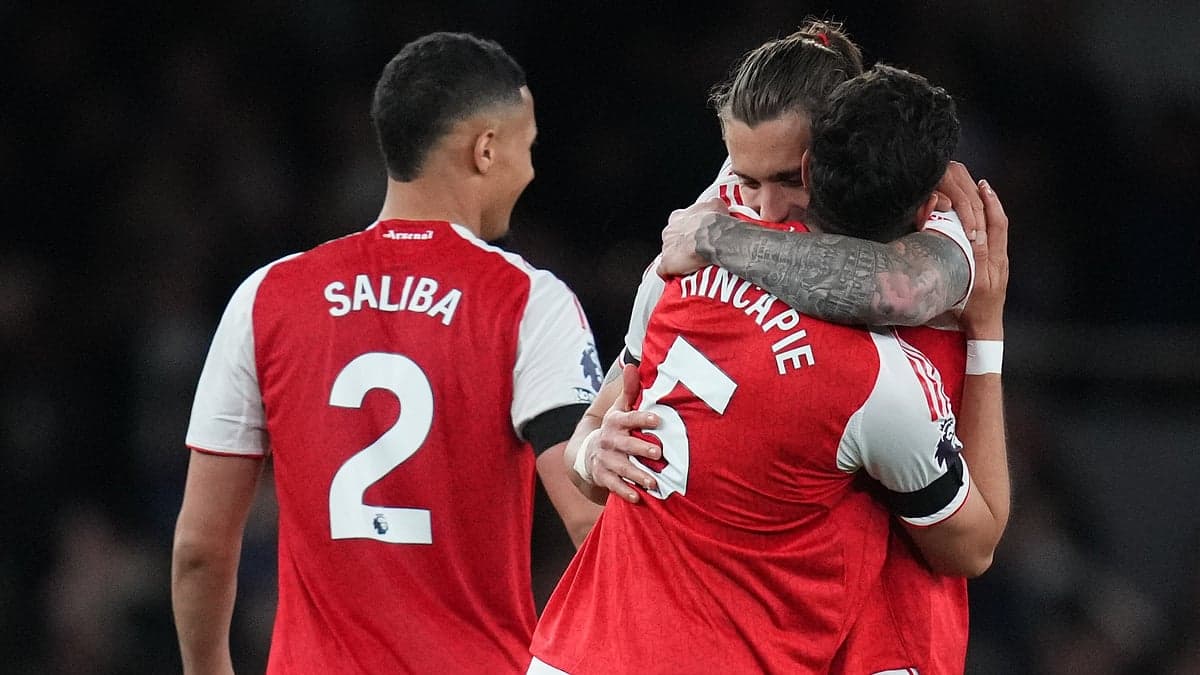
The back four in front of D. Raya was carefully curated. W. Saliba and Gabriel formed the central axis, with C. Mosquera to the right and R. Calafiori to the left. Without B. White (knee injury) and J. Timber (ankle injury), Arsenal lost some of their usual right-sided build-up variety, but Mosquera offered a more conservative, physically robust presence to lock down transitions. Calafiori, by contrast, is a natural progression outlet, stepping into midfield lanes to support the first phase.
Midfield Dynamics
In midfield, D. Rice anchored the structure, flanked by M. Ødegaard and E. Eze. This was Arsenal’s “engine room” in pure form: Rice as the enforcer, Ødegaard the metronome and line-breaker, Eze the dribbler who can destabilise compact blocks. Ødegaard’s league profile this season – 828 total passes with 40 key passes and 6 assists – explains why Arteta keeps him central to the plan; he is the passer who threads the needle when low blocks refuse to open. Rice, meanwhile, is the insurance policy behind that creativity, ensuring Arsenal’s overall record of only 26 goals conceded in 37 matches remains intact.
Ahead of them, the front three carried both craft and end product. B. Saka on the right, L. Trossard on the left and K. Havertz through the middle created a fluid trident. Saka’s 7 goals and 5 assists in total this campaign, underpinned by 63 key passes and 50 successful dribbles, make him the primary “hunter” in wide areas. Trossard, with 6 goals and 6 assists, is the league’s 10th-ranked provider by rating position, and his 36 key passes plus 757 total passes show how he doubles as a playmaker from the flank. Havertz, nominally the striker, often vacated the line to allow those two to attack the box.
On the bench, Arteta had a different type of hunter waiting: V. Gyökeres, Arsenal’s top league scorer with 14 goals. His 40 total shots, 22 on target, and 3 penalties scored from 3 underline a penalty-box forward built for decisive moments. With 232 duels contested and 73 won, he also offers a more direct, physical option if the game state demands chaos rather than control. G. Martinelli and N. Madueke provided extra pace and one‑v‑one threat, while M. Zubimendi and M. Lewis-Skelly gave Arteta the tools to re-balance midfield if Burnley ever wrestled back territory.
Burnley's Tactical Setup
Burnley, by contrast, arrived as a side shaped by damage limitation. Their season numbers on their travels were stark: 19 away matches played, 2 wins, 3 draws and 14 defeats, scoring 20 and conceding 46. An away average of 1.1 goals for and 2.4 against framed Mike Jackson’s dilemma: how to survive long enough to make Arsenal nervous.
He set up in a 4-2-3-1, a shape Burnley have used 12 times in total this campaign. M. Weiss started in goal, shielded by a back four of K. Walker, A. Tuanzebe, M. Esteve and Lucas Pires. Walker’s presence was both an asset and a risk. Over the season he has accumulated 9 yellow cards, underlining his aggressive defensive style: 55 tackles, 10 blocked shots and 44 interceptions show a defender who steps out rather than sits back. At Emirates, that front-foot instinct was vital against Trossard and Calafiori on his side, but also a disciplinary tightrope.
In midfield, Florentino and L. Ugochukwu formed the double pivot, tasked with screening central spaces where Ødegaard and Eze like to drift. Ahead of them, the trio of L. Tchaouna, H. Mejbri and J. Anthony supported Z. Flemming, who led the line. Flemming is Burnley’s standout attacking figure this season: 10 total league goals, 37 shots (20 on target) and 2 penalties scored. He is also combative, with 268 duels contested and 109 won, plus 5 yellow cards. He embodies Burnley’s “hunter” profile – a forward who must both finish and fight for territory.
Burnley’s bench told another tactical story. J. Laurent, among the league’s top red-card recipients with 1 dismissal and 7 yellows, offers energy and ball-winning (48 tackles, 8 blocked shots, 27 interceptions) but carries clear disciplinary risk. In a match where Burnley were likely to spend long spells without the ball, his introduction would always be a double-edged sword: more bite in midfield, but a real chance of leaving his side a man down. J. Ward-Prowse provided set-piece quality and passing range, while J. Bruun Larsen, M. Edwards and Z. Amdouni were the counter-punchers, suited to exploiting any over-commitment from Arsenal’s full-backs.
Absentees and Disciplinary Profiles
The absentees sharpened the tactical edges. For Arsenal, losing M. Merino (foot injury) removed a hybrid eight who could have rotated with Rice or Eze, and the absence of White and Timber narrowed Arteta’s options for asymmetrical full-back roles. It meant more responsibility on Mosquera and Calafiori to manage both width and rest defence. For Burnley, missing J. Beyer (hamstring injury) weakened their central defensive depth, and J. Cullen’s knee injury stripped a calmer passing presence from the pivot, nudging Jackson towards a more combative rather than constructive midfield.
Disciplinary profiles shaped the emotional temperature. Arsenal’s season-long yellow card distribution shows a late-game edge: 26.00% of their yellows arrive between 76-90 minutes, and 20.00% between 61-75. They finish games on the front foot but also at the limit of intensity. Burnley, meanwhile, cluster cards in the middle and late stages: 20.31% of their yellows between 16-30 minutes, 18.75% between 76-90, and another 18.75% between 91-105. Add their three red-card time ranges – one each in 31-45, 76-90 and 91-105 – and you get a picture of a team that frays as pressure mounts.
Overlay that with the “hunter vs shield” dynamic and the contours of the match become clear. Arsenal’s overall scoring average of 1.9 goals per game, rising to 2.2 at home, ran straight into a Burnley defence conceding 2.0 goals per game overall and 2.4 on their travels. Arsenal’s shield, by contrast, has been elite: only 0.7 goals conceded per match in total, 0.6 at home, against a Burnley attack that averages 1.0 goals per game in total and 1.1 away. Statistically, this was a contest between one of the division’s most balanced units and one of its most porous.
Within that frame, the 1-0 scoreline feels almost generous to Burnley. Following this result, the numbers still tell the same story: Arsenal as a side that controls territory, tempo and risk, Burnley as a team forced to chase games with limited tools. Even without explicit xG data, the season-long shot and goal profiles suggest that if this match were played ten times with these squads, Arsenal would dominate the chance quality in the majority.
In the end, the tactical preview and the narrative of the night aligned. Arsenal’s 4-3-3, built on Rice’s control and Ødegaard’s craft, suffocated a Burnley side that needed chaos but rarely found it. The visitors’ best hope lay in Flemming’s opportunism and set-piece variance, perhaps with Ward-Prowse or Laurent tilting the midfield battle. But against a home side that has kept 11 clean sheets at Emirates and 19 in total this campaign, that was always a thin margin. The squad profiles, disciplinary histories and season statistics all pointed in one direction – and the narrow scoreline simply disguised how thoroughly the structural battle had already been won.