
World Cup Stars: Messi, Mbappe, Ronaldo and Emerging Talents
The World Cup has its leading men. Lionel Messi is gliding through defenders at 39, Kylian Mbappe is once again a force of nature on the biggest stage, Erling Haaland is bullying backlines, and now Cristiano Ronaldo has thundered into the conversation with a ruthless display against Uzbekistan.
The expanded 48-team format was supposed to dilute the drama. Instead, it has detonated it. Cape Verde, Japan, Egypt and a cluster of so‑called minnows have refused to play their assigned roles, turning the group stage into a sprawl of tight contests and awkward questions for the traditional powers.
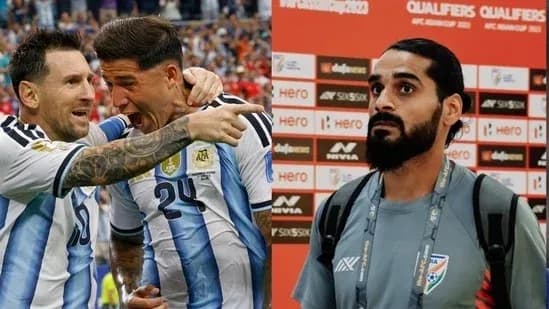
From a studio chair far from the chaos, Sandesh Jhingan is watching it all with a defender’s eye and a player’s heart.
Messi at 39: “He makes you feel like a kid”
Five goals in two games. Braces, hat-tricks, the same left foot, the same cold-blooded calm. Messi is not easing himself into this World Cup; he is ripping through it.
For Jhingan, who has spent his career trying to stop attackers, the numbers only tell half the story. The other half is emotional.
He recalls a moment from the Zee5 show: a 100-year-old woman in the stands, watching Messi. The image sticks with him because he recognises the feeling. Messi, he says, makes everyone feel like a child again. That is the magic. That is the difference between greatness and legend.
But there is a hard, tactical edge beneath the romance. Messi’s longevity, Jhingan insists, is built on consistency at an absurd level. To keep delivering, year after year, on the biggest stage, is – in his words – the greatest talent an athlete can have. And Argentina have given their captain the perfect platform to keep doing it.
Argentina’s steel: a system built for a genius
Argentina have not conceded a goal. That statistic is not an accident, and Jhingan is quick to shift the spotlight from the No. 10 to the men behind him.
For him, the real story is structure. Compact lines. A team that knows exactly when to drop deep, when to hold a mid-block, when to squeeze. He heaps praise on Lionel Scaloni and his staff for building a system around the players rather than forcing a rigid ideology on them.
That structure is Messi’s oxygen.
The defenders and midfielders understand their brief: win the ball, give it to Messi, then trust him to bend the match to his will. That trust, Jhingan says, seeps through the entire squad. It frees Messi to stay higher, conserve energy, and strike when the game tilts his way.
The result? A side that looks calm, ruthless and utterly convinced of its own identity.
“Reliant on Messi”? Jhingan doesn’t see a problem
Lautaro Martinez ran himself into the ground against Austria – pressing, tracking back, dragging defenders away, linking play. Yet the noise outside the camp still circles the same idea: Argentina lean too heavily on Messi.
Jhingan shrugs that off.
If you are Argentine, he argues, you will happily be called “reliant on Messi” as long as you keep winning. And Argentina are winning. Consistently.
He sees a team built on organisation first, not hero worship. They know how to sit back, how to hunt in packs, how to close spaces and then create the right stage for their match-winner. That is not dependence; that is design.
The credit, again, flows back to the coaching staff. Everyone in that dressing room knows their role. The system comes first; Messi finishes the job.
Mbappe and the World Cup switch
On the other side of the bracket, another phenomenon is building his own World Cup mythology.
Mbappe, still only in his late twenties, has stacked up goals and records at a pace that makes statisticians scramble. Jhingan is impressed, but not easily carried away into the “all-time” debate.
Messi and Ronaldo, he says, set a standard over two decades that is almost impossible to comprehend. To enter that bracket, Mbappe must do the hardest thing in football: maintain this level, year after year.
Yet there is something about Mbappe that Jhingan cannot ignore. Whenever the World Cup comes around, the Frenchman seems to flick a hidden switch. Russia 2018. Qatar 2022. The stage gets bigger, and Mbappe grows with it. That, for Jhingan, is the sign of a truly big player – the ability to find an extra gear when the world is watching.
Lamine Yamal: the nightmare one-on-one
Then there is Lamine Yamal, the teenager turning defenders into training cones.
He has not started every game, he has not played every minute, but his impact is already obvious. From a defender’s point of view, Jhingan sees a unique problem: in a pure one-on-one, Yamal usually wins.
He calls Yamal the kind of player you pay to watch. The kind that brings joy back into a sport often buried under tactics and data.
But joy for the fans is anxiety for defenders. Jhingan is clear: trying to beat Yamal in every individual duel is the wrong approach. You can lock him down for 89 minutes, he says, and still lose the “battle” in the headlines with one shot, one deflection.
The real task is to cut off the oxygen. Stay compact. Squeeze the space he receives the ball in. Make sure the midfield presses, the forwards press, and the back line holds high. Limit the number of times he can isolate you. You do not stop him; you reduce him.
Ronaldo, the critics, and a “bold statement”
No World Cup is complete without a Ronaldo debate.
This time, the argument swirls around his age, his mobility, and whether he should start. Jhingan does not sit on the fence.
He calls his view a “bold statement” and then fires: most of this debate, he believes, comes from people who have never played professional football, or barely tasted it. Opinions are fine, he says, but one man’s opinion matters more than any: Roberto Martinez’s. If the Portugal coach thinks Ronaldo is good enough, he plays. End of discussion.
The scrutiny, Jhingan notes, is the price Ronaldo and Messi will always pay. If they score, the narrative is glory. If they do not, the conversation instantly turns to age, decline, and what they used to be.
He points to the recent evidence. Ronaldo finished as top scorer in the Saudi league. He hit plenty of goals in the qualifiers. Those numbers are quickly forgotten when the spotlight shifts to one quiet night. The criticism, Jhingan suggests, often ignores the wider picture.
Golden Boot race: giants only
So who finishes as the tournament’s top scorer?
For Jhingan, the race has a familiar cast. Messi, already out in front with five, has built a “very healthy lead”. Mbappe is there. Haaland is lurking. The three global superstars the world expected to dominate the scoring charts are doing exactly that.
And then there is Ronaldo.
Jhingan expects him to “open his account in a big way” now that the questions around him have grown louder. Ronaldo, he reminds us, has built a career on turning doubt into fuel and critics into background noise.
The outcome? A Golden Boot contest loaded with narrative. Messi chasing another layer of immortality, Mbappe and Haaland trying to bend the era their way, Ronaldo refusing to let go.
More goals. More tension. More chaos.
Backing Japan in a wide-open World Cup
When it comes to picking a winner, Jhingan drops the analyst’s mask and embraces his bias.
He wants Japan.
He knows Argentina are looming as favourites again, knows the traditional giants are circling, but his heart is with an Asian team that has already shown, in recent tournaments, it can stand toe-to-toe with anyone.
He is not making a safe prediction; he is making a hopeful one. Japan to go “as high as they can”.
In a World Cup where Messi is rewriting time, Mbappe is chasing ghosts, Ronaldo is still raging against the light, and Lamine Yamal is announcing a new generation, betting on Japan feels like the perfect question to hang over the rest of the tournament:
If this World Cup can make 100-year-olds feel like children again, what else is it capable of before it’s done?





