World Cup 2026: A Farewell Tour for Football Legends
The World Cup used to be a young man’s stage. Not this one.
North America 2026 is shaping up as football’s great farewell tour, a rolling tribute to a generation that has defined an era and is now daring to stretch the limits of time, science and common sense.
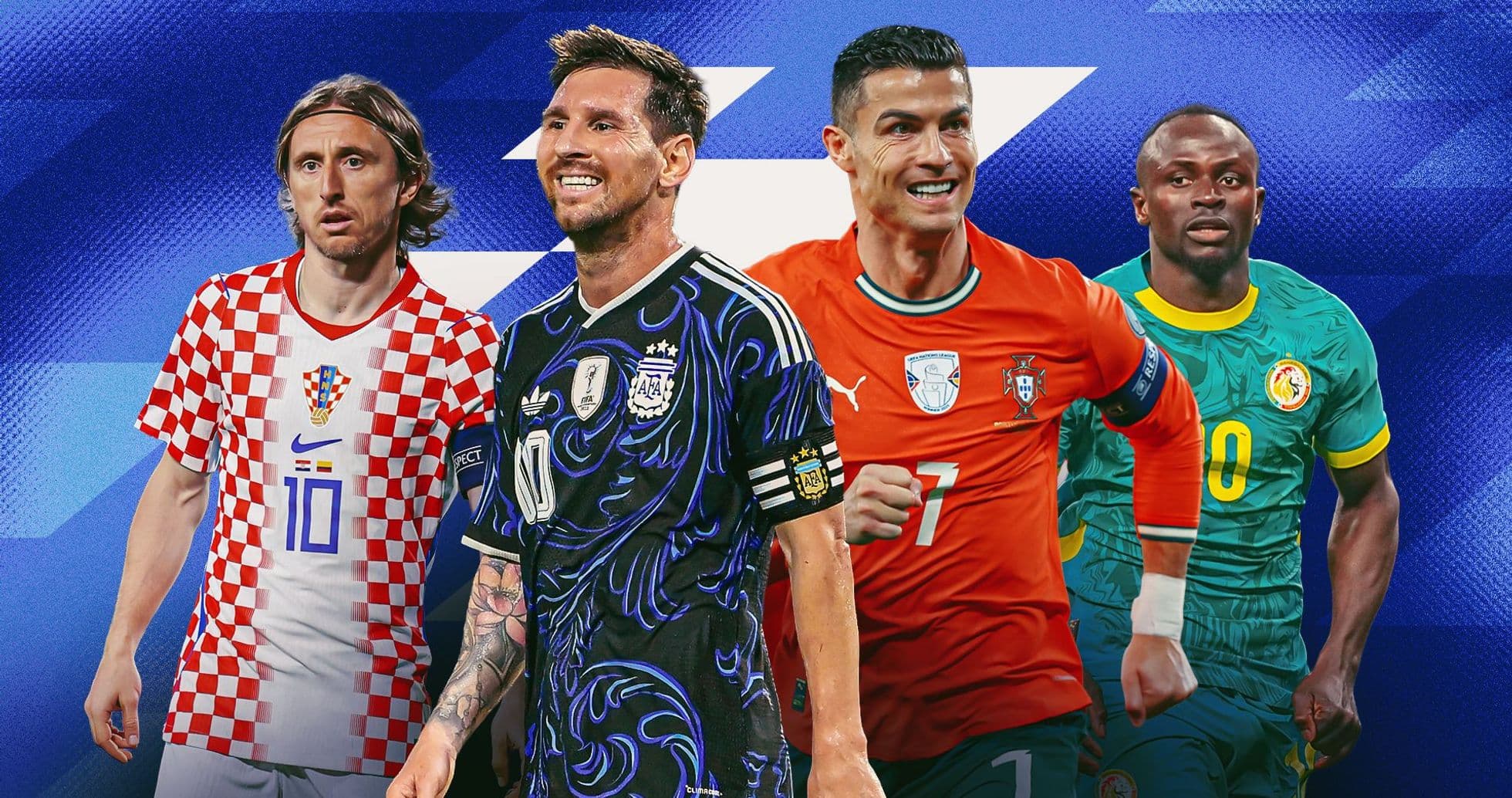
Messi, Ronaldo and Ochoa: the Six-World-Cup Club
Lionel Messi will arrive on the brink of 39, already having completed the game in 2022 when he finally lifted the trophy in Qatar. He could have walked away on that night in Lusail, the story closed, the circle complete. Instead, he has chosen to write a bonus chapter.
Since that final, Messi has traded the grind of European football for Inter Miami and MLS, where the pace is softer on the body but the spotlight burns just as bright. He still slips on the Argentina shirt, still decides games with touches no one his age should even see, let alone execute.
There are doubts. There always are. Can he manage an expanded tournament, criss-crossing a continent in fierce summer heat? Can he still do it every four days? On history, on logic, the answer should be no. On Messi, you hesitate before saying anything definitive. He has never been one for quiet exits.
Cristiano Ronaldo’s World Cup story is very different. No trophy. No knockout-stage goals. A legend of the sport with a strangely modest record on its biggest stage. At 41, if he captains Portugal to glory, he becomes the oldest player ever to lift the World Cup.
By rights, he should not still be here. Yet he keeps scoring relentlessly for Al-Nassr in Saudi Arabia, keeps talking about playing on, keeps bending the arc of a career that refuses to tail off gently. Portugal are loaded with talent – Rafael Leao, Pedro Neto, Goncalo Ramos and others itching to take centre stage – but Roberto Martinez still builds around Ronaldo, still trusts him as the focal point of a squad chasing the country’s first world title. This sixth World Cup feels like his last throw of the dice.
Joining them in the six-tournament club is Guillermo Ochoa, the man who seems to age only between World Cups, never during them. His inclusion looked unlikely for months. One appearance for Mexico after the CONCACAF Nations League finals in March 2024, a new generation emerging, and Javier Aguirre apparently ready to move on.
Then Angel Malagon’s Achilles snapped in March and the door creaked open. Ochoa walked back through it at 40. Over 150 caps, a career that has taken him through Spain, Italy, France, Portugal, Belgium and most recently AEL Limassol in Cyprus, and now one last World Cup with the co-hosts. He has hinted this will be his swansong. For two decades, he has been a recurring character in the tournament’s story. One more appearance feels like footballing fate.
Neuer and Modric: Masters of Control
Ochoa is not the only goalkeeper turning back the clock. Manuel Neuer, who had already stepped away from Germany duty after Euro 2024 on home soil, has been dragged back in for one final campaign.
Injuries to Marc-Andre ter Stegen and question marks over Oliver Baumann’s form pushed Julian Nagelsmann into a bold call. Neuer, 40, will play in his fifth World Cup. Not as a sentimental mascot, but as Germany’s undisputed No.1. He has earned it with another strong season at Bayern Munich, his aura intact, his standards largely undimmed. Germany are desperate to avoid a third straight group-stage exit. Nagelsmann has decided that in a crisis, you trust the man who redefined the position.
Ahead of him, another timeless figure keeps rewriting what is possible in your late thirties. Luka Modric, now 40, remains Croatia’s heartbeat. He dragged them to a first-ever final in 2018, then to third place in 2022, turning a country of four million into a permanent World Cup nuisance for the giants.
After leaving Real Madrid, Modric joined AC Milan last summer, a move designed to keep his legs sharp rather than chase one last big payday. This will be his fifth World Cup, and he is on the brink of joining an exclusive club: only the fourth player to reach 200 caps, assuming Messi, on 198, gets there first. Modric sits on 197 and counting. Every touch now feels like part of a farewell tour, even if he refuses to say the word.
Dzeko’s Return, and a New Wave of Goodbyes
Edin Dzeko probably thought his World Cup story ended in 2014, when Bosnia and Herzegovina made their only appearance at the tournament. The country’s struggles since then made another finals look a fantasy.
Then came one last surge. Bosnia beat Italy in the UEFA play-offs and, at 40, Dzeko will walk out in North America, a veteran striker with more than 70 international goals and close to 150 caps. He has proved at Schalke, where he helped fire them back into the Bundesliga after joining in January, that he still knows where the goal is. For a player of his quality, one World Cup never felt enough. This second act on the biggest stage offers the farewell his career deserves.
Across the world, national teams are bracing for similar partings.
South Korea know that, at some point soon, they will have to imagine life without Son Heung-min. He turns 34 in July. On paper, he has time. In reality, the strain of captaining a nation that lives and breathes every kick of its football team is immense.
Son has already left Europe for LAFC in MLS. By the time this World Cup ends, he may decide that he has given everything he can to the Korean cause. If he walks away after 2026, the country will lose not just its captain, but its defining modern icon.
Egypt live the same tension with Mohamed Salah. Just days older than Son, he has carried his country almost alone for years. This time, there is more help – Manchester City’s Omar Marmoush leads a stronger supporting cast – but the focus will still land squarely on Salah in North America.
His form for Liverpool has dipped sharply over the last 12 months, and his only previous World Cup, in 2018, was scarred by the shoulder injury he suffered in that year’s Champions League final. For a player of his stature, the global stage still feels like unfinished business. With a move to Saudi Arabia looming after his Anfield exit, and the inevitable winding down that follows, expecting him to push on to another World Cup feels optimistic. The urgency around this one is obvious.
Senegal face a similar crossroads with Sadio Mane. Now 34, he has been central to everything the Lions of Teranga have achieved in the last decade. It was Mane who scored the decisive penalty in 2021 to win Senegal their first Africa Cup of Nations. It was Mane who hauled them to consecutive World Cup appearances, only to miss 2022 through injury.
His transfer to Al-Nassr in Saudi Arabia has taken him out of the weekly European spotlight, but his commitment to Senegal has never wavered. He still wears the armband. With Ismaila Sarr, Illiman Ndiaye and others blossoming around him, his leadership and experience could yet push Senegal deep into the tournament. If this is his last World Cup, he will not go quietly.
Riyad Mahrez, now 35, completes a remarkable African trio. One of the most gifted footballers his continent has produced, his first touch and close control remain a spectacle even as the years pile up. Yet his World Cup résumé is astonishingly thin: just one appearance, all the way back in 2014.
Algeria’s failures to qualify since then have kept him away from the stage his talent demands. This summer offers a long-overdue chance to shine at a World Cup as he winds down his club career with Al-Ahli in Saudi Arabia. For a player of his flair, a final act on this platform feels overdue.
De Bruyne, Van Dijk and James: Chasing One Last Peak
Kevin De Bruyne’s body has started to argue with him. His first season at Napoli after leaving Manchester City has been disrupted by injuries, and he approaches his 35th birthday with more questions than answers about how long he can keep dictating games at the highest level.
When fit, he remains a conductor without equal, capable of slicing open defences with a single pass or thundering a shot into the top corner from distance. Belgium’s so-called Golden Generation is fading, the squad in transition under Rudi Garcia, but De Bruyne still stands at its centre. If he stays healthy, Belgium could yet emerge as a dangerous outsider in North America. If not, this might be remembered as the World Cup he never quite reached in full flow.
Virgil van Dijk, who will turn 35 during the tournament, has taken a different path into his mid-thirties. For years he has been Liverpool’s defensive pillar, a centre-back so dominant that some strikers have openly admitted to avoiding one-on-one duels with him.
The most recent season has not been his finest. On Merseyside, there are whispers that he has lost half a step, that his anticipation is not as razor-sharp as it once was. Even so, for the Netherlands he remains indispensable. This will be only his second World Cup, and almost certainly his last. Dutch fans will hope that, for one month, the old Van Dijk reappears.
James Rodriguez, meanwhile, returns to the stage that made him. In 2014 he lit up Brazil with one of the great individual World Cup campaigns, earning a move to Real Madrid and global fame. Since then, his career has been a patchwork of injuries and short-term club spells.
He has drifted through teams, including a recent stint at Minnesota United in MLS, often saving his sharpest performances for Colombia. He turns 35 in July. For Colombian fans, his presence in North America is non-negotiable. James owes his career to this tournament. One last chapter here feels not just fitting, but necessary.
Neymar and Brazil’s Last Gamble
Then there is Neymar, the eternal storyline. Brazil’s all-time leading scorer has not played for his country since tearing his ACL in October 2023. When Carlo Ancelotti took the national team job in September and initially ignored him, the assumption was clear: the Neymar era, at least at World Cups, was over.
Injuries to other forwards changed that. At the last moment, Ancelotti reached for the phone and handed Neymar a lifeline, naming the Santos forward in his 26-man squad. The reaction in Brazil was instant and wild. Hope, chaos, nostalgia – all rolled into one.
What role he can actually play is another matter. He suffered yet another injury just days after that call-up and must prove his fitness all over again. His body is sending louder and louder warnings. The idea of him holding together enough physical resilience to reach 2030 belongs in fantasy. This World Cup is his final chance to chase the sixth star that Brazil craves.
Kane and England’s Quiet Clock
Not every story here is about decline. Harry Kane, at 32, may be at the height of his powers. More than 60 goals for Bayern Munich this past season, England’s all-time leading scorer, and a striker who looks as ruthless as ever.
On current form, there is a scenario where he leads England into the 2030 World Cup as well. Given the drop-off behind him in the pecking order, many England fans will cling to that idea. Yet the calendar tells a different story.
England will co-host the European Championship in 2028. A major tournament on home soil, a chance to lift a trophy in front of his own people – it has all the ingredients of a perfect international farewell for Kane. If that proves to be the plan, then 2026 becomes his last World Cup.
He will not be the only one weighing that choice. Jordan Pickford, John Stones, perhaps even Marcus Rashford could eye 2028 as the right moment to step away, to close their international careers where they began: at home.
Across the globe, similar calculations are being made. One more World Cup? One more month of flights, pressure, heat and expectation? One last dance on the sport’s biggest stage?
In North America, we are about to find out how many of this golden generation can squeeze one more masterpiece from bodies that have already given so much.