Uruguay's World Cup Opener: Bielsa's High-Pressure Tactics
Uruguay begin their World Cup story in Miami on Monday night, and there is no room for a gentle easing into the tournament. Saudi Arabia await, the heat will bite, and Marcelo Bielsa’s Uruguay are built to run until the tank is empty.
This is Group H’s curtain-raiser, but Bielsa has been rehearsing it for months.
Bielsa’s Uruguay: All gas, no brake
Since the Argentine took charge, La Celeste have played on fast‑forward. The high press is non-negotiable. Uruguay squeeze the pitch, hunt in packs and ask their players to cover absurd distances. It is exhilarating when it works. It is unforgiving when it doesn’t.
South American qualifying suggested they were on the right track. Uruguay moved through the campaign with authority, the two-time world champions rarely looking in danger. They imposed themselves physically, snapped into duels, and turned games into Bielsa’s kind of chaos.
Then came the warm-up matches, and the picture blurred.
Uruguay failed to score against both Mexico and Algeria. The attacking patterns that looked promising in qualifying suddenly misfired. Worse, they were thrashed 5-1 by the United States, a brutal reminder of what happens when a high line and high press lose their timing.
The goals, or lack of them, hang over this opener.
Life after Cavani and Suarez
For the first time in more than a decade, Uruguay arrive at a World Cup without Edinson Cavani or Luis Suarez leading the charge. Cavani’s international retirement has left a sizeable void in the penalty area. Suarez, omitted from the final squad, is no longer the talismanic safety net.
There is no proven, battle-hardened World Cup finisher here. That reality has already shown up in the friendlies.
So the burden shifts. Uruguay’s route to a “dominant victory” – the internal expectation for this opener – runs straight through their midfield.
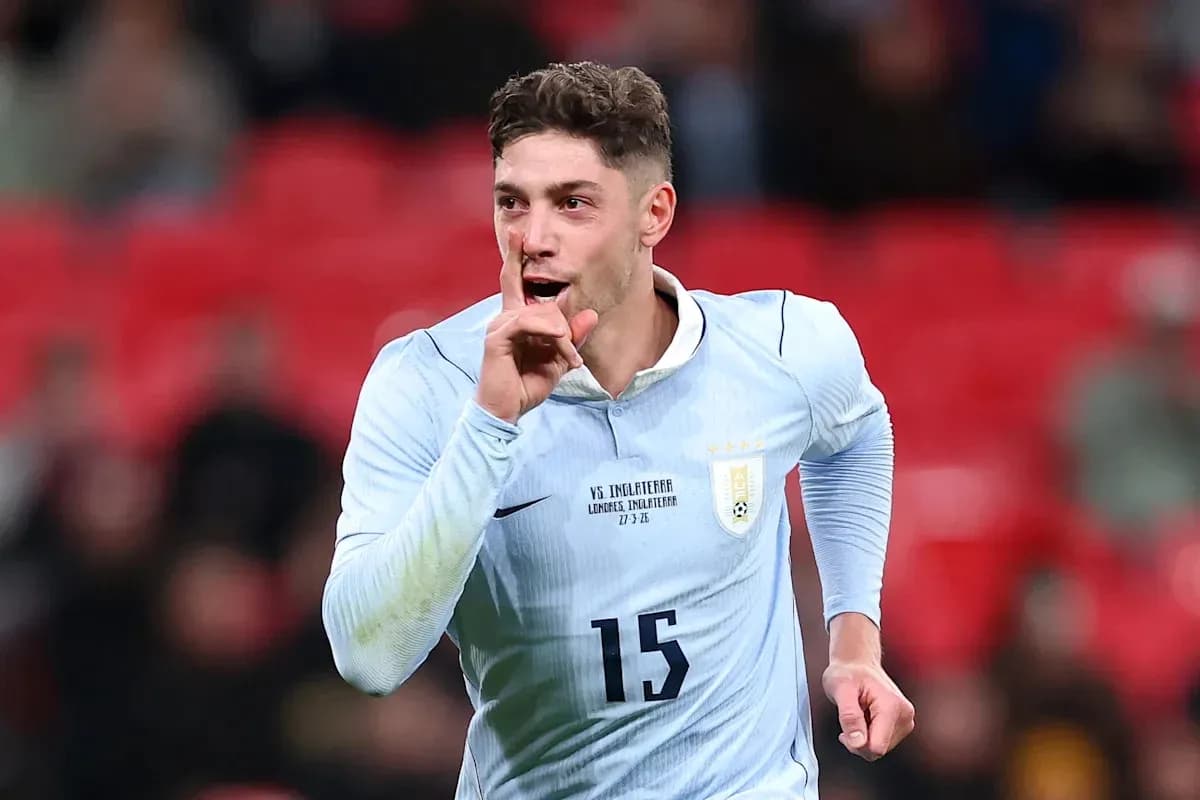
Federico Valverde stands at the heart of it all. The Real Madrid midfielder will dictate the tempo, drive from deep and threaten from distance. Around him, Manuel Ugarte brings bite and balance, screening the defence with relentless aggression. Rodrigo Bentancur adds craft and composure, knitting phases together in what looks, on paper, like a world-class central trio.
Out wide, Maximiliano Araujo will be asked to stretch Saudi Arabia, provide width, and give Darwin Nunez space to attack. Nunez, now based in the Saudi Pro League, knows this opposition and these defenders. That familiarity raises the stakes for him. Uruguay need his chaos to come with a cutting edge.
Federico Vinas should work close to Nunez, buzzing around the final third, linking play and attacking second balls. Between them, they must turn Bielsa’s volume into numbers on the scoreboard.
An injury crisis at the back
If the questions in attack are about chemistry, the concerns in defence are about bodies. Bielsa’s back line has been shredded by injury at the worst possible moment.
Ronald Araujo is effectively out with a calf problem, a huge loss of athleticism and authority. Jose Gimenez is still struggling with an ankle issue and remains a major doubt. Matias Vina is nursing a muscle injury and could also miss out. Each name removed from the team sheet strips away experience and stability.
Sebastian Caceres suffered a recent head knock but might recover in time. If he is cleared, he is the most likely to start alongside Santiago Bueno in central defence. It is a pairing that can function, but it is not the one Bielsa would have drawn up when he took this job.
Giorgian de Arrascaeta, so often Uruguay’s creative spark between the lines, is also doubtful with a lingering calf complaint. His absence would further reduce the side’s ability to unlock a low block with one pass or a sudden change of rhythm.
The result is a strange tension: a side built to dominate without the comfort of its first-choice spine.
Predicted XI and the stakes in Miami
Bielsa is not in the habit of compromising his principles, even when injuries pile up. The shape is expected to stay aggressive, the intent unchanged. The likely XI reflects that:
Muslera; Varela, Caceres, Bueno, Olivera; Valverde, Ugarte, Bentancur, M Araujo; Vinas, Nunez.
It is a team designed to own the ball, own the territory, and suffocate Saudi Arabia from the opening whistle.
Kick-off comes late – 23:00 BST on Monday, 15 June 2026 – but the noise around Uruguay will be loud long before then. In the UK, ITV1 will carry the game live. In the United States, Fox Sports will beam Bielsa’s experiment into living rooms across the country.
For Uruguay, this is more than a group-stage opener. It is a test of a new identity under a demanding coach, stripped of its old heroes, leaning on a ferocious midfield and a volatile centre-forward.
If La Celeste want to turn a bold idea into a deep World Cup run, nights like Miami cannot be wasted.