Tottenham’s £320m Struggle: Why De Zerbi’s Attack Isn’t Clicking Yet
Four games in, the Premier League table has an odd quirk: only two clubs are still waiting for their first goal. Coventry City. And Tottenham Hotspur.
One is battling to stay afloat. The other has spent around £320million, much of it on forwards and creators, to drag itself into the elite. Yet the scoreboard refuses to budge.
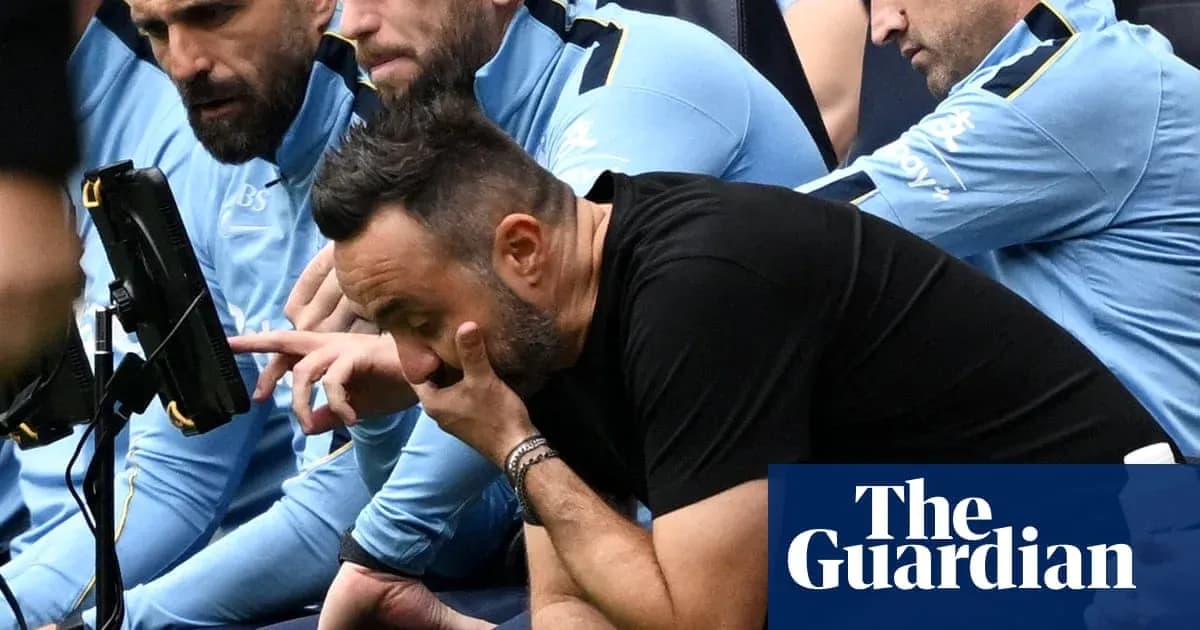
So what exactly is going on with Roberto De Zerbi’s Tottenham?
De Zerbi’s risk-and-reward blueprint
The league De Zerbi has returned to is not quite the one he left with Brighton in 2024, but his core ideas remain intact. You can already see them in Tottenham’s structure, even if the end product is missing.
His teams invite pressure. They slow the game down, roll passes back towards their own goal, and almost dare opponents to step up. Once that press comes, they try to punish it: the tempo suddenly spikes, the passes go forward, runners burst into the gaps left behind.
De Zerbi once summed it up neatly in a 2020 coaching seminar: “The stronger the pressure of the opponent, the more vertical [our] action becomes. [The fewer opponents behind], the easier it becomes to go and score.”
At Marseille between 2024 and 2026, that idea translated into numbers: 2.3 goals per game, forwards constantly breaking into huge spaces, defenders scrambling back. The same patterns are starting to appear at Spurs. The difference is what happens at the end of those moves.
A shape that looks complex – and is
In possession, Tottenham’s shape can look chaotic to the naked eye. On the tactics board, it usually resolves into a 2-3-2-3.
- Two centre-backs.
- A holding midfielder – typically Rodrigo Bentancur – sitting just ahead of them.
- Then a rotating cast of full-backs, wingers and central midfielders forming the rest of the structure.
Bentancur and the centre-backs hold their ground, forming a fixed spine. Around them, the other seven players move, swap, and slide into each other’s zones. Wingers drop inside, full-backs push high or tuck in, central midfielders drift wide. The key rule: if you vacate a space, someone else fills it.
That positional discipline is layered on top of De Zerbi’s broader principles. He wants his team to pull opponents in, then slice through them. The template has already worked for him at Marseille. It just hasn’t yet produced goals in north London.
Not that Spurs are miles away. The structure is there. The patterns are there. The details are not.
Central corridors, crowded spaces
De Zerbi wants his teams to play through the middle. That’s non-negotiable.
When Spurs’ centre-backs have the ball, they are encouraged to look inside rather than funnel possession down the wings. As they do, opposition forwards and midfielders step up to close them down, which in turn opens pockets between the lines for Tottenham’s attacking midfielders.
If the ball goes into those pockets, defenders are dragged infield. That’s when space appears out wide for Spurs’ direct wingers to attack. Central passes to pull you in; wide runners to rip you apart.
It sounds simple. On the pitch, it is anything but.
Players receiving in those tight central areas need to be comfortable under pressure. Some are. Some are learning. De Zerbi has already made a small but telling adjustment: recognising that Sandro Tonali is more dangerous when he can face forward in bigger spaces, he has often rotated him with Archie Gray, who nominally starts at right-back.
Gray, just 20, has been asked to operate in those congested pockets. It is not his natural role, but he has coped, and more importantly, he looks like he understands what his manager wants.
The return of James Maddison, back from a shoulder injury in the Carabao Cup tie at Liverpool, should sharpen that central play. Maddison is built for those zones – quick touches, brave angles, disguise – and should help Spurs reach the final third more frequently and with more control.
But this is also about habits. Under Thomas Frank at the start of last season, Tottenham largely avoided the middle of the pitch in build-up, funnelling play down the flanks to limit the risk of central turnovers. De Zerbi is asking the same players to do the opposite: take the ball in traffic, take risks, trust the structure.
Unlearning is often harder than learning.
The pass that never comes
For all the talk of structure, Tottenham are getting into promising areas. They regularly break lines and emerge behind opposition midfields after triggering a press.
The problem lies in what happens next.
Turning those situations into goals hinges on three things:
- recognising the best pass,
- movement ahead of the ball,
- and the technique to execute it.
Right now, Spurs are stalling on step one. The biggest blockage has been a reluctance – or inability – to play through balls in behind when the run is on.
Omar Marmoush has made those runs. Often. His timing and intent have been good, but the ball hasn’t always followed. Gray has tried to slide passes down the line, but centrally Tottenham have been far more hesitant.
This is where Pedro Porro could change the picture. For Spain’s World Cup-winning side in the summer, he played a more central role in possession and showed exactly the kind of vertical passing De Zerbi craves. As he returns to this Spurs side, his natural instinct to look forward and thread passes could unlock the same joy De Zerbi’s forwards enjoyed at Marseille.
Learning the runs
While Porro plays catch-up on fitness and rhythm, others are still getting to grips with the off-ball movements De Zerbi demands.
At Marseille, diagonal runs from wide attackers on the last line were a staple. Wingers would start wide, then dart in behind diagonally, with midfielders and full-backs ready to fire vertical passes into their path. It was a simple pattern, repeated with precision, and it brought goals.
Igor Paixao’s strike in Marseille’s 2-2 draw with Toulouse last season was a textbook example: a well-timed diagonal run, a direct pass, and a finish that looked inevitable by the time the ball hit the net. Everyone knew their role.
Against Liverpool in midweek, there were flashes of that understanding in north London. Destiny Udogie repeatedly surged into space on the left as the game stretched. Andy Robertson has been solid for Tottenham this season, but Udogie’s power and timing gave Spurs a different kind of outlet, especially against a disorganised Liverpool shape.
Those runs pulled Tottenham into crossing positions. The structure was working. The final actions were not.
Crosses, cut-backs and missing finishes
When an attacking team suddenly accelerates play, defenders tend to panic and retreat towards their own box. That creates a familiar picture: a crowded penalty area, but acres of room just in front of it.
That space is gold dust for late-arriving midfielders or strikers who drop off the line. Marmoush has tried to exploit it, peeling away into those zones to receive cut-backs. Too often, the pass hasn’t come, or the angle hasn’t been right.
On the flanks, there’s another technical wrinkle. Savio, a left-footed right-winger, is excellent at driving to the byline on his stronger foot. Pulling the ball back across goal on his weaker side is a different story. Udogie and Robertson, both left-footed on the left, have produced clearer chances with their crosses.
At Marseille, De Zerbi had a different balance. Both the right winger and right full-back were comfortable cutting the ball back on their right foot from that side. Those deliveries were then finished ruthlessly by Pierre-Emerick Aubameyang, whose movement in the box at 37 remained elite.
The contrast is stark. Tottenham are reaching similar zones. They are not yet finding the same finishes.
Close, but not close enough
Look closely at Tottenham’s attacking moves and a pattern emerges: so many of them are almost right. The press is baited. The space appears. The run is made. The ball, the touch, or the finish is just a fraction off.
De Zerbi’s ideas are not a magic trick. They depend on quality – especially in the final third – and at Marseille he had forwards who thrived in space and needed only one invitation. Spurs have invested heavily in that area, but cohesion and instinct are still catching up with the plan on the whiteboard.
Nothing about this suggests an instant transformation. The margins are small, and the Premier League is unforgiving. But if Tottenham refine those details – the bravery to play the risky pass, the timing of the runs, the technique on the final ball – the goals should follow.
And when they do, the question will flip: how did a team with this much attacking structure ever go four games without scoring at all?