Tottenham’s £320m Struggle: Why Can’t De Zerbi’s Spurs Score?
Four games in, the Premier League table throws up an awkward truth for Tottenham Hotspur. Only they and newly promoted Coventry City are yet to score a goal.
That’s Tottenham, who have spent around £320m on new talent, much of it pointed straight at the final third. New forwards, new creators, new ideas. No goals.
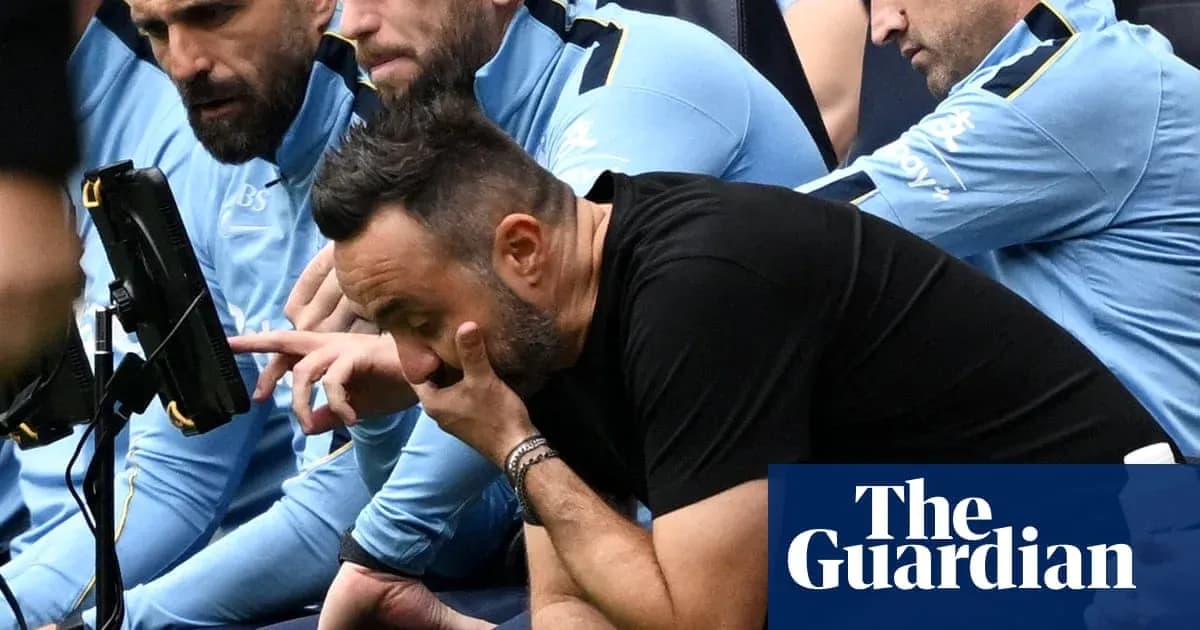
So what exactly is Roberto De Zerbi trying to build – and why does it look so close to working without actually delivering?
De Zerbi’s Risky Blueprint
The league he has returned to is not the one he left with Brighton in 2024. The tempo has shifted, pressing schemes have evolved, and opponents are far more familiar with his style. But the Italian has not walked away from his principles. He’s reshaping them.
De Zerbi still wants opponents to come after his team. He tempts the press. Spurs slow the game down, roll the ball backwards, invite pressure, and almost dare opponents to over-commit.
Then comes the snap.
Once the press bites, Spurs try to flip the picture: speed up play, punch passes through the middle or drive forward on the dribble, and attack the spaces behind the pressing line. It’s the same basic idea he outlined in a 2020 coaching seminar, when he said: “The stronger the pressure of the opponent, the more vertical [our] action becomes. [The fewer opponents behind], the easier it becomes to go and score.”
We’ve already seen Spurs’ forwards popping up in big, open spaces with fewer defenders to beat. The structure is doing its job. The payoff isn’t.
Because turning clever build-up into goals is where the whole thing is breaking down.
The 2-3-2-3 and a Squad Still Learning It
On the ball, Tottenham’s shape is fluid enough to look messy if you catch it mid-rotation, but it usually resolves into a 2-3-2-3.
Two centre-backs. In front of them, a holding midfielder – most often Rodrigo Bentancur – anchoring the middle. Those three tend to stay put, forming the base.
Ahead of that, the full-backs, wingers and central midfielders spin around each other. The shape remains, the names in each lane change. Players are told to keep the structure intact by swapping zones: if one vacates, another slides in. It’s choreography, not chaos.
On top of these positional rules sit De Zerbi’s game principles. Spurs are being asked to do what his Marseille side did so well between 2024 and 2026, when they averaged 2.3 goals per game. Lure pressure, play through it, attack space, finish.
Tottenham are stuck on the step before “finish”.
A big reason? The players are still internalising a completely different way of thinking. Under Thomas Frank at the start of last season, Spurs largely avoided the middle of the pitch in their build-up, funnelling play down the flanks to limit risky turnovers in central areas.
De Zerbi wants the opposite. He wants bravery in the most congested part of the pitch, short passes under pressure, and the courage to keep offering for the ball even when the press is closing in. Unlearning old habits is not a quick job.
Tonali, Gray and the Fight for the Middle
When Spurs play into central pockets, several things must click at once.
The receiver has to be comfortable taking the ball with an opponent tight to his back. He has to know where the next pass is before the ball arrives. And he has to trust that his team-mates are moving in sync.
Not everyone is built for that.
Sandro Tonali, for instance, is more dangerous when he can face forward in bigger spaces. De Zerbi has recognised that and adjusted, often rotating him with Archie Gray, who nominally starts at right-back. It’s a neat tweak: Tonali steps wider or higher, Gray moves inside.
Gray, just 20 and not a natural central midfielder, has handled those tight spaces reasonably well and looks to understand what De Zerbi is asking. But he is a stop-gap solution, not the finished article.
The real boost should come from James Maddison. Back from a shoulder injury in last Tuesday’s Carabao Cup tie at Liverpool, Maddison is far more at home receiving in traffic, turning under pressure and threading passes into the final third. His return gives Spurs a player built for the role De Zerbi prizes most.
Still, even with the right profiles, this approach only works when the whole squad moves as one. That cohesion is not there yet.
From Breakthrough to Breakdown
Spurs actually succeed quite often at the first phase: drawing the press and breaking beyond the opposition midfield. They reach promising positions with numbers ahead of the ball. This is where the frustration really starts.
From there, three things matter: spotting the right pass, making the right runs, and then executing the ball.
Tottenham are stalling on the first two.
The biggest bottleneck so far has been an odd reluctance – or inability – to play through balls in behind when the run is on. Omar Marmoush has made sharp, well-timed darts off the shoulder. Too often, the pass doesn’t come.
Gray has tried to feed passes down the line, but those vertical balls are not being played often enough through central channels, where they hurt most.
The return of Pedro Porro could change that dynamic. For Spain’s World Cup-winning side in the summer, he operated more centrally in possession and showed how naturally he can create from those inside lanes. His instinct to thread passes and combine in tight areas fits De Zerbi’s model almost perfectly.
If Porro can bring that to Spurs, the same patterns that once freed Marseille’s forwards could finally start to open Premier League defences.
Width, Crosses and Missed Connections
Tottenham are not just trying to slice teams open through the middle. There is a wide threat, and it showed again in the Carabao Cup at Anfield.
Destiny Udogie repeatedly surged into dangerous positions on the left, especially once the match became stretched. Andy Robertson has been solid for Spurs this season, but Udogie’s power and timing gave Liverpool problems and allowed Spurs to hit the byline against a disorganised defence.
From there, the picture is familiar. When an attacking side accelerates play, defenders tend to drop in a rush, sprinting back to protect the six-yard box. That collapse opens up space at the edge of the area and just inside it – perfect zones for late-arriving midfielders or strikers who cleverly pull off the front line.
Marmoush has tried to exploit those pockets, drifting away from the centre-backs and waiting for the cut-back. The ball hasn’t always found him.
Some of that is chemistry. Players are still learning each other’s timings and tendencies. Some of it is technical: Savio, a left-footed right-winger, is more comfortable driving to the byline than cutting the ball back sharply on his weaker foot.
On the opposite flank, Udogie and Robertson, both left-footed, have delivered more threatening crosses. But the balance is not yet what De Zerbi enjoyed at Marseille, where both right winger and right full-back were happy to chop the ball back onto their right foot and fire low crosses into the box.
Those deliveries were made to measure for Pierre-Emerick Aubameyang, whose movement at 37 remained razor sharp. He attacked space in the area with ruthless efficiency. Tottenham do not yet have that level of synergy between crosser and finisher.
Close, But Not Close Enough
Look closely at Tottenham’s attacking sequences and a pattern emerges. The ideas are there. The structures are there. The spaces are being created.
So many moves are one decision, one touch, one pass away from becoming clear chances.
This isn’t a guarantee that everything will click. Tactics, no matter how smart, still rely on the quality of the players at the end of the move. Marseille’s forwards were clinical and thrived in the open grass De Zerbi carved out for them. Spurs’ new-look frontline still has to prove it can do the same.
But the margins are fine. Sharpen the recognition of runs. Trust the through ball. Refine the timing of the cut-back. Let Maddison and Porro impose their instincts.
If those small details fall into place, Tottenham should create enough chances to finally break their drought – and then we’ll find out whether this £320m experiment is built for a season, or for something much bigger.