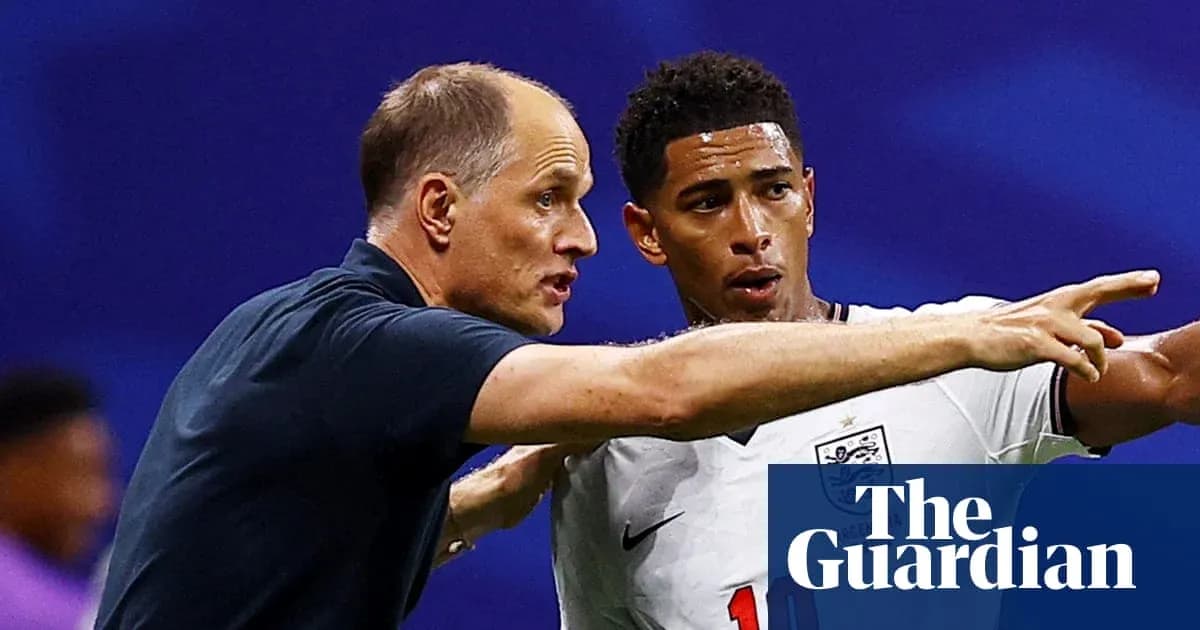
Thomas Tuchel Faces England's Next Challenge After World Cup Heartbreak
Thomas Tuchel has been a familiar face around Premier League grounds again this season, slipping into VIP areas, exchanging handshakes, small talk, the usual. One remark, though, has stuck.
“People are killing me,” the England manager said. Still. Two months on.
The 2-1 World Cup semi-final defeat by Argentina in the United States has not loosened its grip. The emotions remain raw: heartbreak, anger, disbelief. For those who invested in this England team, it felt like a wound, not a result. A 1-0 lead with five minutes to go, gone. A shot at a second star, gone. The sense of waste lingers.
From that moment, the conversation around Tuchel has split in two.
On one side stand the furious. They see a golden chance squandered and pin the collapse squarely on the manager. The late retreat, the defensive change, the inability to halt Argentina’s surge – all of it, in their eyes, belongs at his door.
On the other side, there is a quieter camp. They look at the broader canvas. A semi-final for only the fourth time in England’s history. A best World Cup finish since 1966 after beating France in the third-place playoff. A run stitched together with nerve and personality: the thrilling opening win over Croatia, the last-16 epic against Mexico at the Azteca, the draining, extra-time grind past Norway in Miami’s 40C heat.
Both versions of England’s World Cup are true. Tuchel knows it. He just feels the sting of the first one more.
Scars and faith
The England job has long been described as impossible, and this is why. Expectation crushes perspective. Every defeat comes with a postmortem, every decision a referendum. Lose, and the noise makes it harder for the team to move on. It becomes a loop.
Tuchel is caught in that loop as he prepares for the next cycle, one that ends with Euro 2028 on home soil, co-hosted with Scotland, Wales and the Republic of Ireland. On Friday he names his squad for four Nations League fixtures: Spain at Wembley, Czechia home and away, Croatia away. The next campaign begins under the shadow of the last one.
He wants to look forward. So do the FA. For them, the semi-final exit does not define his tenure. Their view is simpler: this is not a country that strolls into World Cup last fours. The idea that he should have resigned or been sacked after reaching one is, internally, treated as nonsense.
If anything, the FA’s faith hardened during the tournament. They saw a coach whose in-game changes repeatedly shifted matches. The last-32 tie against the Democratic Republic of the Congo nearly ended him – 1-0 down with 15 minutes left, the entire project wobbling – before Harry Kane’s two late goals flipped it. That night went down as one of the most stressful England games in recent memory. Inside Wembley, Iceland 2016 ghosts hovered. Kane pushed them back.
The FA loved the response, the tactical tweaks, the refusal to panic. They loved the atmosphere around the camp, too. Tuchel spoke often of a brotherhood among his players and, by all accounts, it was more than a soundbite. The unity was real, and the FA has placed huge value on that.
Death-or-glory and its cost
Tuchel went to the World Cup with one mission: put a second star on the shirt. He said it, publicly, with a kind of death-or-glory certainty he later softened. Did that rhetoric make the semi-final exit feel even more brutal? Probably. But what would have been more acceptable – a manager publicly aiming for the quarter-finals?
Privately, the FA never truly expected England to win it. They knew the ranking – fourth seeds – and they did not like the draw. The schedule was awkward, the late start and long gap between the first and second group games followed by a compressed run. Travel, heat, altitude: all stacked against them. The hope was to punch above their weight, not rewrite history.
That context matters when you rewind to the Argentina game. England had emptied themselves at altitude against Mexico with 10 men. They had gone 120 minutes in the Miami furnace to edge past Norway. By the second half of the semi-final, the legs were gone.
Still, the key calls belong to Tuchel. England started to drop deeper long before the hydration break, long before the change that will follow him around: Ezri Konsa on for Anthony Gordon, a switch to a five-man defence. From that moment, England were locked in survival mode, unable to get on the ball, unable to change the rhythm. Argentina went into all-out fury; England simply absorbed it.
Tuchel saw the numbers, weighed the evidence and chose to double down on defence. To him, it felt like the percentage play, the least bad option. It failed. And when it failed, it looked terrible. Would a more aggressive change have altered the outcome? No one can say. What is clear is that, by the end, England were well beaten.
He knows that. He also knows he cannot live in that 10-minute spell forever.
A harder road by design
The Nations League now offers him something he did not have before: jeopardy against elite opponents on a regular basis. England are back in Group A, with Spain, Czechia and Croatia standing between them and a quiet autumn.
It is exactly what the FA wanted. Last time out, Group B – with Ireland, Finland and Greece – did little to sharpen the team’s edge. Even then, Greece at Wembley turned into a mess, a 2-1 home defeat that underlined how flat the campaign felt. World Cup qualifying had not stretched them either.
This time, the thinking is clear. If Euro 2028 is to be a genuine shot at a trophy, England need to be hardened now, not cosseted.
Tuchel’s first squad of the new cycle will not be straightforward. Four World Cup players are likely to miss out through injury: John Stones, Dan Burn, Djed Spence and Jordan Henderson. That opens doors in defence for the likes of Tino Livramento, Levi Colwill, Jarrad Branthwaite and Lewis Hall, all pushing for recalls.
Midfield poses a different kind of question. Does Kobbie Mainoo keep his place after a World Cup he barely influenced? His form for Manchester United has been one of the few bright spots in their poor start, which helps his case. Alex Scott and Myles Lewis-Skelly are hoping to force their way back in as well.
Further forward, the No 10 positions bring their own intrigue. Cole Palmer and Phil Foden are in the frame again. Eberechi Eze and Noni Madueke, by contrast, have not restarted well at Arsenal, which weakens their hand. Around the forward line there is fresh energy: Josh King and Ryo Ngumoha are generating buzz, as are Dominic Calvert-Lewin and Liam Delap.
These are the choices that will define the next phase, not the substitutions in one doomed second half in the States.
On Friday, when Tuchel steps up to announce his squad, the words will matter. So will the tone. The last time he went into defensive mode, it only fuelled the storm. Now, with Spain coming to Wembley and Euro 2028 creeping into view, the question is simple: does he carry the weight of Argentina into this new chapter, or finally put it down?