Sunderland's Struggles at Roker Park Amidst Rising Tensions
Bill Murray walked into August 1939 as a new man in an old house. Only a few months earlier he had replaced Johnny Cochrane, the manager under whom he had once played, and he knew exactly what Roker Park demanded. This was the club that had been league champions in 1936 and FA Cup winners in 1937. The slide that followed had hurt. Murray’s mission was simple enough to state, far harder to execute: restore Sunderland to their former heights.
An opening-day win over Derby County hinted that the climb back might be quicker than feared. The mood around Wearside lifted. Maybe the worst was over.
Then Huddersfield Town came to town.
They left with both points and most of the praise, their 2-1 victory on this day in 1939 exposing just how far Murray’s Sunderland still had to travel. Huddersfield were better organised, more cohesive, more certain of themselves. Sunderland looked like a side in transition. Because they were.
A frail defence, a limping captain
From the outset, the home defence wobbled. Sunderland’s back line hesitated, failed to pick up runners, and struggled to sort their marking. Huddersfield sensed weakness and went after it.
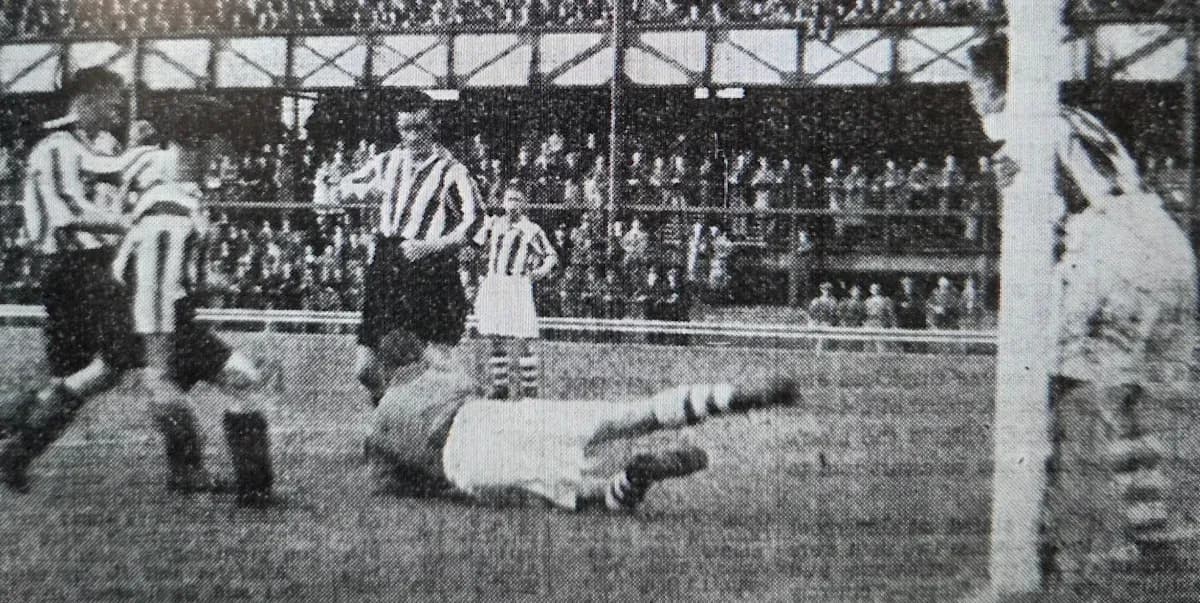
The visitors were ahead inside four minutes. The move came from Clem Stephenson’s side, a cross swung in and met by Billy Price. Many in the ground were adamant Price’s header was bound for the net on its own. The referee saw it differently, recording the opener as an own goal off Jimmy Gorman, who had challenged Price in the air. On the scoreboard it went down as Gorman o.g., but Huddersfield scarcely cared whose name was attached. They had the lead, and Sunderland were rattled.
The home forwards never truly found rhythm. Attacks broke down too easily, passes went astray, and the crowd’s early optimism drained into frustration. Match reports the next day pointed a finger at the officials, accusing them of allowing Huddersfield to skate close to the edge with a string of borderline fouls that disrupted Sunderland’s flow. Yet the more telling problem lay within the home ranks.
Raich Carter, the captain and creative heartbeat, took “a knock” and moved with nothing like his usual freedom. Once that happened, the side lost its shape and belief. Carter still managed to haul Sunderland level on 33 minutes, finding the equaliser that briefly revived Roker Park. But he was effectively playing on one leg, and his team-mates were criticised for failing to shoulder the extra responsibility. When their leader faltered, too few followed.
At the other end, only one Sunderland player escaped serious scrutiny: goalkeeper Johnny Mapson. Reports agreed he could do little about either Huddersfield goal, and without him the scoreline might have been harsher.
Price has the final word
After Carter’s leveller, the game drifted into an uneasy balance. Sunderland never quite convinced, Huddersfield always looked capable of more. The pressure eventually told.
With around ten minutes remaining, Price struck again. This time there was no debate over who the goal belonged to. The Huddersfield forward found the decisive touch, and with it the match. As the final whistle approached, there was little argument from the home support. Huddersfield had been the more complete side. Sunderland’s shortcomings were laid bare.
Those leaving Roker Park that afternoon did so with mixed emotions. Some grumbled about the referee. Most accepted the result. Many, though, had something else on their minds entirely.
War on the front page, football on the back
Anyone who had bought a newspaper on the way to the ground would have seen it instantly: football did not own the headlines. The front pages were dominated by mounting international tension and the looming prospect of a second world war.
The Sunderland Echo and Shipping Gazette carried reports of French radio being handed over to military control, of urgent diplomatic talks across Europe, and of preparations at home. One photograph showed workmen stacking sandbags in front of the Royal Infirmary, a stark reminder that the threat was no longer distant.
There was a chilling piece on helmet and respirator arrangements for parents in Sunderland. Notices listed demonstration and collection points at schools across the town: Redby, Hudson Road, Cowan Terrace, Thomas Street, Commercial Road, Hylton Road, Diamond Hall, High Southwick, James William Street and Barnes. Children were to be fitted out, with specially adapted versions for infants. It read less like civic housekeeping and more like a warning.
All of that hung over Roker Park. Football was meant to be an escape, but the outside world had forced its way into the turnstiles.
One last look at Roker?
Among the 16,315 in attendance were soldiers and sailors already called up under the emergency measures. They were allowed in for half price, provided they entered through what was usually the “boys gate”. The gesture underlined the strangeness of the times: grown men in uniform queueing where schoolkids normally stood, watching a game that might soon vanish from the calendar.
The performance on the pitch did little to lift the region’s spirits. Sunderland, disjointed and second-best, hardly offered a rallying point. Yet some supporters would have tried to savour it all the same, aware this might be their last visit to Roker Park for quite a while.
They were right to worry.
By the time Sunderland travelled to Arsenal the following weekend, German forces had invaded Poland and a wider war was all but certain. The match at Highbury was pushed back to a 17:00 kick-off so that emergency public transport timetables could cope and a hurried evacuation of local children could be completed. Football slid down the list of priorities. It still kicked off, but it no longer felt central.
Soon, the results against Derby, Huddersfield and Arsenal were wiped from the official records. The season itself was swallowed by events. Murray’s rebuilding project was put on hold. Instead of plotting tactical tweaks and transfer moves, he spent his time overseeing fitness work for troops stationed in County Durham. Roker Park, quickly designated an evacuation zone, sat largely idle for the next two years.
On 30 August 1939, Sunderland lost a league match to Huddersfield Town. Within days, that defeat barely mattered. The real contest was starting elsewhere, and football’s place in the world would not be the same again for a very long time.
Saturday 30 August 1939
Football League Division One
Sunderland 1 (Carter 33')
Huddersfield Town 2 (Gorman o.g. 4', Price 80')
Sunderland: Mapson; Gorman, Hall; Housam, Lockie, Hastings; Duns, Carter, Robinson, Smeaton, Burbanks.
Roker Park, attendance 16,315