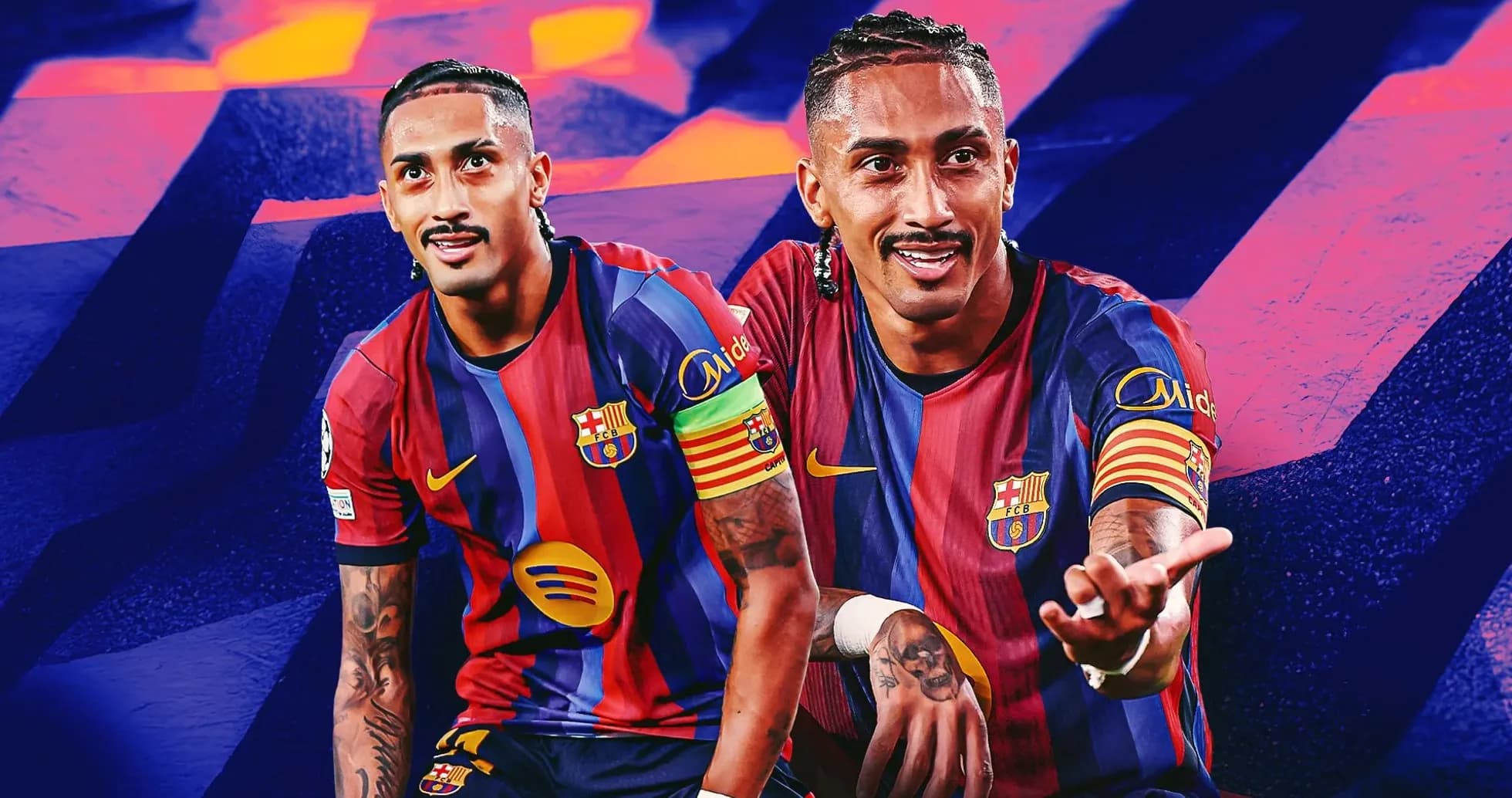
Raphinha's Transformation: From Snubbed to Europe's Most Dangerous No.9
A year ago, Raphinha was broken.
Hamstring twinges became full-blown tears, 125 days on the treatment table, and a World Cup wrecked. His numbers told the story brutally: 60 goal contributions in a dazzling 2024-25 season, then less than half of that – 29 – the following campaign.
This year, the numbers are back. The swagger is back. And so is the argument that he belongs among the very best on the planet.
He just isn’t on the Ballon d’Or list.
Hansi Flick cannot believe it. “He (Raphinha) is far too good not to be on that list, but we can’t change it,” the Barcelona coach snapped, speaking with the calm assurance of a man who knows what he’s seeing every day in training – and every week on the pitch.
Right now, Raphinha looks like the best player in the world. And he’s doing it in a position many never expected him to own.
A winger turned ruthless spearhead
Under Flick, Raphinha has shifted from the left flank into the heart of the attack. It has changed everything – for him and for Barça.
The transformation exploded into the wider consciousness on a Champions League night against Feyenoord. Raphinha didn’t just score twice in a 5-1 win. He put on a clinic in what a modern centre-forward can be.
The first goal was pure theatre. He collected a slightly off-target pass from Lamine Yamal, slipped past one defender, surged into the box and shaped to shoot. Then came the twist: an outrageous dummy that sent two Feyenoord defenders sprawling, opening a lane for him to roll the ball, almost lazily, into the corner.
The second was straight from a striker’s manual. He initially moved towards Dani Olmo, dragging his marker with him, then spun and burst into the opposite channel. Olmo’s pass sliced Feyenoord open; Raphinha didn’t break stride, arrowing a low finish across the goalkeeper. One movement, one touch, one ruthless conclusion.
Player of the Match was a formality. What mattered more was the feeling: this wasn’t a winger improvising up front. This was a fully-formed No.9 dictating the terms.
“Rapha has played fantastic,” Flick said. “He’s on another level – he’s unbelievable.”
The numbers agree. Raphinha already has 11 goals this season, a blistering start no Barcelona player has matched in 60 years. Lionel Messi hit 10 in his first seven outings in 2012-13 and twice reached nine at this stage. Ronaldo hit nine in 1996-97.
Raphinha has gone beyond them all in the opening stretch.
The engine of Flick’s fluid attack
Robert Lewandowski gave Barça a classic reference point up top. Ferran Torres offered runs in behind and clever movement. Raphinha is something else entirely.
He roams. He drifts between the lines, drops short, spins in behind, and constantly toys with defensive structures. His acceleration and close control don’t just beat players; they bend entire back fours out of shape.
That chaos is calculated. When Raphinha drags centre-backs out, space opens for Yamal and Anthony Gordon on the wings. When they hold their positions, he darts into the gaps himself. He is almost always a step ahead of the defender in front of him – mentally and physically.
Racing Santander felt it in full in La Liga. Barça shredded them 7-2; Raphinha walked away with a hat-trick and barely looked like he broke sweat.
Two of those goals came from the penalty spot. The middle one was the purest illustration of his new role. Again, Olmo found the angle, and again Raphinha found the void. He ghosted between the centre-backs, paused, waited for the pass, then met it with a single touch and a half-volley guided into the corner. No fuss. No backlift. Just cold execution.
On the ball, he makes everything look simple. Off the ball, he is relentless. The press starts with him, and it rarely lets up. He hounds defenders, chases lost causes, and forces panicked clearances that Barça’s midfield eagerly hoover up.
This is the intensity Flick demands from his front line. With Raphinha, he gets it with a clinical edge attached.
You can see why the coach won’t be losing sleep over a move for Julián Álvarez that never happened. The frontline is humming; the money can be spent elsewhere.
Walking in the footsteps of R9
Barcelona’s love affair with Brazilian brilliance is long and glittering: Romário, Rivaldo, Ronaldinho, Neymar. Yet one season still sits on its own pedestal – Ronaldo’s 1996-97.
Arriving from PSV for a then-world record $19.5m at just 20, Ronaldo tore La Liga apart. Forty-seven goals in 49 games. Copa del Rey, UEFA Cup Winners’ Cup, Supercopa de España. Defenders bounced off him as he mixed terrifying strength, raw speed and surgical finishing.
He took the Pichichi with 34 league goals, claimed the European Golden Shoe, and won the 1997 Ballon d’Or. The highlights still feel unreal: the solo run against SD Compostela, the hat-trick to overturn Atlético Madrid in a 4-3 Copa del Rey quarter-final epic.
“He is the most spectacular player I’ve ever seen,” said Sir Bobby Robson. Laurent Blanc went further: “I’ve never seen anyone with that velocity and power. He was like a freight train coming at you with a ball at his feet.”
Ronaldo – R9 – was a fixed point, a brutal spear at the top of the team. Raphinha is more fluid, more elastic in his movements, but the similarities are hard to ignore. The directness. The refusal to waste time on the ball. The sense that any possession within 25 yards of goal might end with the net rippling.
If he keeps this level, the comparison will only grow louder. Matching Ronaldo’s 47-goal haul is a huge ask. Matching his impact on a season – and turning it into a treble of major trophies – no longer feels outlandish.
A captain forged in doubt
The mindset is what makes this surge believable. Raphinha doesn’t talk like a man who thinks he has cracked the game.
“I will never say I am performing well; I always strive to improve everything I can,” he said after the Racing rout. “I am happy with the goals, and with the win, and that is the most important thing, but we have to keep improving.”
He also made it clear he now feels “comfortable” through the middle, and he didn’t hesitate to credit the man who repositioned his career. “He is the coach who changed the way I think and how I see myself,” Raphinha said of Flick. “I am extremely grateful.”
He has every reason to be. Without Flick, he might not even be at the club.
Raphinha’s first two seasons at Camp Nou were underwhelming. Under Xavi, he never fully nailed down a starting spot, drifting in and out of the XI, his talent visible but never fully harnessed. Last summer, a departure would not have shocked anyone.
Flick stopped that. He saw a different ceiling and handed Raphinha responsibility, not just minutes.
When Marc-André ter Stegen left on loan for Ajax, Flick didn’t hesitate: Raphinha would be Barcelona’s new permanent captain. The first Brazilian ever to wear the armband in Catalonia. A risk on paper. On the pitch and in the dressing room, it has been a revelation.
His passion is obvious. His work rate is non-negotiable. Younger players look at him and see a star who sprints after full-backs in the 90th minute as if it’s the first. When games drift, he is the one who demands the ball, the one who decides that enough is enough.
Depth, balance and a fearsome supporting cast
For all Raphinha’s fireworks, this is not a one-man band. Flick’s Barcelona are sharper in attack despite losing Lewandowski and Torres and sending Marcus Rashford back to Manchester United.
The summer recruits have hit the ground running. Gordon offers direct running and width. Karim Adeyemi brings pace and unpredictability. Gabriel Jesus adds intelligence and link play. Flick now also has 18-year-old Egyptian striker Hamza Abdelkarim stepping up from Barça B, another profile to throw at tired defences.
“Raphinha, Gabby and Hamza are three different profiles, but there are other ways we could play,” Flick has said. “Anthony and Karim can also play in this position (as striker). Or Dani Olmo. Dani has showed us in last two years he can play there – the same with Fermin [Lopez]. We have a lot of options.”
Those options matter for one crucial reason: Raphinha’s legs.
Flick has learned from last season’s injury nightmare. He hooked his captain early against Feyenoord, did the same in league wins over Athletic Club and Racing. No hero minutes in September, no chasing individual records at the expense of hamstrings. The message is clear: the season is long, and this version of Raphinha must be protected.
The same goes for Yamal. The teenager has become even more devastating playing closer to his captain, their understanding growing with every game. Their combinations are brutal in their simplicity. The instant a centre-back shifts his weight to track Yamal, the ball is slipped into Raphinha, who is already darting into the blind-side channel.
Yamal doesn’t seem bothered about ceding the spotlight. That matters. Flick has stars everywhere, but no one behaves like a diva. The dressing room hums with a collective edge that feels more like a title-winning side than a highlight-reel project.
A Brazilian carving his place in Barça’s history
Barcelona’s history with Brazilian greats is rich, but no one has yet eclipsed that single, incandescent season from R9. That’s the bar.
Raphinha isn’t there yet. Not in goals, not in trophies, not in the weight of myth. But he is carrying the armband, leading the press, ripping through defences and dragging a new-look Barça into a new era.
If this form holds, if the legs stay intact, if the goals keep coming in Europe and La Liga, the conversation will change. The Ballon d’Or snub will look absurd. The comparisons with Ronaldo will feel less like nostalgia and more like a live debate.
For now, he is the clearest expression of what Flick wants this team to be: intense, fearless, collective – and utterly ruthless.
The Hall of Fame at Camp Nou already has a place for one Brazilian No.9 who burned bright and left too soon. How long before Raphinha’s name is etched alongside Ronaldo’s, not as a flattering echo, but as a rival chapter in Barça’s Brazilian saga?