Raphinha's Remarkable Transformation: From Injury to Barcelona's Central Star
Raphinha was supposed to be yesterday’s story by now. A winger whose body betrayed him, a Ballon d’Or near-miss filed under “what might have been”.
Instead, under Hansi Flick, he has kicked the door back off its hinges and walked straight into the centre of Barcelona’s attack – and possibly into the club’s history books.
From injury wreckage to central force
Two seasons ago, Raphinha looked ready to join the game’s elite. Sixty goal contributions in a blistering 2024-25 campaign had him brushing up against the Ballon d’Or podium. Then came the crash: persistent hamstring problems, 125 days out, output slashed to 29 goal contributions, and a World Cup campaign wrecked.
This year, he didn’t even make the 30-man Ballon d’Or shortlist. Flick was furious.
“He is far too good not to be on that list, but we can’t change it,” the Barça coach said, speaking from a position of absolute conviction rather than frustration. He had just watched the Brazilian tear Feyenoord apart in the Champions League from his new home through the middle.
What followed on the pitch backed every word.
A No.9’s body with a winger’s soul
Against Feyenoord, Raphinha produced the kind of performance that changes how a player is talked about.
His first goal was pure mischief and nerve. He took a slightly off-target pass from Lamine Yamal, slipped past one defender, glided into the box and shaped to shoot. Instead, he sold a dummy so outrageous that two Feyenoord defenders ended up on the turf, leaving him all the time in the world to slide the ball into the corner.
The second was straight out of the centre-forward handbook. As Dani Olmo picked up possession in the centre-circle, Raphinha initially moved towards the ball, then exploded in the opposite direction, shaking off his marker. Olmo threaded a perfect pass, Raphinha met it in stride and drove a ruthless finish across the helpless goalkeeper.
Barcelona won 5-1. Raphinha walked away with Player of the Match and, more importantly, the aura of a man playing at a different speed to everyone else.
“Rapha has played fantastic,” Flick said. “He’s on another level – he’s unbelievable.”
Right now, he looks like he believes it.
Numbers that echo through the Camp Nou
The statistics are starting to sound historic. Raphinha already has 11 goals this season – a mark no Barça player has reached this quickly in the last 60 years.
Lionel Messi managed 10 in his first seven games of 2012-13, and hit nine by the same point on two other occasions. Ronaldo reached nine in 1996-97. Raphinha has gone past them all in terms of early-season scoring pace.
His instant adaptation to the central role is the engine behind Barça’s attacking surge. Robert Lewandowski offered classic back-to-goal craft. Ferran Torres hurt teams with clever runs in behind. Raphinha does both jobs and then adds chaos.
At 29, he drifts between the lines, using his acceleration and close control to yank defenders out of shape and link play. That movement opens corridors for Yamal and Anthony Gordon on the flanks. When the space appears for him, he doesn’t hesitate. He’s already on the move, usually a beat ahead of the back line.
Hat-trick, high press, and a manager quietly relieved
The pattern repeated in La Liga against Racing Santander. Barcelona didn’t just beat Racing; they shredded them 7-2, and Raphinha walked away with a hat-trick.
Two goals came from the spot, but the one in between showed exactly why Flick has built his attack around him. With Olmo again pulling strings, Raphinha slipped between the centre-backs, paused in the blind spot, then burst onto the through ball. One touch to set, a half-volley guided into the corner. Simple on the eye, brutal in execution.
He makes the difficult look routine when the ball is at his feet. When it isn’t, he is the first line of defence. Barça’s press now starts with Raphinha charging at full speed, forcing rushed clearances and bad decisions. Flick wants intensity and dynamism; his captain supplies both, along with a cold edge in front of goal.
No wonder the coach must be quietly content that a move for Julián Álvarez never materialised. The frontline is humming, and the club can divert resources to other areas in the next transfer windows.
Walking in the shadow of R9
Barcelona know a thing or two about Brazilian brilliance. Romário, Rivaldo, Ronaldinho, Neymar – the lineage is rich. Yet one season still stands alone: Ronaldo’s 1996-97.
Signed from PSV for a then-world record $19.5m fee at just 20, Ronaldo scored 47 goals in 49 games, tore La Liga apart, and dragged Barça to the Copa del Rey, UEFA Cup Winners’ Cup and Supercopa de España. He bullied defenders with raw power, shredded them with pace and finished with chilling accuracy.
He took the Pichichi with 34 league goals, claimed the European Golden Shoe and won the 1997 Ballon d’Or. The highlight reel from that year – the solo run against SD Compostela, the hat-trick in the 4-3 Copa comeback against Atlético Madrid – still feels unreal.
“He is the most spectacular player I’ve ever seen,” Sir Bobby Robson said at the time. Laurent Blanc called him “a freight train coming at you with a ball at his feet.”
Ronaldo, the original R9, played as a fixed spearhead. Raphinha roams more, but the comparison doesn’t feel ridiculous anymore. The Brazilian captain has the same hunger for goal, the same directness, the same willingness to knife through a defence in seconds.
If he keeps this level, matching Ronaldo’s numbers over a full season is no longer a fantasy. The bigger question is whether he can turn that into a treble of major trophies.
A captain who refuses to stand still
For all the fireworks, Raphinha refuses to declare himself the finished product.
“I will never say I am performing well; I always strive to improve everything I can,” he said after the Racing rout. “I am happy with the goals, and with the win, and that is the most important thing, but we have to keep improving.”
He stressed how natural he now feels through the middle and put the credit squarely on Flick. “He is the coach who changed the way I think and how I see myself. I am extremely grateful.”
That relationship has already altered the course of his Barça career. Under Xavi, Raphinha never quite convinced. Two underwhelming seasons left him on the brink of an exit in 2024. Flick stopped that story from ending early. He saw a leader, not a luxury.
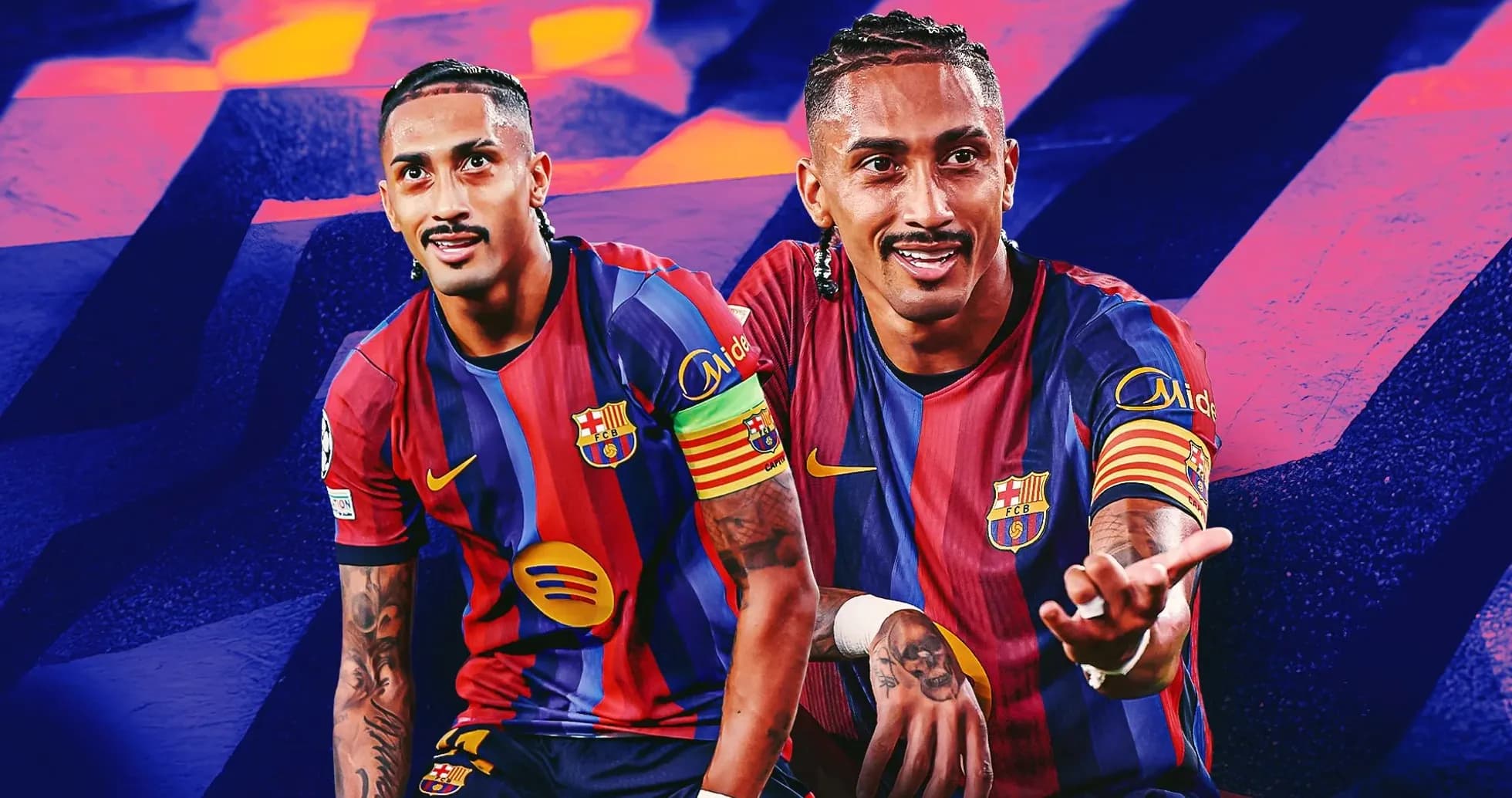
When Marc-André ter Stegen left on loan to Ajax in the summer, Flick didn’t hesitate. He handed Raphinha the armband. The Brazilian became the first of his countrymen to captain Barcelona in Catalunya on a permanent basis. He has responded by setting the standard for intensity, humility and responsibility.
He doesn’t wait for games to come to him. He grabs them.
A new-look attack, built around one man
Even after losing Lewandowski and Torres and sending Marcus Rashford back to Manchester United, Barça’s attack looks sharper than ever.
That’s not solely down to Raphinha, but he is the focal point. Gordon, Karim Adeyemi and Gabriel Jesus have all settled quickly. Flick also has 18-year-old Hamza Abdelkarim, promoted from Barça B, as another striking option.
“Raphinha, Gabby and Hamza are three different profiles, but there are other ways we could play,” Flick has said. “Anthony and Karim can also play in this position. Or Dani Olmo. Dani has showed us in last two years he can play there – the same with Fermin [Lopez]. We have a lot of options.”
Those options matter. They allow Flick to manage Raphinha’s minutes carefully, a non-negotiable after his previous hamstring problems. The coach has already been proactive, substituting him early against Feyenoord and in league wins over Athletic Club and Racing.
The same care is being taken with Yamal, whose threat has grown by drifting closer to Raphinha. Their understanding is instinctive. The moment a centre-back adjusts his body to track Yamal, the teenager slips a pass inside, knowing Raphinha will already be darting into the empty channel.
Yamal seems content to let the captain take centre stage. Flick’s dressing room is full of stars, but egos are kept in check by a collective drive that feels genuine rather than manufactured.
The Brazilian heartbeat of a new Barça
Raphinha stands at the centre of it all. He runs, presses, scores, creates, leads. He wears the armband like it belongs to him, not as a borrowed symbol.
Barcelona have been here before with Brazilians who lit up the Camp Nou. The difference now is the role: this is not just about spectacle, but structure. Flick’s Barça revolve around their Brazilian captain in a way they never quite did with his predecessors.
If he keeps this up, the question will not be whether Raphinha deserves to be on a Ballon d’Or list. It will be whether his name belongs alongside Ronaldo’s in the club’s Hall of Fame – and whether this season becomes the one that defines his era in Catalunya.