
Pep Guardiola's Impact on Premier League Tactics
When Premier League managers are asked who shaped the way they see the game, one name comes up more than any other: Pep Guardiola.
He arrived at Manchester City as a radical. He will leave as the man who rewired an entire league.
This is not just about trophies or records, although six titles in seven seasons and a 100-point campaign in 2018 scream for attention. It is about how his ideas seeped from the Etihad into every corner of English football – from Champions League nights to Sunday league pitches – and then, intriguingly, began to bend back on themselves.
From shot-stopper to playmaker – and back again
The first real shock came before Guardiola had even settled into his office. Joe Hart, a terrace idol and England’s No 1, was moved aside. In came Claudio Bravo, then Ederson. The message was blunt: if you could not play with your feet, you could not play for City.
At the time, the Premier League still worshipped the pure shot-stopper. Goalkeepers were there to save, not to pass. Guardiola ripped that up. He wanted a No 1 who could act as a deep-lying playmaker, someone who could invite pressure, split lines, and turn a goal-kick into a midfield overload.
He was hammered for it early on. Risky, reckless, overcomplicated – the critics lined up. But a decade later, the argument has flipped. It is now almost unthinkable for a top-flight side to field a keeper who looks uncomfortable with the ball at his feet.
By the early 2020s, the dominoes had fallen. Manchester United moved from David de Gea to Andre Onana. Arsenal turned from Aaron Ramsdale to David Raya. Chelsea cycled from Edouard Mendy to Kepa Arrizabalaga to Robert Sanchez. Across the division, old-school keepers gave way to passers.
Then the game changed again.
High pressing from goal-kicks grew more aggressive, more man-to-man, more suffocating. Building short became a higher-stakes gamble. Space shifted up the pitch. The very trend Guardiola had helped create began to invite new problems.
And so, at City, the symbol of his philosophy, Ederson, gave way to Gianluigi Donnarumma – a goalkeeper far less polished with the ball, but supreme in one-on-one situations. Donnarumma had been crucial to Paris St-Germain’s Champions League triumph, and Guardiola decided that, in tight matches, elite shot-stopping now offered more value than the extra pass.
It was a notable pivot. Not a rejection of his ideals, but a recalibration.
City still sometimes played short against intense presses, dropping Bernardo Silva or Rodri into the box to receive from the keeper in patterns that looked more five-a-side than Premier League. Yet the broader message was clear: the equation had changed. Risk versus reward now tilted towards the man who could win duels rather than just break lines.
Others followed. Manchester United replaced Onana with Senne Lammens, a more traditional goalkeeper. In a league Guardiola had dragged towards the ball-playing No 1, the pendulum began to swing back. A full circle, almost, but on his terms.
The birth of the inverted full-back – and the centre-back wide man
The 2017-18 season, the one that ended with 100 points, did not start with a grand tactical manifesto. It started with a problem.
Injuries stripped City of natural full-backs. Big-money signings were unavailable. Guardiola, often accused of inheriting ready-made squads, had to improvise. This is where his real genius has often shown: not in executing a pre-written plan, but in constructing a new one from what he has left.
He looked at his squad and saw left-footers Oleksandr Zinchenko and Fabian Delph. Neither was a conventional left-back. Both were technically sharp, comfortable in tight areas, happy to pass infield. So he moved the role. Instead of hugging the touchline, his left-back stepped inside next to the holding midfielder.
The effect was immediate and devastating. City gained extra security in the centre, more options in the build-up, and a clearer structure. The winger stayed wide, stretching the pitch. The inverted full-back formed a new midfield shape. Opponents struggled to close all the angles. The puzzle pieces clicked.
When Mikel Arteta later took Zinchenko to Arsenal, he carried that idea with him. Arsenal’s best football under him has often flowed from those same principles: full-backs drifting infield, midfielders rotating around them, wide players isolated one-on-one.
Ange Postecoglou, another Guardiola admirer, echoed the pattern at Tottenham. Pedro Porro and Destiny Udogie stepped into central lanes in possession, tucking in alongside the defensive midfielder and giving Spurs a different kind of platform to build from.
Guardiola kept tweaking. When Zinchenko was injured in 2018-19, Aymeric Laporte, a left-footed centre-back, slid across to left-back. In the Treble-winning 2022-23 campaign, Manuel Akanji and Nathan Ake often started as nominal full-backs, flanking Ruben Dias and John Stones. Stones, in particular, blurred lines, stepping into midfield to create yet another layer of control.
What began as a workaround became a template. Centre-backs at full-back, inverting into midfield or forming back threes in possession, are now a familiar sight. Newcastle’s 6ft 7in Dan Burn has made a career-defining move to left-back, shuffling inside to create a back three when Newcastle have the ball and then defending wide when they do not.
Guardiola did not stop with defenders who simply tucked in. He pushed further with attack-minded options such as Joao Cancelo and, more recently, Nico O’Reilly. These full-backs did not just move centrally; they advanced higher, arriving in the box, contributing to goals, behaving almost like extra No 10s.
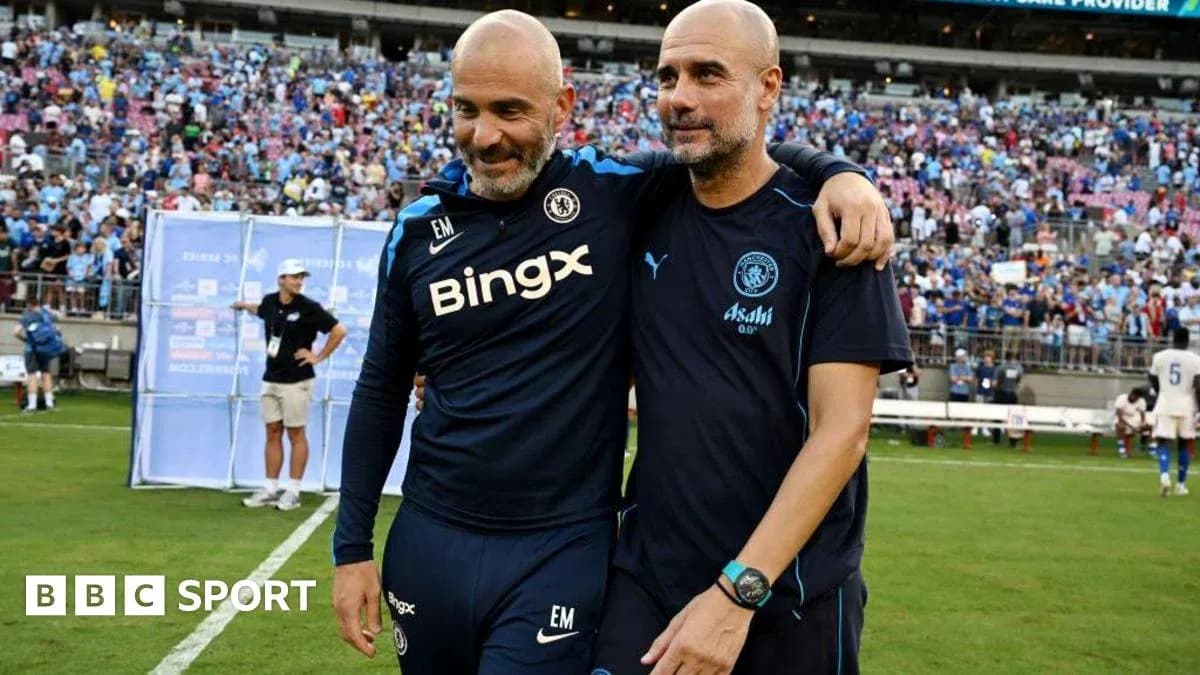
Arteta has done something similar with Jurrien Timber and Riccardo Calafiori at Arsenal. At Chelsea, Malo Gusto and Marc Cucurella have been asked to step into midfield zones under former Guardiola assistant Enzo Maresca. The lineage is obvious. The roles look different at each club, but the root idea is the same: full-backs are no longer just line-huggers. They are central actors in the drama.
Possession as a weapon, not a statistic
Guardiola’s obsession with the ball predates his time in England. At Barcelona, after a chastening defeat to Inter Milan in the Champions League, he confided that he had betrayed himself. With Zlatan Ibrahimovic up front, he had gone more direct, played quicker, ceded more possession than he liked. It did not sit right. He vowed not to compromise his principles again, even if it meant failure.
At City, those principles have been non-negotiable. Through the use of inverted full-backs, technically gifted centre-backs, and midfielders everywhere, his teams have dominated the ball almost by default.
In 2017-18, City averaged 71.9% possession. Season after season, they have stayed above 60%. This was not sterile control; it was a form of suffocation. Opponents chased shadows, then paid for their fatigue in the final half-hour.
Six titles in seven seasons turned that style from an experiment into a blueprint. High-possession, positional football stopped being a foreign import and became the standard for ambitious clubs.
Look at Liverpool. Under Jurgen Klopp, they were the embodiment of intensity and transition, thriving on chaos. Under Arne Slot, who won the Premier League in his first season, they tilted closer to Guardiola’s principles: more control, more structure, more of the ball.
Arsenal, under Arteta, have combined a mean defensive record with long spells of possession. They do not just defend well; they starve teams of opportunities by denying them the ball.
Brighton have built an entire model on coaches who want to impose themselves through possession. Roberto De Zerbi and Fabian Hurzeler have both leaned into that, turning Brighton into a club where the ball is a statement of identity as much as a tool.
Others have tried to follow the same path with less success. Scott Parker, Vincent Kompany, Russell Martin – all insisted on building from the back, dominating possession, playing through pressure. Their teams often fell short not because the ideas were flawed, but because the players could not consistently execute them and the managers refused to bend.
That, too, speaks to Guardiola’s impact. The league is now full of coaches who would rather risk failure on the ball than survive without it.
From Ferguson’s England to Guardiola’s league
Before Guardiola, the Premier League’s tactical soul belonged to Sir Alex Ferguson. His Manchester United sides played with ferocious speed, direct running, and ruthless counter-attacks. English football’s identity, at the top level, revolved around intensity and verticality.
United under Michael Carrick have leaned back into that heritage, embracing counter-attacks and quick transitions. Yet they now operate in a landscape that Guardiola has fundamentally altered.
He did not simply arrive and impose a foreign system on a stubborn league. He walked into an environment shaped by Ferguson and reshaped it from within. He did it while adapting constantly to new opponents, new trends, and new squads.
There is a persistent myth that Guardiola is rigid, that he has one way of playing and forces leagues to conform. The reality in England has been the opposite. His core beliefs have remained – dominate the ball, control space, use technically gifted players in every line – but the details have shifted again and again.
He has won with false nines and with orthodox strikers. With wingers hugging the touchline and with wide players rolling infield. With traditional full-backs, inverted full-backs, and centre-backs masquerading as both.
When injuries hit, he has built new structures. When opponents copied his ideas, he moved the goalposts. When pressing patterns changed, he altered his goalkeeper profile. Each time, the league reacted, tried to catch up, and found that the target had already shifted.
That is Guardiola’s real legacy in the Premier League. Not just that managers cite him as an influence, or that possession football is now fashionable, or that kids in academies are told to play out from the back.
It is that by the time everyone else has finished copying his last great idea, he is already busy inventing the next one.





