Liverpool at a Crossroads: Slot and Salah's Diverging Visions
A year ago, Anfield was dressing itself for a coronation. Liverpool were about to lift the Premier League trophy in front of their own supporters for the first time. Noise, colour, a sense of inevitability.
Twelve months on, the mood is very different. The title has long gone, the swagger with it, and Liverpool still have not mathematically secured a place in next season’s Champions League. Twenty defeats in all competitions have drained belief and sharpened voices in the stands. The season closes on Sunday against Brentford with the club staring not at a parade, but at a reckoning.
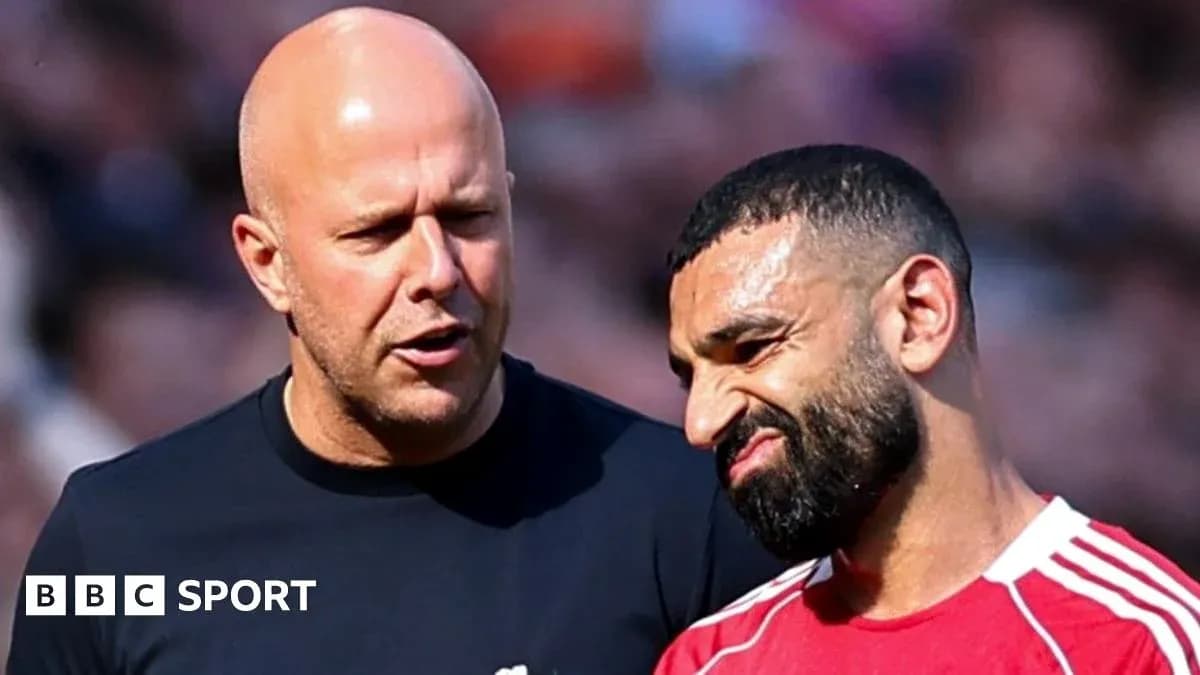
At the centre of it all stand Arne Slot and Mohamed Salah, pulling in the same direction on paper, yet exposing a fault line that runs through the club.
Slot’s Demand: Evolution or Stagnation
Slot has not hidden from what he sees. He has not tried to dress up a campaign that has turned sour.
“We have to find a way to evolve the team and play a brand of football I like,” he said ahead of Brentford’s visit. “And if I like it, the fans will like it too because I haven’t liked a lot of the ways we've played this season.”
That is a blunt admission from a head coach under pressure. Performances have been languid, the tempo often flat. Supporters have felt it, voiced it, and Slot has heard it. He knows this cannot simply be written off as a bad run.
He framed Sunday not as a dead rubber, but as a starting point.
“What we want, what he wants and what I want is for the club to be as successful as last season,” Slot said, speaking about Salah but really about Liverpool’s standards. “The game on Sunday could give us a really base heading into next season. That is where we should focus.”
The task is clear in his mind: evolve now, reshape over the summer, and arrive next season with a side that looks like his. A side he can recognise.
Salah’s Message: Heavy Metal, Not Easy Listening
If Slot chose his words carefully, Salah chose his moment.
The Egyptian rarely uses his own social media for anything beyond farewells or direct messages to supporters. When he does, people listen. With his Liverpool career down to its final week, he delivered a verdict that cut straight to the heart of the debate over style and identity.
“Us crumbling to yet another defeat this season was very painful and not what our fans deserve,” he wrote after the loss at Aston Villa. “I want to see Liverpool go back to being the heavy metal attacking team that opponents fear and back to being a team that wins trophies.”
He talked about the journey from “doubters to believers, and from believers to champions”, about always doing everything he could to help the club reach that level. Then came the line that will echo around Anfield long after he has gone:
“That is the football I know how to play and that is the identity that needs to be recovered and kept for good. It cannot be negotiable and everyone that joins this club should adapt to it.”
Salah framed Champions League qualification as “the bare minimum” and promised to do everything he can to deliver it. But he also made it clear he believes Liverpool have drifted from what they should be.
This was not a heat-of-the-moment mixed-zone outburst. Those close to him had previously considered a similar statement before his explosive interview at Leeds in December, when he said his relationship with Slot had broken down. Then, he let emotion lead. This time, he chose a more measured, written message.
The reaction told its own story. Comments from players such as Curtis Jones and Hugo Ekitike, and likes from team-mates, suggested Salah is not shouting into the void.
Slot vs Salah? Or the Same Fight in Different Words?
Slot was asked directly whether Salah’s public comments had unsettled the dressing room.
“I don't know if it had an impact on the group,” he replied. “What I have seen is the team have trained really well this week, and we hope to continue really well in the upcoming two days so we are really prepared.”
He refused to be drawn into a personal back-and-forth.
“I don't think it is that important what I feel about it,” he said of the social-media post. “What is important is that we qualify for the Champions League on Sunday, and I prepare Mo and the rest of the team to be ready for the game in the best possible way. That is what matters.”
Slot and Salah, he insisted, share a core ambition.
“I think Mo and I have the same interest – we want the best for this club. We want the club to be as successful as possible. We were both part of giving the fans their first league title in five years – but we are also aware of this season.”
In public at least, Slot framed the issue as one of shared standards rather than clashing egos. Yet the subtext is impossible to ignore: a manager talking about evolving towards a style he likes; a departing icon demanding a return to the “heavy metal” football that defined the Klopp era and saying, pointedly, “That is the football I know how to play.”
Rooney’s Blast: “Have Him Nowhere Near the Stadium”
Outside the club, the reaction has been far less diplomatic.
Wayne Rooney, speaking on his own show, did not spare Salah or Slot. He took aim at the timing and tone of Salah’s intervention.
“I find it sad at the end of what he's done and what he's achieved at Liverpool,” Rooney said. “It's not the point for him to come out and aim another dig at Slot.”
Rooney then turned to the football itself.
“He wants to play heavy metal football, so he's basically saying he wants Jurgen Klopp football. Now I don't think Mo Salah can cope with that type of football any more. I think his legs have gone to play at that high tempo and high intensity.”
The former Manchester United striker went further, calling for a hard-line response.
“If I was Arne Slot, I'd have him nowhere near the stadium in the last game,” Rooney said, recalling his own fallout with Sir Alex Ferguson and being left out of the Scot’s final Old Trafford squad. In Rooney’s eyes, Salah had “almost just dropped the grenade and said he doesn't trust and believe in Arne Slot” and left his team-mates to deal with the shrapnel.
It was a stark view, but it underlined the scale of the storm swirling around Liverpool’s final match of the season.
A Club Wrestling With Its Identity
The numbers are brutal. Twenty defeats across competitions. Champions League qualification still not secure. A style that has left sections of the fanbase restless and, at times, openly frustrated.
Keifer MacDonald of BBC Sport described a “wretched campaign” and a “languid style of play” that has fuelled discontent at Anfield in recent weeks. The stadium that once crackled with inevitability has instead grown edgy, impatient.
Slot insists he will still be in the dugout at the start of next season and says he has “every reason to believe” he can turn things around. He is not shying away from the challenge, on the pitch or off it.
Yet the conversation around Liverpool now is not just about results. It is about what this team should look like, how it should feel. Salah’s words cut to that core. “Winning some games here and there is not what Liverpool should be about. All teams win games.”
He set the bar where he believes it belongs: trophies, fear in opponents’ eyes, an attacking identity that is “not negotiable”.
On Sunday, he will walk out at Anfield in Liverpool colours one last time, with a Champions League place still on the line and a fanbase hanging on every touch, every hint of what comes next. Slot will stand in the technical area, tasked with delivering the minimum Salah demanded and the platform he himself insists can be a base for the rebuild.
One game, one farewell, one manager fighting to prove that his idea of evolution can coexist with the heavy metal soundtrack this club still hears in its head.
Which version of Liverpool walks out of Anfield when the curtain falls?