Patrick Vieira's Homecoming as Senegal Coach: A New Era Begins
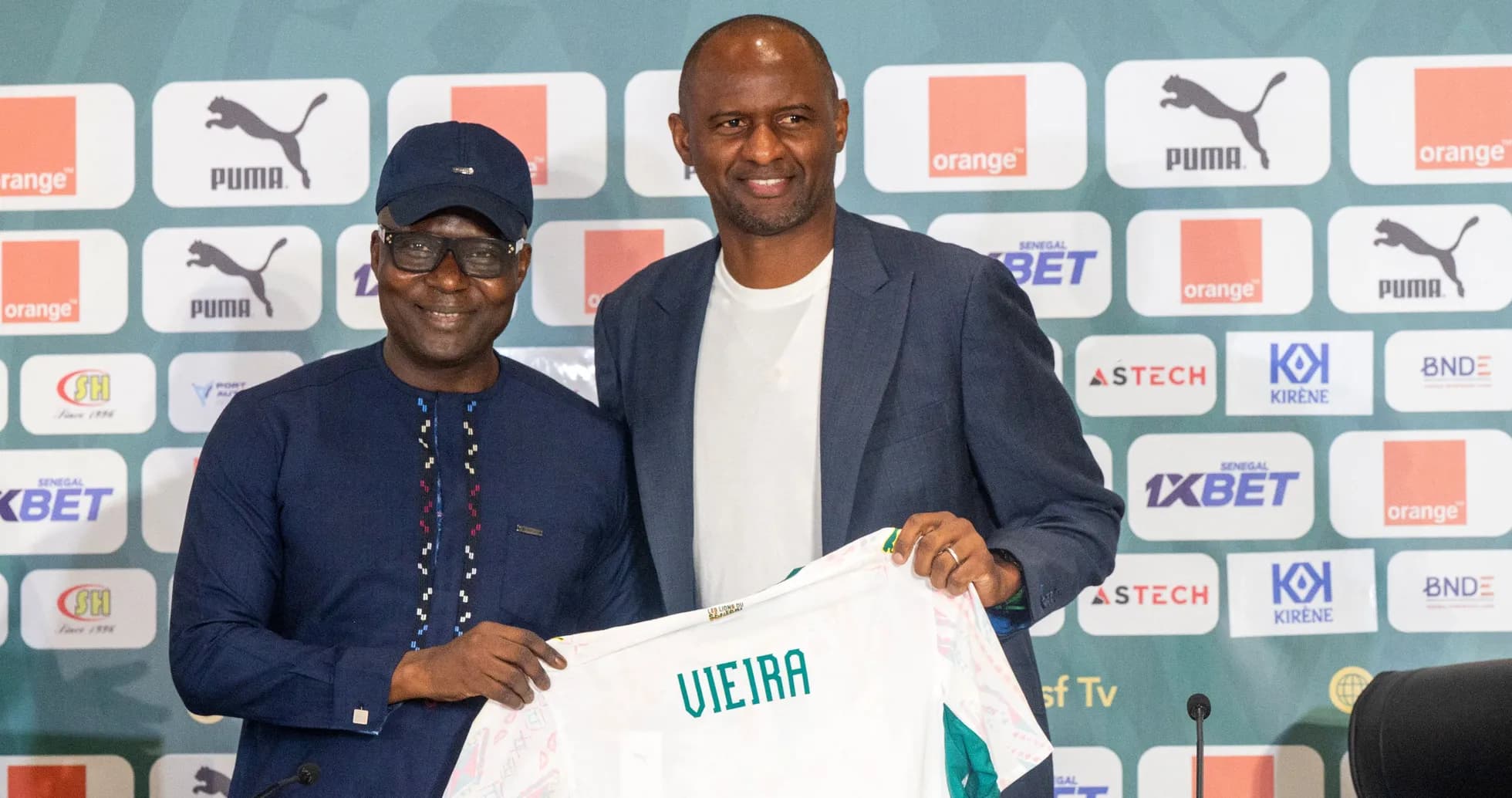
Patrick Vieira walked back into Dakar not as a visiting legend, but as the man now responsible for steering Senegal’s future. Presented officially as head coach of the Lions of Teranga, the 50-year-old launched a four-year cycle that the federation hopes will carry them, strong and stable, towards 2030.
For Abdoulaye Fall, president of the Senegalese Football Federation, this was not a luxury hire. It was, in his words, an “absolute necessity” for a national team determined to remain among the elite.
A job that feels like destiny
Vieira didn’t sell this as a career step. He sold it as a return.
Born in Dakar and raised in France from the age of eight, he framed the appointment as something far deeper than a professional move. He spoke of parents from Dakar, of family, of roots. Of history.
“This national team is not a new step in my career, it is a homecoming,” he said, leaning firmly into the emotional pull of the role. He insisted he accepted the federation’s offer for reasons of heart, not money, and promised total commitment to a fanbase used to demanding the maximum.
The expectations are huge. So is the symbolism. A World Cup and European Championship winner coming back to lead the country of his birth, charged with preserving a golden era while refreshing it on the fly.
And he wasted no time getting to work.
A 29-man squad, a major omission
Vieira’s first big decision arrived quickly: a 29-man squad, expanded and reshaped, but not ripped apart.
Seven debutants. Four goalkeepers. New names mixed with familiar pillars. This was not a revolution, but it was clearly a reset.
The headline, though, wrote itself. No Sadio Mane.
Senegal’s talisman, the face of the team for a decade, was left out of the squad for the upcoming international window. In a country where every Mane touch is scrutinised, his absence from a new coach’s first list could have sparked instant drama.
Vieira moved quickly to shut that down.
He explained that the Al-Nassr forward is dealing with a minor physical problem and that the decision came after a direct phone call between the two. No rupture, no disciplinary angle. Just a fitness issue, he insisted, and a short-term one at that.
“Regarding Sadio’s absence, whom I spoke to on the phone, he has a physical issue and that is why he will not be with us for this camp, but he surely will be for the next one,” Vieira said.
So the first camp of the Vieira era will begin without the country’s biggest star, but with the clear suggestion that Mane remains central to the project.
Not a clean break, but a careful evolution
Vieira made one thing clear: he is not here to tear down what has already been built.
“The important thing is not to start from scratch,” he said. “I’m not going to tear everything down or throw everything out the window, but to preserve what has been achieved and begin a four-year cycle.”
That philosophy runs through his first squad list.
With Edouard Mendy now retired from international duty, the goalkeeping department has been opened up. Four keepers are in, including first-time call-ups for Monza’s Ngagne Demba Thiam and AS Saint-Etienne’s Mamour Ndiaye. It’s a nod to the future, but not a dismissal of the present.
Across the pitch, seven debutants have been drafted in. Monaco centre-back Sadibou Sane, Auxerre full-back Lamine Sy, and FC Metz forward Pape Moussa Fall headline the new wave, each offering fresh energy in key areas of the pitch.
This is the balance Vieira has chosen: continuity with a twist. The spine remains, the identity is respected, but the edges are being sharpened and refreshed.
A brutal first test window
There will be no soft launch.
Senegal’s 29-man group will assemble immediately for a demanding international window that offers Vieira little time, but plenty of evidence. His ideas will have to land quickly.
The journey starts in Maputo on September 25, where Senegal open their 2027 AFCON qualification campaign against Mozambique. A tricky away day, heavy conditions, and points on the line from the first whistle of his reign.
Four days later, on September 29, they travel again, this time to face Ethiopia. Another test of organisation, mentality, and how fast the squad can absorb new tactical instructions.
Then comes a different kind of challenge: a friendly against Comoros in Marseille on October 4. Less pressure, perhaps, but a valuable laboratory for Vieira to tweak shapes, test combinations and watch how his new faces cope under the national-team spotlight.
All of it, crucially, will be done without Mane.
That absence strips away a safety net. It forces others to step forward. It gives Vieira an immediate, unfiltered look at the depth of his attacking options and the resilience of his game model when the main star is missing.
This is not just the start of a four-year cycle. It is a crash course in what Senegal will look like when the old guard eventually steps aside.
Vieira has called it a homecoming. The next few weeks will show whether it can also be the beginning of a new era that keeps Senegal exactly where Fall insists they must stay: among the teams nobody wants to face.