Patrick Vieira Takes Charge as Senegal Coach: A Homecoming
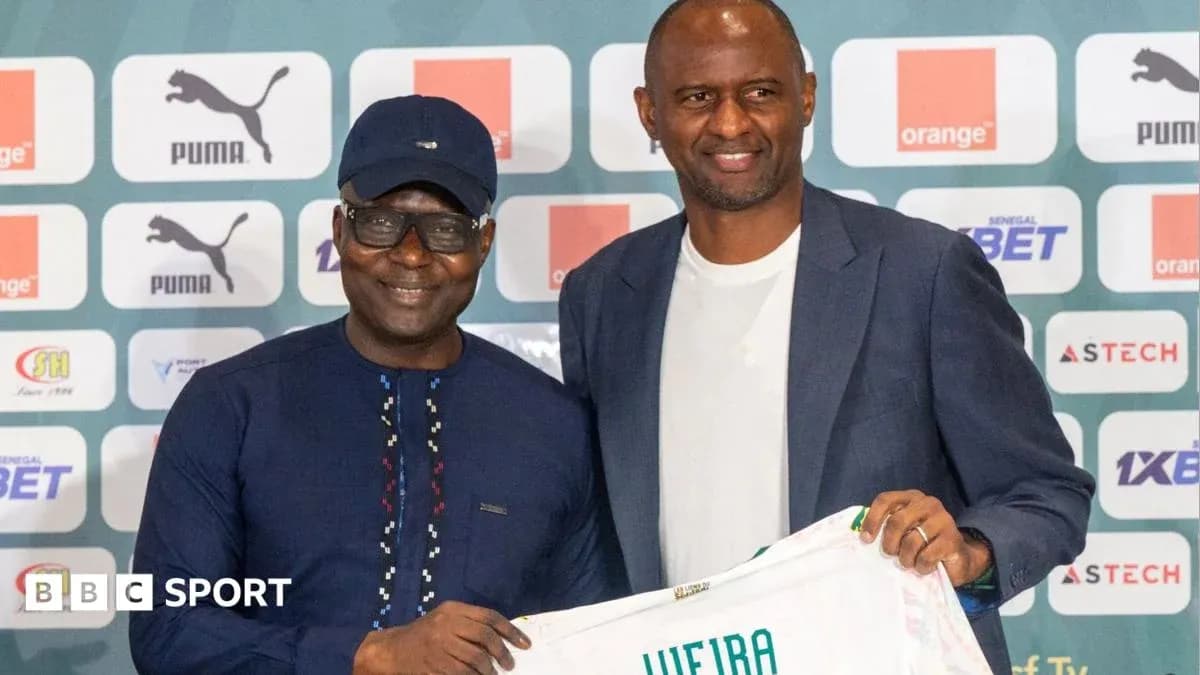
Patrick Vieira leans into the microphone in Dakar, pauses, and lets the words land.
“An honour.”
“A dream.”
“A homecoming.”
At 50, the World Cup and European Championship winner has taken on the job that, he says, comes from the heart: head coach of Senegal.
Born in the country he now leads, but made a global star in French colours, Vieira returns not as the midfield enforcer who lifted trophies with Arsenal and Les Bleus, but as a coach with scars, lessons and a point to prove.
A World Champion Comes Home
“I was born here, my parents were born here,” he says. “It really is a homecoming.”
This is his first international job after a club journey that has taken him from New York City to Nice, Crystal Palace, Strasbourg and Genoa. None of those posts carried the emotional weight of Friday’s unveiling in Dakar, where the Teranga Lions presented him as the man to guide a golden generation.
From the very first conversations with the president of the Senegal football federation, Vieira says, he did not hesitate. The talent was too rich, the moment too big.
“I accepted this challenge straight away, because there was also an exceptional generation of players,” he explains. “I realise the expectations of the people – all 20 million Senegalese.”
He knows exactly what that means. This is not a nation content with plucky exits and polite applause anymore.
A Team on the Edge of Greatness – and Turmoil
Vieira inherits a side still processing a whirlwind year.
On the pitch, Senegal are Africa’s benchmark. They won the 2025 Africa Cup of Nations with a 1-0 extra-time victory over Morocco in January, another statement from a team that has pushed itself into the global elite.
Off the pitch, the story is messier. The ultimate destination of that Afcon trophy now rests with the Court of Arbitration for Sport after a chaotic fallout: a walk-off by some Senegal players and staff in protest at a penalty decision in the final led to the cup being handed to hosts Morocco in March. A title won, then taken away, at least for now.
And the World Cup? That ended in brutal fashion. In the last 32 of the 2026 tournament, Senegal led Belgium 2-0 with five minutes of normal time to play. They still lost 3-2 after extra time. A collapse that still stings.
Pape Thiaw paid with his job. Vieira walks into a dressing room that knows how to win, but also how quickly it can all unravel.
“Today, Senegal is among the major nations in world football,” he says, without blinking. “Senegal’s objectives aren’t what they were 10 or 15 years ago. On the back of its recent results, Senegal has moved forward, has reached new levels. The demand for results has also stepped up.”
The bar is clear. The foundations, he insists, must be just as strong.
Not a Revolution, But a New Chapter
Vieira talks about structure, intensity, aggression. He wants a team with a “very precise structure” that can play with edge and purpose. But he is not here to burn everything down.
“What matters to me isn’t starting again from scratch,” he says. “It’s about respecting what the federation has put in place over the last few years and building the next stage, opening a new chapter.
“A new chapter meaning my job isn’t to tear everything down, it isn’t to throw everything out of the window. It’s about keeping this team’s strength: its identity, its unity, its ability to suffer together.”
This is not the language of a revolutionary. It is the language of a man who knows he is walking into a successful, if wounded, camp.
“To make this project work, I’ll need the whole nation united. I’ll work heart and soul to restore the team’s pride.”
Thrown Straight Into the Fire
There is no soft launch. No gentle friendlies to find his feet.
Vieira steps directly into the qualifiers for the 2027 Afcon. Six games, spread across this international window, November, and March 2027, will shape the early judgement on his reign.
His first assignment was meant to be a home debut in Dakar against Mozambique on Friday, 25 September. The city, though, is in full preparation mode for the 2026 Youth Olympic Games, and the match has been reversed.
“Of course, I’d have preferred to play the first match here in Dakar,” he admits. “But unfortunately, with the federation, we all felt the best decision was to postpone the match and go and play in Mozambique. Those are difficulties we’re going to accept and deal with.”
So instead of a roaring welcome at home, Vieira’s first competitive steps as Senegal coach will come away in Maputo, followed by another trip, to Ethiopia on 29 September.
The challenge is immediate. The squad, weakened.
Big Names Missing, Big Decisions Ahead
Long-time number one Edouard Mendy, 34, has retired from international duty. A pillar of the Teranga Lions era is gone.
Another icon, Sadio Mane, will not be there either. Vieira says the 34-year-old forward is out with “a bit of a physical issue”. That alone would worry a nation used to seeing Mane drag them through tight games.
Rumours of Mane following Mendy into retirement have swirled for months. Vieira moves quickly to shut that down.
He insists the former Liverpool and Bayern Munich star will “surely” be in his next squad, if fit.
Elsewhere, right-back Krepin Diatta is left out as he is currently without a club, and forward Ismaila Sarr also misses out, still sidelined by a groin problem and transfer uncertainty at Crystal Palace.
The new coach must start his project without some of his most familiar weapons. It sharpens the test. It also offers a glimpse of the transition to come.
A Coach Shaped by Setbacks
As a player, Vieira’s career was drenched in silverware. With France and Arsenal, success became routine.
As a manager, life has bitten back.
He left Crystal Palace in March 2023 with 22 wins from 74 games in all competitions. Respectable, not spectacular. At Strasbourg, he lasted a season. At Genoa, he guided the club to safety in Serie A in the 2024-25 campaign, only to be sacked in November the following season after six defeats in nine league matches left the team bottom.
He arrives in Dakar having been out of work since that dismissal.
Yet he refuses to carry those setbacks as baggage.
“I’ve always been someone who stays positive,” he says. “That means you learn, and there are always positive things to take from it. I’m a better coach today than I was in my last spell at Genoa, because that experience helped me grow and made me realise certain things.
“Given the experience I have as a manager, I’ve got no doubt about my ability to meet the expectations of fans.”
The message is clear: those bruises, he believes, have hardened him for this stage.
A City’s Embrace, A Nation’s Expectation
On Thursday evening, as Vieira stepped off the plane in Dakar, the welcome told its own story.
Videos from the airport showed him holding a Senegal flag aloft, swallowed by a crowd of fans, hands reaching out, phones raised, noise bouncing off the terminal walls.
“I couldn’t have been given a warmer welcome,” he says. “I saw the supporters’ enthusiasm and I thank them for it. Taking charge of this national team isn’t just a new stage in my career – it’s coming back home.”
Now comes the hard part.
The country that once watched him conquer the world in French blue will judge him in green, yellow and red. The team is strong, the expectations higher still, the margins tiny.
Vieira says he will give heart and soul to restore pride. The question, as the qualifiers begin on foreign soil and a nation leans in, is simple:
Can one of Senegal’s most famous sons turn a dream homecoming into sustained dominance on the pitch?