Parma Secures Serie A Survival with Tactical Win over Sassuolo
The late spring light at Stadio Ennio Tardini felt almost ceremonial as Parma closed their Serie A return with a 1–0 win over Sassuolo, a narrow scoreline that mirrored their season: limited firepower, but just enough resolve to stay afloat. Following this result, the table locks in with Parma 13th on 45 points and Sassuolo 11th on 49, both clear of danger yet clearly short of European contention.
I. The Big Picture – contrasting identities, converging on mid-table
Over the campaign in total, Parma have been a study in minimalism. Across 38 matches they scored just 28 goals and conceded 46, giving them a goal difference of -18. At home they averaged only 0.8 goals for and 1.3 against, and they failed to score in 7 of their 19 games at the Tardini. The 3-5-2 that Carlos Cuesta trusted again here is less about volume of chances and more about structure: three centre-backs, wing-backs who double as full-backs and wingers, and a front two that live off moments rather than waves of pressure.
Sassuolo’s season has been the stylistic opposite. Their 4-3-3 under Fabio Grosso has produced 46 goals and 50 conceded overall, a goal difference of -4 that speaks to openness and volatility. On their travels they averaged 1.1 goals for and 1.3 against, with 5 away wins but also 9 defeats. They arrive as a side that can hurt anyone going forward, yet rarely control games defensively.
The full-time scoreline – Parma 1, Sassuolo 0 – therefore feels like a tactical victory for Cuesta’s pragmatism over Grosso’s expansive intent.
II. Tactical Voids – absences that shaped the chessboard
Parma’s squad sheet carried a long list of absentees, and not just fringe names. A. Bernabe (muscle injury), G. Oristanio and M. Frigan (both knee), G. Strefezza (ankle), plus B. Cremaschi, N. Elphege and J. Ondrejka all missing reduced Cuesta’s ability to rotate or inject creativity between the lines. It pushed even more responsibility onto H. Nicolussi Caviglia as the central conduit and onto the wing-backs, S. Britschgi and E. Valeri, to provide width and progression.
For Sassuolo, the defensive and midfield depth was thinned. D. Bakola, F. Cande, E. Pieragnolo and S. Walukiewicz were all ruled out with injuries, while F. Romagna and A. Vranckx were listed as inactive. D. Boloca’s muscle injury further stripped the midfield of an all-round presence. The result was a back four featuring W. Coulibaly, T. Macchioni, J. Idzes and U. Garcia that, on paper, lacked a dominant organiser, and a midfield where K. Thorstvedt had to balance creativity with control.
Discipline has been a live wire for both clubs all season. Parma’s yellow-card timings show a clear late-game edge: 21.21% of their bookings arrive between 46–60 minutes and another 21.21% between 76–90, with a further 13.64% in added time (91–105). Their red cards also cluster in key pressure phases, with 40.00% between 31–45 minutes and another 20.00% each in the 61–75, 76–90 and 91–105 windows. Sassuolo, meanwhile, are notorious for late yellows: 28.92% of their cautions land between 76–90 minutes, and 14.46% from 91–105. Their reds spike around half-time and early second half, with 25.00% between 16–30, 50.00% between 46–60 and 25.00% between 76–90. This match, tight and tense, always risked being decided as much by temperament as by tactics.
III. Key Matchups – Hunter vs Shield, and the engine rooms
Hunter vs Shield
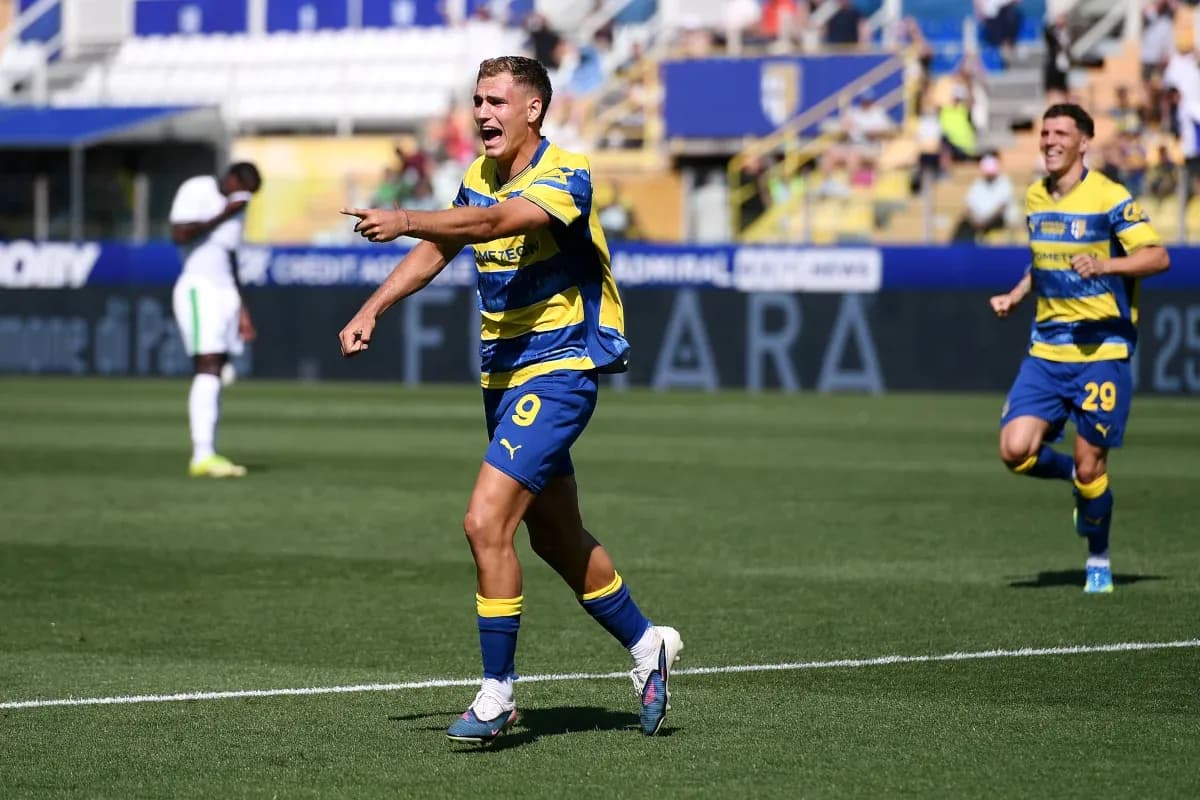
The centrepiece duel was always going to be between the top scorers: Mateo Pellegrino for Parma and Andrea Pinamonti for Sassuolo.
Pellegrino, starting again at the tip of Parma’s 3-5-2, has been their reference point all year. In total this campaign he scored 9 goals and added 1 assist in 37 appearances, with 53 shots and 22 on target. His game is not just about finishing; 546 duels contested and 233 won underline how much he works as the first defender, and he has blocked 5 shots and made 4 interceptions, a pressing forward in a low-scoring team. He also carries set-piece responsibility, having scored 1 penalty without a miss.
Pinamonti, leading Sassuolo’s line in the 4-3-3, matched Pellegrino’s 9 goals in total and contributed 3 assists. He took 57 shots, 30 on target, and offered 17 key passes, a more box-focused yet still link-capable striker. Crucially, his record from the spot is blemished: he missed 1 penalty this season and scored none, so any notion of him as a flawless finisher from 12 yards would be false.
On paper, the duel favoured Sassuolo’s attack, which averaged 1.1 goals on their travels against a Parma defence conceding 1.3 at home. But Parma’s shape is built to funnel play into areas where their back three can dominate. Mariano Troilo, one of the league’s headline red-card figures, embodies that edge. Across the season he blocked 18 shots, a towering number that shows how aggressively he steps out. His disciplinary line is thin – 7 yellows, 1 yellow-red and 1 straight red – but when he stays on the pitch he gives Parma a rugged shield in front of E. Corvi.
Engine Room – control vs disruption
In midfield, the contest was more nuanced. For Sassuolo, Thorstvedt is the hinge. Over the campaign he scored 4 goals and delivered 4 assists, with 31 shots (13 on target) and 32 key passes. He also made 44 tackles, 13 successful blocks and 32 interceptions, and engaged in 287 duels, winning 149. He is both creator and destroyer, but his 9 yellow cards underline how often he walks the disciplinary tightrope.
Behind him in the season hierarchy, Nemanja Matic looms large even if he started this particular game on the bench. His 1 goal, 1 assist and 1721 completed passes at 86% accuracy speak to metronomic control, while 43 tackles, 10 blocks and 28 interceptions show he remains an elite screen. His single red card this season is a reminder that even experienced enforcers can overstep.
Parma’s midfield lacks a headline star of that magnitude, especially with Bernabe and Oristanio unavailable, but the structure compensates. Nicolussi Caviglia as the central pivot, flanked by the energy of M. Keita and the industry of C. Ordonez, is designed to compress space rather than dominate the ball. Wing-backs Britschgi and Valeri push high to pin Sassuolo’s full-backs, trying to isolate A. Laurienté and D. Berardi in deeper zones.
Laurienté himself is Sassuolo’s creative supercharger. Across the season he scored 7 goals and supplied 9 assists, with 54 key passes and 80 dribble attempts, 29 successful. He is the league’s second-ranked assist provider, a winger who can both carry and create. His battle with Parma’s left-sided defender L. Valenti and the covering Troilo was always going to be decisive in whether Sassuolo could stretch the back three horizontally.
IV. Statistical Prognosis – xG logic vs scoreboard reality
Without explicit xG values, the season-long shot and goal profiles still allow a clear inference. Sassuolo’s attack, with Pinamonti, Berardi (8 goals, 4 assists) and Laurienté, is built to generate higher-quality chances than Parma’s, whose 0.7 goals per game overall suggests a low-xG, low-volume approach. On their travels, Sassuolo’s 21 goals in 19 matches align with a side that typically produces enough opportunities to score at least once.
Parma, conversely, rely on defensive solidity spikes rather than sustained dominance. Their 13 clean sheets in total – 5 at home, 8 away – show that when their structure holds, it really holds. The 3-5-2, used in 19 league matches, is their most familiar and most secure shape. It allows Troilo, A. Circati and Valenti to defend the box in numbers, with Corvi protected from central overloads.
In a probabilistic sense, pre-match models would likely have leaned towards a narrow Sassuolo edge on xG, given their offensive output and Parma’s anaemic scoring rate. Yet the 1–0 outcome reflects how tactical context and game state can tilt those probabilities. Parma’s ability to drag opponents into attritional, low-tempo battles, combined with Sassuolo’s tendency to concede – 24 goals on their travels, 1.3 per game – meant that a single moment for Pellegrino or a set-piece was always capable of deciding it.
Following this result, the season’s storylines harden into identity. Parma finish as the survival specialists: structurally sound, offensively modest, but capable of grinding out clean sheets and one-goal wins. Sassuolo close as the entertaining but flawed aggressor: rich in attacking talent, led by Laurienté, Berardi and Pinamonti, yet undermined by defensive looseness and disciplinary spikes in the very phases where games are won and lost.
At the Tardini, the final act belonged to the shield rather than the hunters. In a league increasingly obsessed with fluid attacking structures, Parma’s rigid 3-5-2 and their willingness to suffer without the ball earned them a final-day statement that fits their season-long tactical truth.