Lecce vs Genoa: A Narrow 1-0 Victory in Serie A's Final Round
The final evening at Via del Mare felt less like a dead rubber and more like a reckoning. Lecce and Genoa arrived for Round 38 of Serie A with survival already mathematically framed, but not emotionally resolved. The table told its own story: Genoa 16th on 41 points, Lecce 17th on 38, both scarred by negative goal differences – Lecce at -22 from 28 scored and 50 conceded overall, Genoa at -10 with 41 for and 51 against. Following this result, Lecce’s 1-0 home win crystallised the season’s identities: a team that suffered, defended in numbers, and survived on narrow margins.
I. The Big Picture – Structure, Suffering, and a Single Goal
Eusebio Di Francesco doubled down on Lecce’s seasonal DNA, rolling out their most-used shape: the 4-2-3-1 that had started 22 league games. Wladimiro Falcone anchored the back line behind a defence of Danilo Veiga, Jannik Siebert, Tiago Gabriel and Antonino Gallo. In front of them, Ylber Ramadani and O. Ngom formed the double pivot, with a dynamic three of S. Pierotti, L. Coulibaly and Lameck Banda supporting lone forward Walid Cheddira.
Across from them, Daniele De Rossi’s Genoa moved away from their more common 3-5-2 and 3-4-2-1 structures into a 3-5-1-1. Nicola Leali stood behind a back three of A. Marcandalli, S. Otoa and N. Zatterstrom. The wing-backs, S. Sabelli and A. Martin, framed a central trio of M. Frendrup, Amorim and P. Masini, with M. E. Ellertsson operating off Lorenzo Colombo.
The scoreline – Lecce 1-0 Genoa – mirrored Lecce’s season: at home they averaged only 0.7 goals for and 1.3 against, but still managed 5 clean sheets in 19 matches. This was another such night: minimal attacking production, maximum defensive concentration.
II. Tactical Voids – Who Was Missing, and What It Cost
Both squads walked into this fixture with important absences that shaped the tactical landscape.
Lecce were without M. Berisha (thigh injury) and R. Sottil (back injury), thinning Di Francesco’s creative and rotational options between the lines. The absence of Berisha in particular removed a technical reference point in the half-spaces, forcing Lecce to lean even harder on Banda’s direct running and Coulibaly’s work between midfield and attack.
Genoa’s voids were far more dramatic. T. Baldanzi (illness), M. Cornet (muscle injury), J. Ekhator (foot injury), C. Ekuban (injury), Junior Messias (muscle injury), R. Malinovskyi (inactive), J. Onana (injury), L. Ostigard (knock) and Vitinha (suspension for yellow cards) were all unavailable. That is a spine ripped out: no Malinovskyi to dictate tempo or threaten from distance, no Vitinha as a penalty-box reference, no Messias or Cornet to break lines from wide or half-spaces.
Without that creative core, De Rossi’s 3-5-1-1 became more about structure than incision. Ellertsson and Colombo worked, pressed and ran channels, but the lack of a true advanced playmaker meant Genoa’s attacks often died before reaching dangerous zones. The bench, populated with youth and depth options like F. Carbone, M. Doucoure, J. Grossi and E. Spicuglia, had energy but not the proven Serie A craft of the missing names.
Disciplinary profiles also coloured the risk map. Lecce’s season-long card distribution shows a pronounced late-game surge in yellow cards: 30.43% of their bookings arrived between 76-90 minutes, with another 13.04% in added time (91-105). Genoa, by contrast, were most volatile between 61-75 minutes, with 25.40% of their yellows there, and had red cards scattered early (0-15), mid (46-60) and in added time. This match, tight and tense, always threatened to tilt on a late tackle or a tired foul.
III. Key Matchups – Hunter vs Shield, Engine Room vs Enforcer
With no explicit league-wide top scorer data provided, the “Hunter vs Shield” duel was less about individual strikers and more about units. On their travels, Genoa averaged 1.0 goals for and 1.3 against; Lecce at home sat at 0.7 for and 1.3 against. Two modest attacks met two vulnerable defences, but Lecce’s clean-sheet record – 10 overall, split evenly between home and away – hinted at a side more comfortable in low-scoring, attritional battles.
The “Engine Room” battle was clearer. Ramadani, one of Serie A’s leading yellow-card collectors with 10 bookings, has been Lecce’s midfield metronome and shield. Across 37 appearances and 3214 minutes, he made 91 tackles, 11 successful blocks and 46 interceptions, while committing 43 fouls and drawing 59. His job against Genoa’s central trio was to suffocate transitions and deny Frendrup and Amorim the time to connect with Colombo.
Behind him, Danilo Veiga’s season explained why he is among the league’s most-carded defenders: 98 tackles, 14 successful blocks and 31 interceptions, but also 44 fouls committed and 9 yellows. His duels with Ellertsson and the overlapping A. Martin were a constant friction point. When Genoa tried to overload the left, Veiga’s aggression, and his willingness to step high, became Lecce’s first line of counter-press.
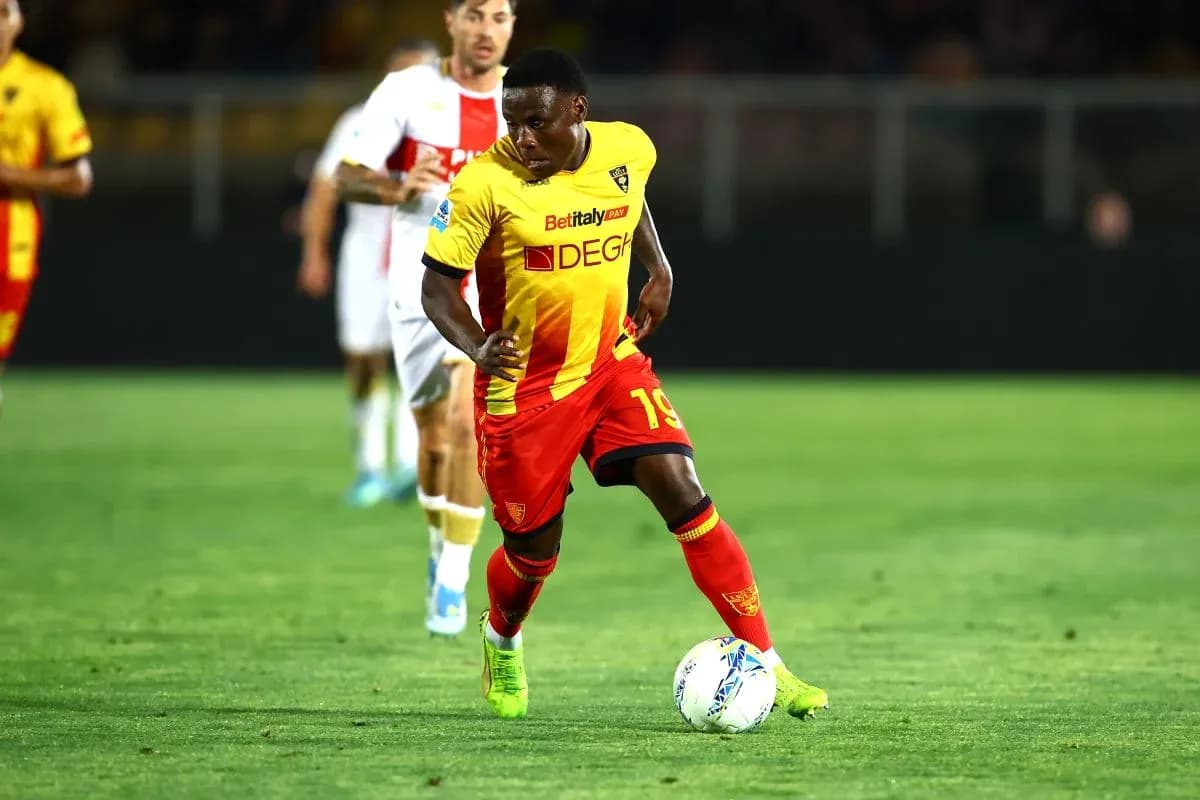
Further forward, Banda offered the chaos. With 5 goals, 4 assists and 87 dribble attempts (34 successful), plus 49 fouls drawn and 44 committed, he embodied Lecce’s high-risk, high-impact edge. His red card earlier in the season sits alongside 6 yellows, underlining how often he plays on the disciplinary edge. Against a Genoa side that already had 1 red card in the early 0-15 window and another between 46-60 in the season data, Banda’s direct running was always likely to tempt desperate challenges.
On the Genoa side, the absence of Malinovskyi – 6 goals, 3 assists, 43 shots (15 on target), 39 key passes and 10 yellows – robbed them of both long-range threat and set-piece quality. Without his left foot, Genoa’s “Hunter” presence from midfield was blunted, and Lecce could defend five to ten metres deeper without fearing the shot from distance.
IV. Statistical Prognosis – xG by Proxy, and Why 1-0 Felt Inevitable
No explicit Expected Goals numbers are provided, but the season-long trends point toward a low-xG contest that Lecce were better built to navigate. Heading into this game, Lecce’s overall scoring rate was 0.7 goals per match, with 1.3 conceded; Genoa’s was 1.1 for and 1.3 against. Neither side reliably outperformed opponents in open play, but Lecce’s 10 clean sheets to Genoa’s 9 suggested marginally greater defensive resilience when games slowed and narrowed.
The disciplinary timing patterns matter here. Lecce’s late yellow-card spike between 76-90 minutes and Genoa’s mid-second-half volatility between 61-75 paint a picture of a match destined to tighten as legs tired. In that context, a single Lecce breakthrough – likely driven by Banda’s dribbling, Cheddira’s channel running or a second-line surge from Coulibaly – was always more probable than a multi-goal shootout.
Genoa’s perfect penalty record this season (5 scored from 5, 100.00%) never came into play, and with no penalties missed on either side, there was no spot-kick drama to swing the narrative. Instead, Lecce leaned into what they had been all year: a side comfortable suffering without the ball, trusting Falcone and a combative back four to protect slim margins.
Following this result, the 1-0 at Via del Mare felt less like an upset and more like a logical conclusion to two contrasting survival stories. Lecce, with their hard-edged enforcers in Ramadani and Veiga and the volatility of Banda, found just enough incision to match their defensive grit. Genoa, stripped of their creative core, defended with structure but attacked without conviction. In a season defined by fine lines, this was one more: a narrow home win, a clean sheet, and a final chapter that perfectly matched the numbers that led into it.