Norway's World Cup Attack Plan: Beyond Haaland
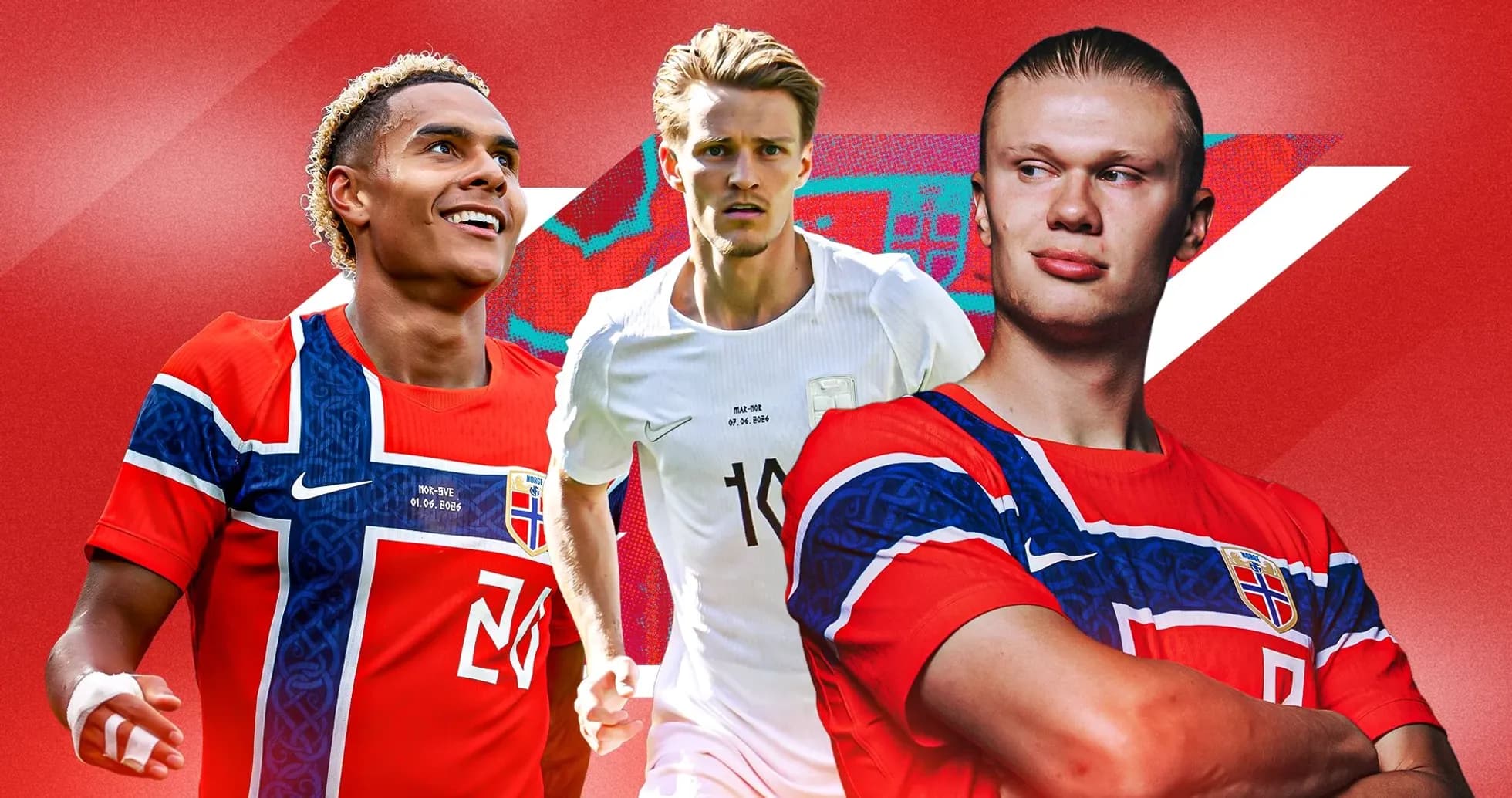
Erling Haaland will dominate the billboards and the television promos, but Norway are heading to the World Cup with an attacking plan that stretches far beyond their No.9. Stale Solbakken has built a side that feeds its superstar from every angle, often in ways that look nothing like the textbook.
This is not just “cross it to the big man” football. It’s more intricate, more layered – and sometimes downright unconventional.
Nusa and Schjelderup: youth with teeth on the left
On the left, Antonio Nusa is expected to start and stay there. The RB Leipzig winger, just 21, doesn’t just hug the touchline; he glides past defenders, slips between challenges and leaves full-backs chasing shadows.
His qualifying numbers back up the eye test: six goal contributions in six games. He scored and assisted in a 3-0 demolition of Italy, then did damage again in the 4-1 win in the return fixture. When Norway turned a heavyweight into a training cone, Nusa was at the heart of it.
Waiting behind him is Andreas Schjelderup, another young talent with a different type of threat. The 22-year-old arrives off a storming second half of the season under Jose Mourinho at Benfica, racking up 10 combined goals and assists in just 14 league matches. He also hit a brace against Real Madrid in the Champions League in January – the kind of performance that changes how the football world talks about you.
Schjelderup is not yet guaranteed a starting berth, but within the Norway camp and beyond, many see him as a future superstar. For now, he’s the luxury option off the bench who can flip a game on its head.
A giant on the right – but not where you expect him
On the opposite flank, the picture looks nothing like the typical winger’s role. Alexander Sorloth, all 6'5" of him, often starts from the right. On paper, that sounds like a square peg. On the pitch, it’s a clever piece of structural engineering.
Out of possession, he works the channel. When Norway have the ball, he tucks in close to Haaland, forming a twin-tower threat in the box. It worked in qualifying: eight goal contributions in eight games underline his importance.
Oscar Bobb offers a more traditional wide option. The Fulham man has not yet exploded at Craven Cottage, but his inclusion gives Solbakken a different profile if the game demands more guile and less muscle. Jens Petter Hauge, revitalised at Bodo/Glimt after his AC Milan days, also makes the squad despite playing no part in qualifying, his club form – including standout displays in Champions League wins over Man City and Inter – simply too strong to ignore.
Norway’s right side, then, is not about chalk-on-boots wingers. It’s about creating chaos in the half-spaces and opening a runway for one of the team’s most dangerous weapons.
Odegaard’s orchestra in the middle
If Haaland is the finisher and the wingers are the accelerators, Martin Odegaard is the conductor. The Arsenal captain leads a midfield stacked with top-level experience, and for Norway, the team bends to his rhythm.
Alongside him, Sander Berge brings Premier League steel in front of the back four, screening danger and recycling possession. Fredrik Aursnes, another Benfica mainstay, operates as a hard-running No.8, knitting phases together and arriving in the right pockets.
Aursnes’ story adds a layer of intrigue. Two years ago, he stepped away from the national team, saying he wanted “more time and freedom to prioritise other things in my life besides football”. In February, he reversed that decision. Now, despite missing the entire qualifying campaign, he looks set to walk straight back into the starting XI at the World Cup. Norway gain a seasoned, versatile midfielder who knows how to handle big nights.
Behind that trio, there is genuine depth. Patrick Berg, the elegant Bodo/Glimt captain, offers control and composure. Kristian Thorstvedt and Morten Thorsby, both based in Italy, add energy and tactical intelligence.
At the centre of it all stands Odegaard. His club performances can divide opinion – some see the genius, others see the games where he drifts. For Norway, the picture is clearer. He delivers.
Even in an injury-hit season that forced him to miss three of eight qualifiers, the 27-year-old produced seven assists, including a hat-trick of them in a single match against Israel. No player in Europe managed more across qualifying. His vision will be as vital as Haaland’s finishing in North America, especially in those tight moments when one pass can unlock an entire defence.
Life after Haaland? Norway have a plan
Haaland will start every game he can and, if Solbakken gets his wish, play every minute. But this is not a one-man dependency with nothing behind it.
Sorloth is the obvious first alternative through the middle. He comes into the tournament off a 20-goal season with Atletico Madrid, despite not always being first choice. His international record is solid, his role well defined.
Solbakken summed him up in an interview with FIFA: “Alexander brings a lot of physicality, and he's a loyal player that can play in different positions up front. Sometimes he plays together with Erling, sometimes he plays a little to the right. He's a goal threat, but he's also an assist threat. But the best thing is that he works so hard for the team, sometimes in a position that he maybe doesn't prefer."
Then there is Jorgen Strand Larsen. The Crystal Palace striker has quickly built a reputation in the Premier League since arriving in 2024, and he sharpened his edge with a brace in a warm-up friendly against Sweden. He also scored against Italy in qualifying, underlining his ability to deliver on serious occasions. With Sorloth often used wide, Strand Larsen should see minutes even if Haaland stays fit.
Norway, for the first time in decades, can look at their centre-forward options and talk about variety, not just survival.
Ryerson: the right-back who turns the whole attack
The most intriguing wrinkle in Solbakken’s blueprint comes from the back. Norway’s “unconventional” use of the flanks revolves around one man: Julian Ryerson.
Listed as a right-back, he often behaves like a winger, sometimes like a playmaker. The idea is simple but smart. When Norway have the ball, Sorloth drifts inside, almost as a second striker. That movement clears the lane for the Borussia Dortmund defender to surge forward.
Once he’s there, Ryerson delivers. His 18 Bundesliga assists in the 2025-26 season are a staggering return for a full-back, and they tell the story better than any tactical board. He hits early crosses, late cut-backs, whipped deliveries from deep. With Haaland and Sorloth as twin aerial targets, every ball into the box feels loaded.
Ryerson is deadly from set pieces as well. A significant chunk of those assists came from corners and free-kicks, making him a constant threat even when the game slows down. Opponents who fixate solely on Haaland’s movement will find Ryerson punishing that lapse from the dead ball.
Call him Norway’s secret weapon if you like. He won’t be a secret for long.
A nation back on the biggest stage – and under no illusions
For all the tactical quirks and attacking options, this World Cup carries a deeper weight in Norway. It ends 28 years of absence from the biggest stage. It restores a sense of belonging.
Solbakken feels that connection. “I think it means a lot for the whole nation, especially the common supporter,” he told FIFA. “I think it's been hard for everyone to sit home at every World Cup back to when I played in 1998. Fifty-thousand fans came to meet us [after qualification was confirmed] on a Monday in minus four [degrees], so that says it all. They have waited for this moment for so long, and now it's finally here."
The draw, though, offers no comfort. Norway land in the so-called Group of Death with France, Senegal and Iraq. No soft landing. No gentle reintroduction.
Solbakken is realistic about their place in that landscape. “I don't think we are dark horses to get all the way. I think we are dark horses in terms of, on our day, we can maybe beat a stronger opponent. But to say that we are dark horses for the whole tournament is too far. We are in a very hard group. I think it will be very tight and hopefully we have the organisation and the match-winners to get through."
The ambition is not wrapped in bombast. It is framed in identity. “For Norway, this is the World Cup to express themselves – to show the world that we play, maybe, a different kind of football than what we have done before, and that we are an offensive team with good individuals that work hard for each other. My dream scenario? I won't talk about it, because my dreams are for myself. But hopefully we can get the best out of the team and on our day, then we can beat anyone."
Haaland will draw the cameras. Odegaard will pull the strings. Nusa, Sorloth, Ryerson and the rest will circle around them, each with a defined role in a system that finally looks built for the modern game.
Norway have waited nearly three decades to show this version of themselves to the world. Now they walk into a brutal group, armed with a generational striker, a daring right-back and a belief that, on the right night, “anyone” really does mean anyone.