Napoli's Defeat to Como: Tactical Analysis of Serie A Clash
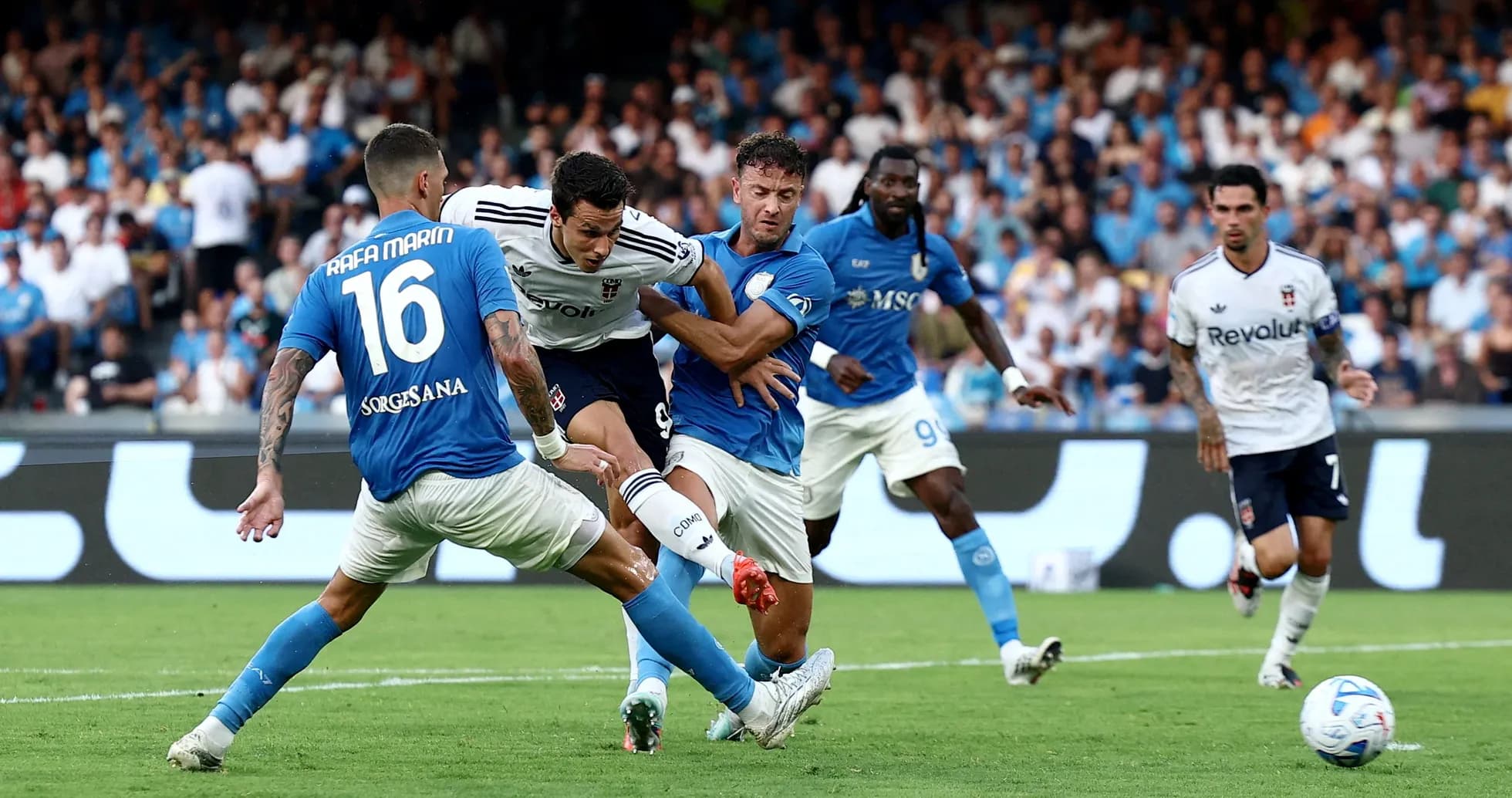
Under the late-summer light at Stadio Diego Armando Maradona, this was supposed to be Napoli’s statement of intent under Massimiliano Allegri: a first home win of the new Serie A season, a reassertion of authority in front of a restless crowd. Instead, the evening closed on a 2–1 defeat to Como, a result that leaves Napoli 10th with 3 points from 2 matches, and confirms the visitors’ bright start as they rise to 8th with 4 points.
Across the opening two rounds, both sides share an identical overall goal profile: 3 scored and 2 conceded, a goal difference of +1. But the distribution of those numbers reveals the real story. At home this campaign, Napoli have played 1, lost 1, scoring 1 and conceding 2. On their travels, Como have played 2, remained unbeaten with 1 win and 1 draw, scoring 3 and conceding 2. Where Napoli’s fortress has cracked early, Cesc Fabregas has built a side that travels with conviction.
Allegri stayed faithful to a 4-3-3 that defines Napoli’s early-season identity. A. Meret anchored the side behind a back four of G. Di Lorenzo, A. Rrahmani, R. Marin and M. Olivera. The midfield three – F. Anguissa, S. Lobotka and S. McTominay – promised control and vertical thrust, while the front line of M. Politano, R. Hojlund and N. Lang offered width, pressing and depth in behind.
Fabregas, by contrast, leaned into a more layered 4-2-3-1. J. Butez started in goal, shielded by Y. Couto, J. Ramon, T. Chalobah and A. Valle. The double pivot of L. Milla and L. Da Cunha sat beneath a creative band of three – A. Diao on the right, N. Paz centrally, M. Baturina from the left – with T. Douvikas as the single striker.
The tactical picture was shaped even before kick-off by absences. Napoli were without A. Buongiorno, L. Marianucci and P. Mazzocchi, all sidelined with knee injuries. For a coach who prizes defensive structure, losing Buongiorno and Mazzocchi removed both depth and tactical flexibility in the back line. It left Rrahmani and Marin as the central pairing with little like-for-like cover, and pushed Olivera into a role where he had to balance his aggression with the knowledge that behind him, options were thin.
Como had their own setback in attack with J. Addai missing due to an Achilles tendon injury. Yet Fabregas’ squad construction showed its value: Baturina and Diao stepped into the creative burden, and Douvikas continued to operate as the reference point in the box.
Across the season so far, Napoli’s statistical profile hints at a side still learning Allegri’s demands. Overall they have played 2, winning 1 and losing 1. They average 1.5 goals scored per match overall, but that hides a split: at home they average 1.0 scored and 2.0 conceded; away they average 2.0 scored and 0.0 conceded. The clean sheet away and the 0 goals conceded on their travels contrast sharply with the fragility on their own turf.
Discipline is another subtle thread. Napoli’s yellow-card distribution shows 1 booking between minutes 31–45 and another between 46–60, each accounting for 50.00% of their cautions this campaign. There is no late-game surge of cards, but those mid-game bookings often force Allegri to temper the aggression of his press and challenges in central areas just as matches are heating up.
Como’s numbers are more understated but quietly impressive. Overall they have played 2, with 1 win and 1 draw, and have yet to lose. On their travels they have scored 3 and conceded 2, averaging 1.5 goals for and 1.0 against away. They have not yet kept a clean sheet, but the defensive line of Ramon and Chalobah, flanked by Couto and Valle, has done enough to allow the attacking unit to decide games.
Within this structure, the “Hunter vs Shield” duel is embodied by T. Douvikas. Across the season he has 2 goals in 2 appearances, from 6 shots with 5 on target, and a rating of 7.05. He is not just finishing; he is a constant reference, engaging in 28 duels and winning 12, occupying centre-backs and opening channels for runners like Diao and Baturina. Against a Napoli defence that has already conceded 2 at home and is missing key depth, Douvikas was always likely to find moments to exploit the space between Rrahmani and Marin.
On the other side, Napoli’s offensive “Hunter” is less a pure striker and more a conductor: K. De Bruyne. Even from the bench across the campaign, he has 1 goal and 1 assist in 57 minutes, with 6 key passes and a pass accuracy of 75. His presence on the substitutes’ list here underlines Allegri’s evolving plan: start with the direct running of Hojlund, Lang and Politano, then unleash De Bruyne to tilt the game’s geometry when legs tire and spaces open.
The “Engine Room” battle is where this fixture truly lived. For Napoli, Lobotka’s metronomic passing and Anguissa’s ball-carrying were tasked with breaking Como’s double pivot. For Como, Milla and Da Cunha had to screen central zones and funnel Napoli’s attacks wide. Behind them, Baturina and Paz operated between the lines, looking to drag Lobotka out of position and isolate Napoli’s centre-backs.
Baturina’s early-season form made him a pivotal figure. With 1 goal and 1 assist, 53 passes at 88% accuracy and 2 key passes, he embodies Fabregas’ idea of a midfielder who can both retain and break lines. His partnership with Diao – who already has 1 assist and 4 key passes – gave Como two different creative angles: Baturina between the lines, Diao attacking full-backs and half-spaces.
Napoli’s disciplinary profile, with those mid-half yellows, intersected dangerously with Como’s capacity to sustain pressure in those same phases. As Napoli’s midfielders and full-backs moderated their challenges after bookings, Como’s technicians found more freedom to receive on the turn and thread passes into Douvikas.
From a statistical prognosis perspective, both sides entered the round with identical overall scoring and conceding averages, and neither had taken nor missed a penalty this season; the spot-kick threat was absent, forcing both to construct their chances from open play. In that context, Como’s more stable away defensive record and the clear cutting edge of Douvikas and Baturina offered a slightly sturdier platform than Napoli’s fragile home baseline.
Following this result, the numbers reinforce the narrative. Napoli remain a team whose 4-3-3 has promise but whose home defensive structure and mid-game discipline still lag behind Allegri’s ideal. Como, meanwhile, look every inch a Fabregas side: brave in possession, clever between the lines, and quietly ruthless on their travels.