Brazil's Historic Olympic Gold in Men's Football: A Decade Later
Ten years ago, the Maracanã held its breath.
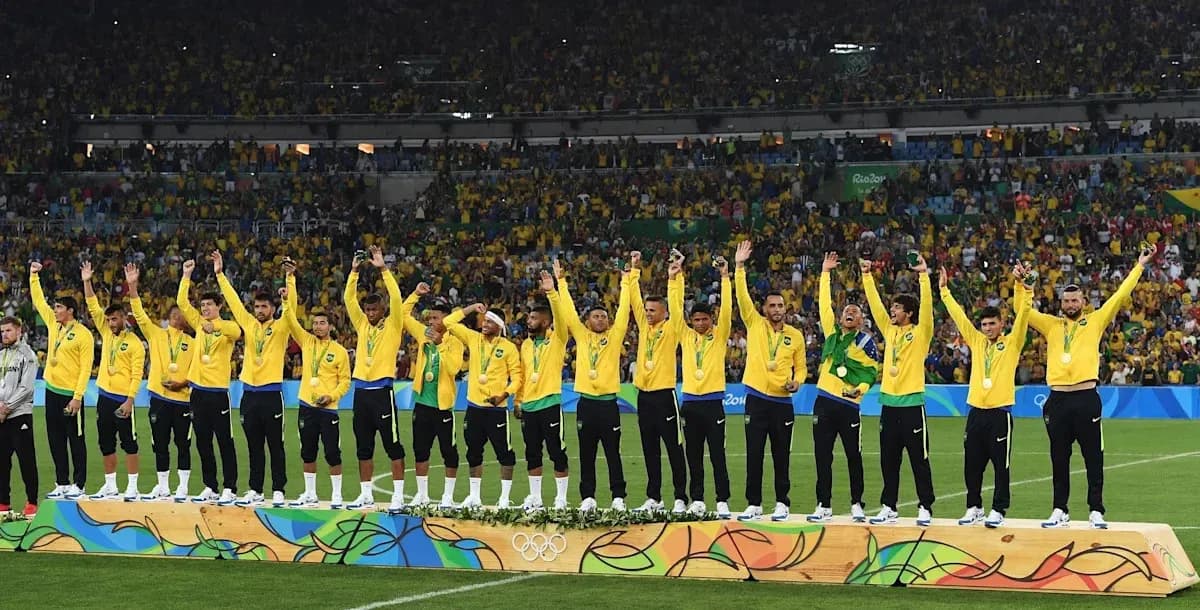
On August 20, 2016, with an entire nation demanding history, the Brazilian National Team finally climbed the one podium that had always eluded it. Olympic gold in men’s football, at home, against Germany, inside a packed and anxious Maracanã. More than 63,000 people in the stands. Millions more glued to screens. The weight of 7-1 still hanging in the air.
And Neymar standing over the ball.
The Final: Nerves, Noise and One Defining Kick
The match itself never allowed anyone to relax. It was tight, tense, and heavy with meaning.
Brazil struck first. In the 26th minute of the first half, Neymar curled a brilliant free kick into the top corner, igniting the stadium and briefly lifting the pressure that had hovered over this team from day one of the tournament. For a moment, the Maracanã sounded like it might burst.
Germany refused to fold. They grew into the game, and in the 15th minute of the second half, Meyer found the equaliser. 1-1. The noise changed. Not silence, but a collective tightening. Everyone in the stadium knew what was at stake.
The clock ticked through 90 minutes, then through extra time. No one found a way through. The final that Brazil had to win would be decided by the method Brazilians fear and cherish in equal measure: penalties.
From the spot, both sides were flawless through the first four rounds. For Brazil, Renato Augusto, Marquinhos, Rafinha and Luan converted. For Germany, Ginter, Gnabry, Brandt and Süle responded in kind. Every successful kick turned up the volume, but also the tension.
Then came Petersen, one of the tournament’s top scorers. His run-up, his strike – and Weverton guessed right. A strong hand, a sprawling save. Suddenly, the script changed. The Maracanã erupted before the ball had even settled.
That save handed Neymar the moment every Brazilian child dreams of. Fifth penalty. Gold on his right foot. He stepped up and buried it, then collapsed to his knees, engulfed by teammates as the stadium exploded around them. Brazil, at last, had its first Olympic football gold.
A Rocky Start, a Ruthless Response
That night at the Maracanã felt inevitable in hindsight, but the road to it was anything but smooth.
Brazil stumbled out of the blocks in Group A. Two matches in Brasília brought two scoreless draws, first against South Africa and then against Iraq. The performances were flat, the finishing off, and the murmurs of doubt began to grow louder. A home Olympics, a star-studded squad, and still no goals.
Everything had to change in Salvador.
At Arena Fonte Nova, needing a win to top the group and calm a restless country, the Seleção finally clicked. Against Denmark, Brazil unleashed the attacking power everyone had been waiting for. Gabriel Barbosa scored twice, Gabriel Jesus added another, and Luan completed a 4-0 rout that felt like a release as much as a result. The group stage ended not with a whimper, but with a statement.
From there, the tournament shifted into knockout mode, and so did Brazil’s mentality.
In the quarterfinals at Arena Corinthians in São Paulo, they met Colombia, runners-up in Group B after draws with Sweden and Japan and a win over Nigeria. This time Brazil controlled the occasion. Neymar opened the scoring, Luan added the second, and a 2-0 victory secured at least a shot at the medals. The football looked sharper, the team more assured, the anxiety slowly giving way to belief.
Then came the semifinal, and any lingering nerves vanished in a single, ruthless performance.
Facing Honduras at the Maracanã, a side that had emerged from a group with Argentina, Algeria and Portugal and then knocked out South Korea 1-0 in the quarters, Brazil simply overwhelmed them. Neymar struck twice, Gabriel Jesus matched him with two of his own, and Marquinhos and Luan joined the party in a 6-0 demolition. The home crowd, which had spent the group stage worrying, now roared with the confidence of a country sensing destiny.
All roads pointed back to the Maracanã and a final against Germany. The stage, the opponent, the scars of 2014 – everything aligned. And Brazil did not let it slip.
The 18 Who Wore the Gold
Eighteen players left Rio 2016 with the first Olympic gold in Brazilian football history around their necks. One more lived the journey up to the brink.
- Goalkeepers
Weverton (Athletico-PR), the man who saved Petersen’s penalty and opened the door for Neymar’s winning kick.
Uilson (Atlético Mineiro). - Full-backs
William (Internacional).
Douglas Santos (Atlético Mineiro).
Zeca (Santos). - Center-backs
Rodrigo Caio (São Paulo).
Luan Garcia (Vasco da Gama).
Marquinhos (Paris Saint Germain, FRA). - Midfielders
Thiago Maia (Santos).
Rodrigo Dourado (Internacional).
Rafinha Alcântara (Barcelona, ESP).
Renato Augusto (Beijing Guoan, CHI).
Felipe Anderson (Lazio, ITA).
Walace (Grêmio). - Forwards
Neymar (Barcelona, ESP).
Luan (Grêmio).
Gabriel Barbosa (Santos).
Gabriel Jesus (Palmeiras).
One name sits slightly apart. Fernando Prass was part of that group, called to bring experience and leadership to the Olympic squad. An elbow injury during the warm-up for a friendly against Japan at Serra Dourada in Goiânia forced him out before the group stage even began. He never got to step onto the Olympic pitch, but his role in the buildup remains part of that story.
A decade later, the images still feel fresh: Neymar’s free kick, Weverton’s save, the final penalty, the roar of the Maracanã. For a country that measures itself in football triumphs, Rio 2016 was more than a medal. It was closure, redemption, and a long-awaited first step onto the top of an Olympic podium.
The question now is simple: how long until another Brazilian generation writes a night to rival it?