
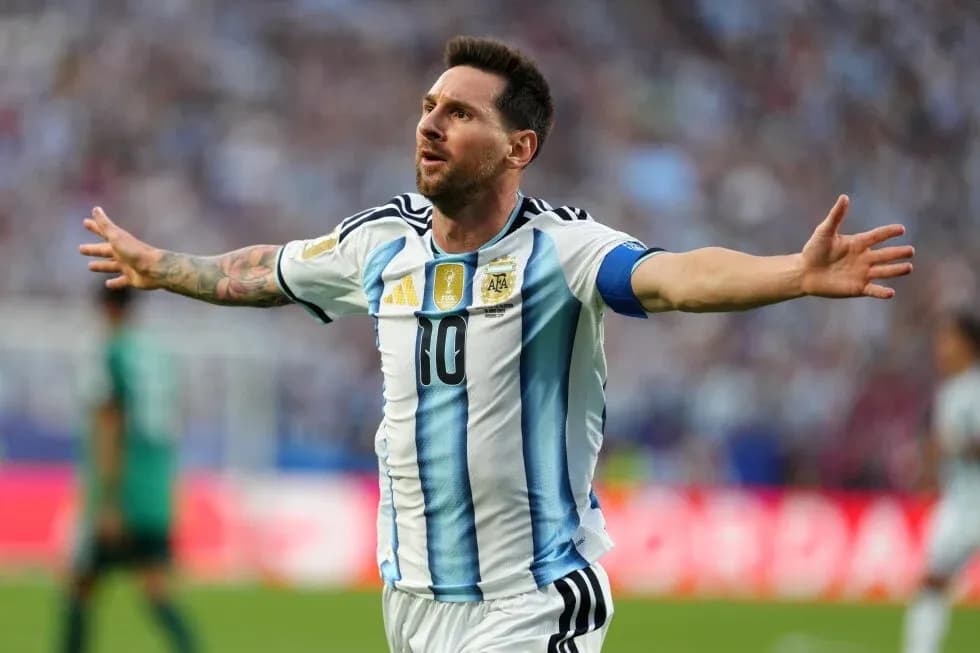
Lionel Messi's Hat Trick Leads Argentina to Victory Over Algeria
KANSAS CITY, Mo. — Lionel Messi buried his face in the front of his white-and-blue shirt, using the sweat-soaked fabric to wipe away tears that refused to stay hidden.
The World Cup’s greatest showman had scored early. The mask slipped.
Then he scored again. And again.
By the final whistle of Argentina’s 3–0 win over Algeria, every doubt that had followed him into this tournament — the hamstring scare, the mileage on those 39-year-old legs, the question of whether he could drag a nation toward back-to-back World Cups — lay scattered across the Arrowhead turf.
Messi had a hat trick. Argentina had three points. And the man from Rosario had pulled level with Miroslav Klose as the joint all-time leading scorer in men’s World Cup history.
Tears, then a ruthless response
The first goal came early, the product of a move Argentina fans have already seen in pink with Inter Miami. Rodrigo De Paul slipped a clever ball into space, Messi ghosted into the pocket, and the net rippled. Simple on the surface, devastating in its execution.
The reaction was anything but routine.
“My tears after the first goal? I’ve had some tough days. It wasn’t related to football. And those feelings were because of that,” Messi said, stopping there, choosing not to open the door any further. “I thank my teammates, the coaching staff and the delegation for helping me.”
The pressure that had built around his fitness evaporated with every touch. He kept demanding the ball, kept dictating the rhythm. Early in the second half, he pounced on a rebound, turning an opportunistic chance into his second of the night. Late on, with the stadium already humming his name, he arrowed in a crisp third before walking off to a standing ovation from 69,045 fans, most of them draped in Argentina’s colors.
“At a loss for words about Leo. What can I say?” Argentina coach Lionel Scaloni admitted. “He’s incredible.”
Twenty years on, still rewriting the record book
The symmetry of the night was impossible to ignore. Exactly 20 years had passed since Messi’s World Cup debut against Serbia and Montenegro, a game in which he also scored. Two decades later, he became only the second man to find the net in five different editions of the tournament.
This was his 16th World Cup goal, spread across a record six appearances. One more, and Klose’s mark will be his alone. The hat trick was the 61st of Messi’s career, his 11th for Argentina, but astonishingly his first on this stage.
It also stretched his scoring streak to five straight World Cup matches.
“It makes me very happy to have lived through everything that came my way. What I’m living though now is the cherry on top,” Messi said. “I’m very happy and grateful for this wonderful group. I enjoy it so much.”
On a night when Kylian Mbappé struck twice for France in a 3–1 win over Senegal to move to 14 World Cup goals, and Erling Haaland hit a brace in Norway’s 4–1 victory over Iraq, Messi still owned the spotlight.
“Messi is a madman,” Haaland posted on Snapchat as Argentina’s No. 10 dismantled Algeria.
From injury doubts to driving force
This performance had been far from guaranteed. In the buildup with Inter Miami, a minor hamstring problem had slowed him, raised alarms, and fueled talk that this World Cup might demand too much of a body that has already given so much.
The tuneup against Iceland calmed some nerves. Messi came on, played 20 sharp minutes, and scored from the spot. On this stage, against Algeria, he looked like a man who had timed his run to perfection.
“This is my sixth World Cup, and I still feel like I’m in good shape,” he said. “Fortunately, I’m doing well, and today we managed to win a tough match. It’s important to start the tournament with a victory in the first game, as that’s never easy in a World Cup.”
His appearance was his 200th for Argentina, a journey that began in 2005 when he was 18. Only Cristiano Ronaldo, who is set to play his 229th game for Portugal on Wednesday, and Kuwait’s Bader al-Mutawa, with 202, sit ahead of him on the men’s international caps list.
Messi and Ronaldo now share another distinction: the only men to score in five World Cups.
“Class is permanent,” Algeria coach Vladimir Petkovic said. “He’s fortunate to have the privilege that the entire Argentina team works for him, and supports him, and for a number of years now — decades — he’s done incredible things.”
A city taken over by No. 10
Argentina chose the Kansas City metro as one of four base camps for this World Cup, and the city has responded as if a rock band set up residency. Messi-mania hasn’t just arrived here; it has settled in.
On match day, waves of supporters in No. 10 shirts flowed toward the home of the NFL’s Chiefs, turning the outskirts of Kansas City into a slice of Buenos Aires. Songs rolled down the streets, flags snapped in the wind, and every lull in conversation seemed to circle back to the same name.
Downtown, at the Power & Light District watch party, the symbolism got a little more literal. A goat, led on stage by former NFL quarterback-turned-Fox broadcaster Jameis Winston, appeared wearing an Argentina jersey. The crowd roared. An hour later, Messi scored, and the joke felt more like prophecy.
Every touch, every feint, every glance up at goal sharpened the argument that the GOAT debate is drifting toward a conclusion with each passing match.
“It’s an advantage to have Leo because of how he handles the group and pushes it forward. Because of who he is,” De Paul said. “He doesn’t care about individual records. He prioritizes the group, and for us it’s incredible.”
The numbers say he is chasing history. The performance in Kansas City suggested something else: that he is still shaping it.





